. 2003 Nov 25;100 Suppl 2(Suppl 2):14537-42.
doi: 10.1073/pnas.2335847100. Epub 2003 Nov 7.

Molecular evolution of the insect chemoreceptor gene superfamily in Drosophila melanogaster

Affiliations

Molecular evolution of the insect chemoreceptor gene superfamily in Drosophila melanogaster

Hugh M Robertson et al. Proc Natl Acad Sci U S A. .

Abstract

The insect chemoreceptor superfamily in Drosophila melanogaster is predicted to consist of 62 odorant receptor (Or) and 68 gustatory receptor (Gr) proteins, encoded by families of 60 Or and 60 Gr genes through alternative splicing. We include two previously undescribed Or genes and two previously undescribed Gr genes; two previously predicted Or genes are shown to be alternative splice forms. Three polymorphic pseudogenes and one highly defective pseudogene are recognized. Phylogenetic analysis reveals deep branches connecting multiple highly divergent clades within the Gr family, and the Or family appears to be a single highly expanded lineage within the superfamily. The genes are spread throughout the Drosophila genome, with some relatively recently diverged genes still clustered in the genome. The Gr5a gene on the X chromosome, which encodes a receptor for the sugar trehalose, has transposed from one such tandem cluster of six genes at cytological location 64, as has Gr61a, and all eight of these receptors might bind sugars. Analysis of intron evolution suggests that the common ancestor consisted of a long N-terminal exon encoding transmembrane domains 1-5 followed by three exons encoding transmembrane domains 6-7. As many as 57 additional introns have been acquired idiosyncratically during the evolution of the superfamily, whereas the ancestral introns and some of the older idiosyncratic introns have been lost at least 48 times independently. Altogether, these patterns of molecular evolution suggest that this is an ancient superfamily of chemoreceptors, probably dating back at least to the origin of the arthropods.


Figures
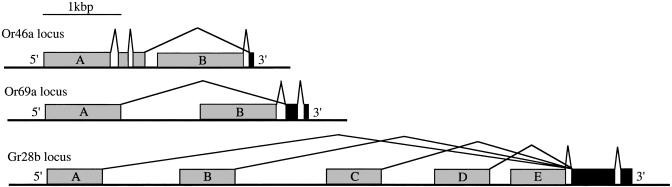
Fig. 1.
Fig. 1.
Alternative splicing of Or46a, Or69a, and Gr28b. The gray boxes indicate the N-terminal exons that are unique to the differently spliced products, labeled with a letter designating the splice product, whereas the black boxes indicate the shared exons. In the case of Or46a, the encoded proteins share TM7; for Or69a, they share TM6 and -7; and for Gr28b, they share TM5-7. See Clyne et al. (2) for alternative splicing of Gr23a and -39a.
Fig. 2.
Fig. 2.
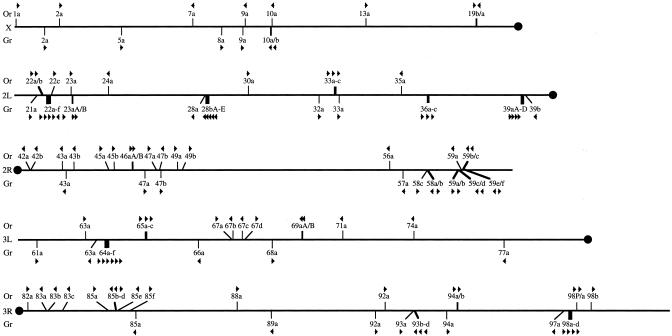
Genomic locations of the Or and Gr genes. The Or genes are shown above, and the Gr genes below, central lines representing each of the five major chromosome arms drawn to scale following Adams et al. (27). Genes with inferred independent origins are designated by thin lines, whereas clusters of related adjacent genes, or alternatively spliced genes, are shown by thick lines. Orientation of transcription is shown with an arrow; the arrows for the alternatively spliced products are contiguous. The fragmentary Or pseudogene is indicated as 98P. All gene locations and orientations are based on data from Release 3.1 of the genome.
Fig. 3.
Fig. 3.
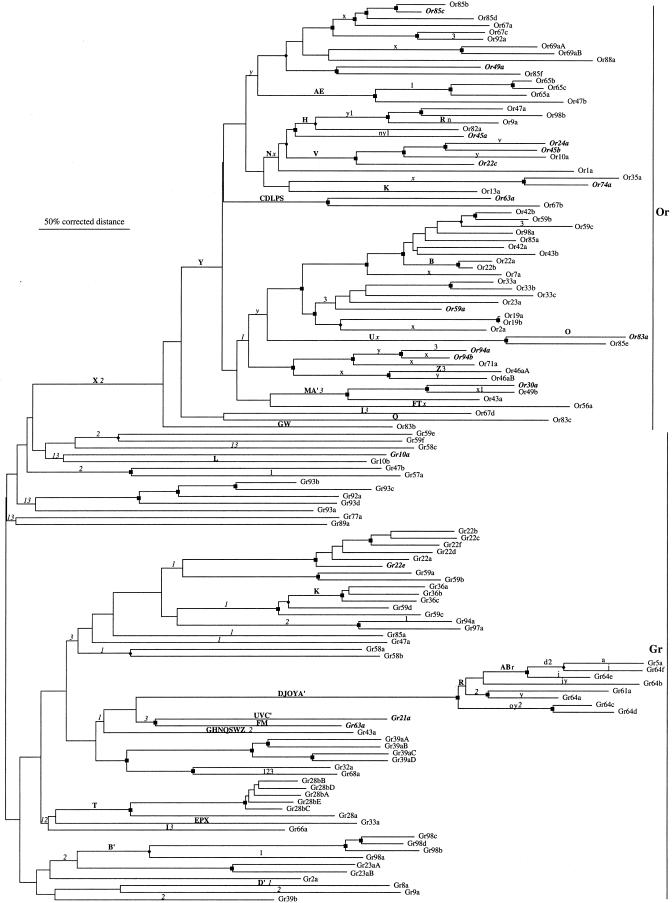
Tree of the insect chemoreceptor superfamily. The tree is rooted at the midpoint. The Or and Gr families are indicated on the right, and the scale bar indicates 50% divergence in corrected distances (far larger than the uncorrected distances when comparing distantly related proteins). Branches with 75-100% bootstrap support are indicated with a square and can be considered to be confident, whereas branches with 60-75% bootstrap support are indicated with a diamond and can be considered somewhat confident. Inferred intron gains within the superfamily are indicated above branches in bold uppercase letters, whereas inferred intron losses are shown in lowercase letters (intron losses that are not confidently independent according to the bootstrap support for branches are shown in italics). The Or and Gr families have separate sets of intron letter designations (see Fig. 4), and the putatively ancient ancestral phase-0 C-terminal introns 1-3 are shown as numbers. The Or genes for which no evidence of expression in antenna or maxillary palp has been detected by Vosshall et al. (6) or by us are highlighted in bold italics, as are the four Gr genes that Scott et al. (15) and Dunipace et al. (16) showed to be expressed in the antenna and/or maxillary palp.
Fig. 4.
Fig. 4.
Locations and phases of introns in the Or and Gr genes. The intron locations (above the lines) and phases (below the lines) are shown separately for the two families, relative to a scale of the average receptor size in amino acids (determined by excluding the large insertions in some of the receptors). The ancestral phase-0 C-terminal introns 1 and 3 are shared between the two families.

References

    1. Clyne, P. J., Warr, C. G., Freeman, M. R., Lessing, D., Kim, J. & Carlson, J. (1999) Neuron 22, 327-338. - PubMed
    1. Clyne, P. J., Warr, C. G. & Carlson, J. R. (2000) Science 287, 1830-1834. - PubMed
    1. Vosshall, L. B., Amrein, H., Morozov, P. S., Rzhetsky, A. & Axel, R. (1999) Cell 96, 725-736. - PubMed
    1. Kim, J., Moriyama, E. N., Warr, C. G., Clyne, P. J. & Carlson, J. R. (2000) Bioinformatics 16, 767-775. - PubMed
    1. Kim, J. & Carlson, J. R. (2002) J. Cell. Sci. 115, 1107-1112. - PubMed

Publication types

Substances