Comparative Study
. 2003 Dec;122(6):689-702.
doi: 10.1085/jgp.200308899. Epub 2003 Nov 10.

Stretch of beta 1 integrin activates an outwardly rectifying chloride current via FAK and Src in rabbit ventricular myocytes

Affiliations
Comparative Study

Stretch of beta 1 integrin activates an outwardly rectifying chloride current via FAK and Src in rabbit ventricular myocytes

David M Browe et al. J Gen Physiol. 2003 Dec.

Abstract

Osmotic swelling of cardiac myocytes and other types of cells activates an outwardly rectifying, tamoxifen-sensitive Cl- current, ICl,swell, but it is unclear whether Cl- currents also are activated by direct mechanical stretch. We tested whether specific stretch of beta1-integrin activates a Cl- current in rabbit left ventricular myocytes. Paramagnetic beads (4.5-microm diameter) coated with mAb to beta1-integrin were applied to the surface of myocytes and pulled upward with an electromagnet while recording whole-cell current. In solutions designed to isolate anion currents, beta1-integrin stretch elicited an outwardly rectifying Cl- current with biophysical and pharmacological properties similar to those of ICl,swell. Stretch-activated Cl- current activated slowly (t1/2 = 3.5 +/- 0.1 min), partially inactivated at positive voltages, reversed near ECl, and was blocked by 10 microM tamoxifen. When stretch was terminated, 64 +/- 8% of the stretch-induced current reversed within 10 min. Mechanotransduction involved protein tyrosine kinase. Genistein (100 microM), a protein tyrosine kinase inhibitor previously shown to suppress ICl,swell in myocytes, inhibited stretch-activated Cl- current by 62 +/- 6% during continued stretch. Because focal adhesion kinase and Src are known to be activated by cell swelling, mechanical stretch, and clustering of integrins, we tested whether these tyrosine kinases mediated the response to beta1-integrin stretch. PP2 (10 microM), a selective blocker of focal adhesion kinase and Src, fully inhibited the stretch-activated Cl- current as well as part of the background Cl- current, whereas its inactive analogue PP3 (10 microM) had no significant effect. In addition to activating Cl- current, stretch of beta1-integrin also appeared to activate a nonselective cation current and to suppress IK1. Integrins are the primary mechanical link between the extracellular matrix and cytoskeleton. The present results suggest that integrin stretch may contribute to mechano-electric feedback in heart, modulate electrical activity, and influence the propensity for arrhythmogenesis.


Figures
F<sc>igure</sc> 1.
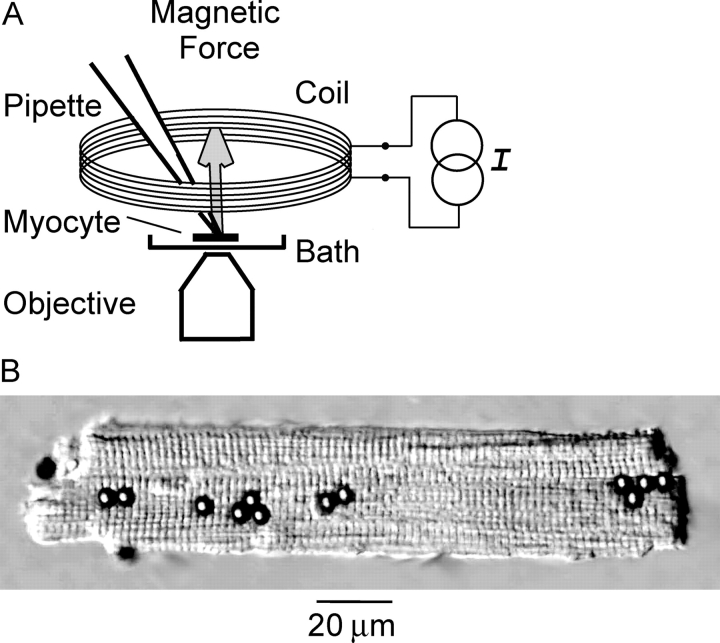
Figure 1.
Paramagnetic bead method for stretching β1-integrins. (A) Schematic diagram of the apparatus. A water-cooled electromagnet coil was placed directly on top of the bath. Energizing the coil with a constant current source, I, generated a magnetic flux density gradient of 2,400 G/m. The resulting force vector for each bead pointed upward toward the plane of the coil and perpendicular to the long axis of the myocyte. (B) Ventricular myocyte with 4.5-μm diameter beads coated with anti-β1 integrin mAb attached to the upper surface. Out-of-focus beads are near chamber floor.
F<sc>igure</sc> 2.
Figure 2.
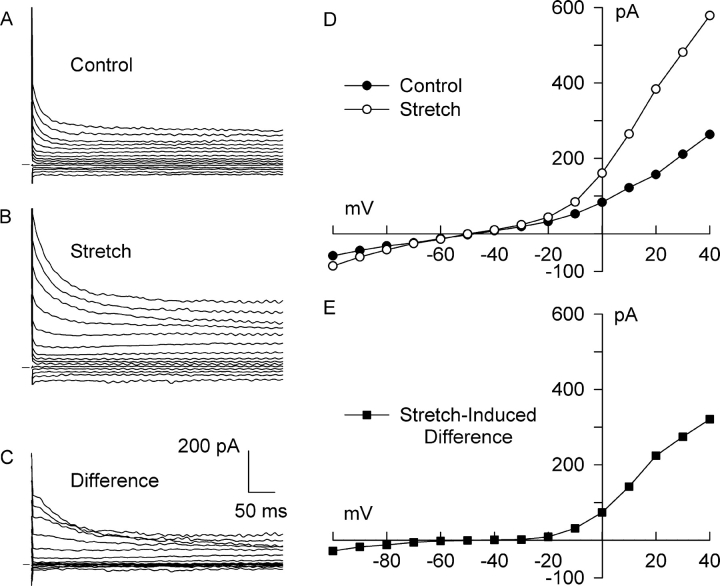
Stretch of β1-integrins activated a Cl current (Cl SAC) in bath and pipette solutions designed to isolate anion currents. Membrane potential was stepped from −60 mV to between −100 and +40 mV for 500 ms. Families of currents before stretch (A, Control), after 5 min of integrin stretch (B, Stretch), and the stretch-induced difference current (C, Difference) obtained by digital subtraction. Horizontal bar denotes 0 current. I-V relationships for membrane current (D) before (•) and after (○) integrin stretch, and (E) for the stretch-induced difference current (▪). The background current in the absence of stretch was outwardly rectifying, reversed near ECl (−52 mV), and underwent partial inactivation at positive potentials. Stretch markedly augmented outward currents, and the resulting Cl SAC exhibited much stronger outward rectification, reversed near ECl, and partially inactivated at positive potentials. Cl SAC elicited by β1-integrin stretch was 1.13 ± 0.10 pA/pF at + 40 mV (n = 34).
F<sc>igure</sc> 3.
Figure 3.
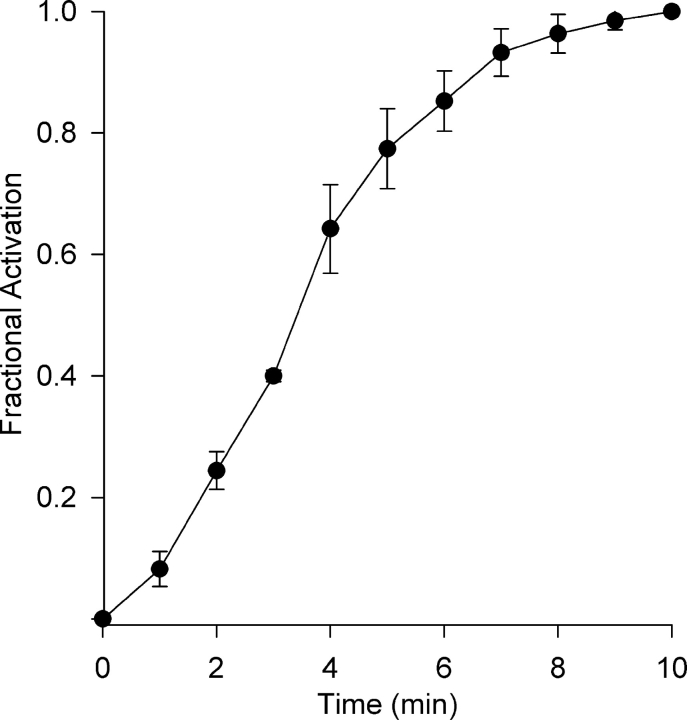
Time course of Cl SAC activation by β1-integrin stretch. Stretch-induced currents at +40 mV were recorded at 1-min intervals and normalized by the current at 10 min to obtain fractional activation. Activation of Cl SAC followed a sigmoidal time course with a half time of 3.5 ± 0.1 min (n = 5).
F<sc>igure</sc> 4.
Figure 4.
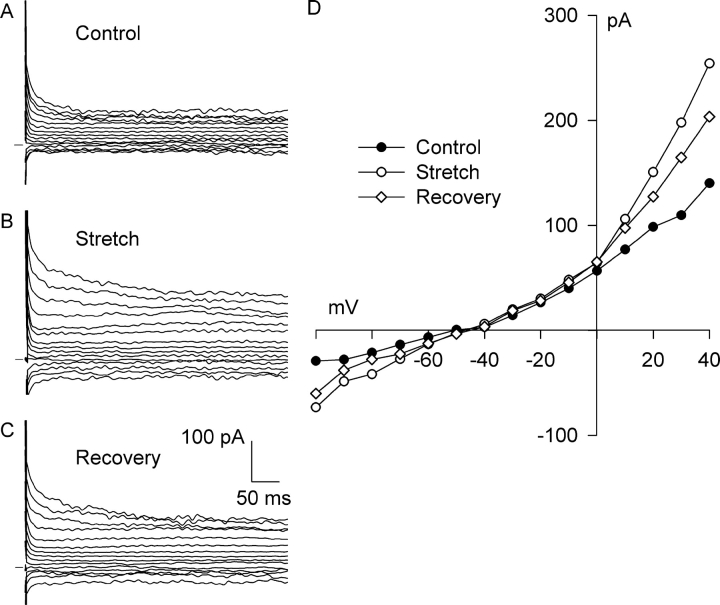
Cl SAC activation partially reversed upon termination of integrin stretch. Families of currents before (A, Control) and after (B, Stretch) activation of Cl SAC by 6 min of integrin stretch and after a recovery period of 10 min with the magnet turned off (C, Recovery). (D) I-V relationships for control (•), stretch (○), and recovery (⋄). At +40 mV, Cl SAC decreased by 64 ± 8% (n = 4) during the recovery period.
F<sc>igure</sc> 5.
Figure 5.
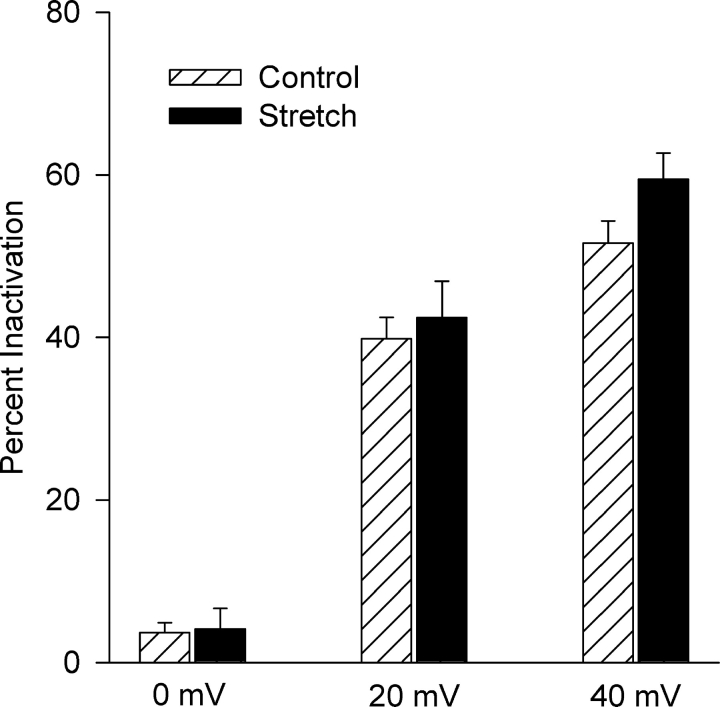
Stretch did not alter the voltage dependence of steady-state inactivation. The percentage of current undergoing inactivation was determined at 0, +20, and +40 mV both before and after 5–8 min of integrin stretch (n = 20). Steady-state inactivation was significantly dependent on voltage (P < 0.001) but was not significantly affected by stretch (P = 0.137). Because the overall effect of stretch was not significant (2-way ANOVA), comparison of stretch and control at individual test potentials was precluded. The Cl SAC did not undergo inactivation at negative potentials before or after stretch.
F<sc>igure</sc> 6.
Figure 6.
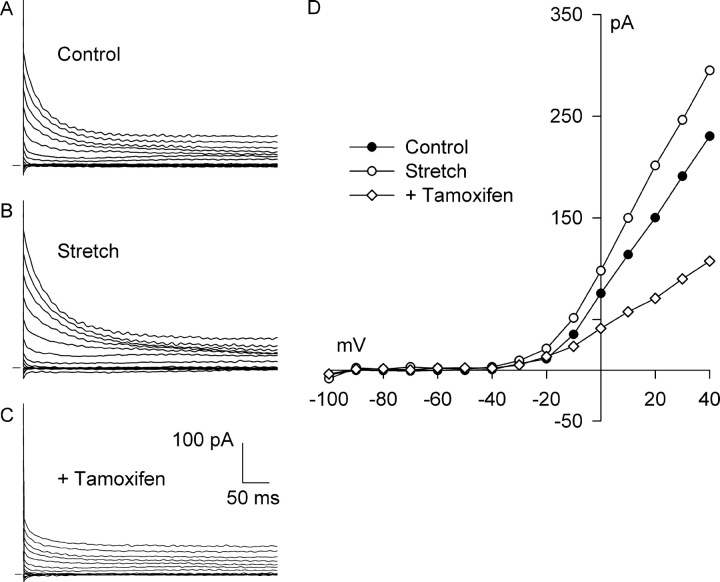
Tamoxifen, an inhibitor of ICl,swell, blocks both Cl SAC and background Cl current. Families of currents before (A, Control) and after (B, Stretch) activation of Cl SAC by 6 min of integrin stretch and after application of 10 μM tamoxifen for 6 min with continued stretch (C, +Tamoxifen). (D) I-V relationships for A-C. Each reversed near ECl. Tamoxifen blocked all of the Cl SAC and a large fraction of the background Cl current. At +40 mV, tamoxifen blocked 116 ± 5% (n = 5) of the stretch-induced current.
F<sc>igure</sc> 7.
Figure 7.
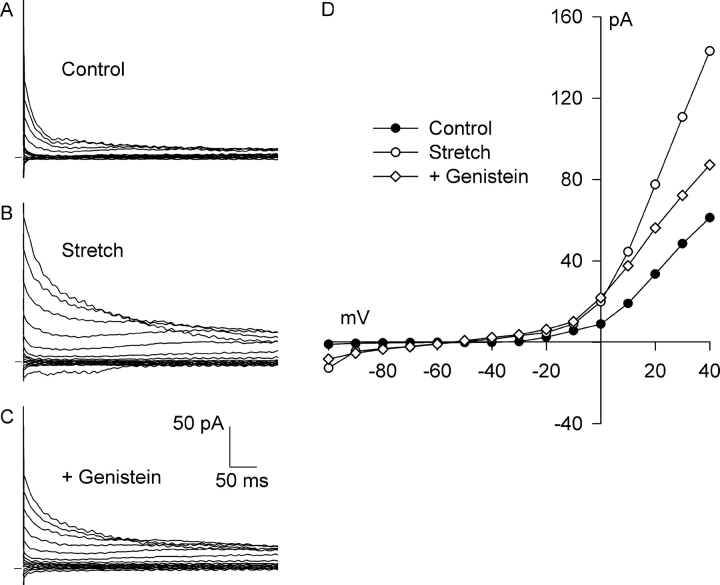
The PTK inhibitor genistein partially blocks Cl SAC. Current records before (A, Control) and after (B, Stretch) activation of Cl SAC by 6 min of integrin stretch and after application of 100 μM genistein for 8 min with continued stretch (C, +Genistein). (D) I-V relationships for A–C. Each reversed near −50 mV. At +40 mV, genistein blocked 62 ± 6% (n = 4) of the stretch-induced current.
F<sc>igure</sc> 8.
Figure 8.
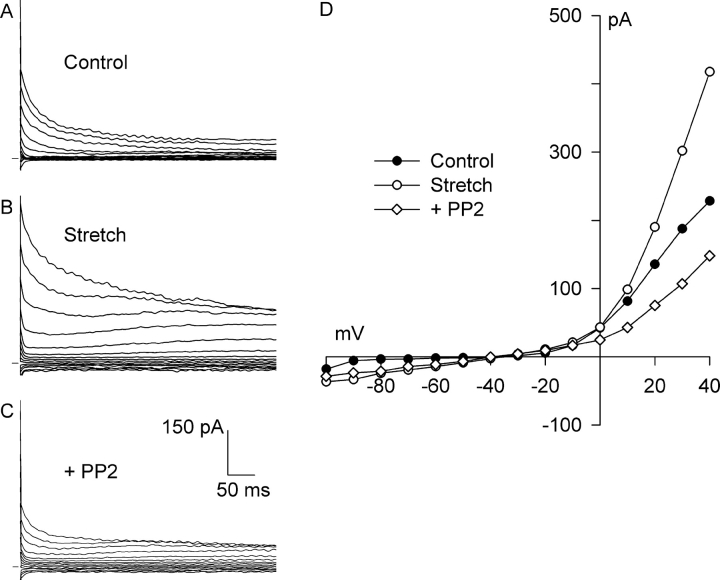
PP2, a selective inhibitor of Src and FAK, blocks both Cl SAC and background Cl current. Current records before (A, Control) and after (B, Stretch) activation of Cl SAC by 5 min of integrin stretch and after application of 10 μM PP2 for 10 min with continued stretch (C, +PP2). (D) I-V relationships for A–C. Each reversed near −50 mV. At +40 mV, PP2 blocked 134 ± 13% (n = 6) of the stretch-induced current.
F<sc>igure</sc> 9.
Figure 9.
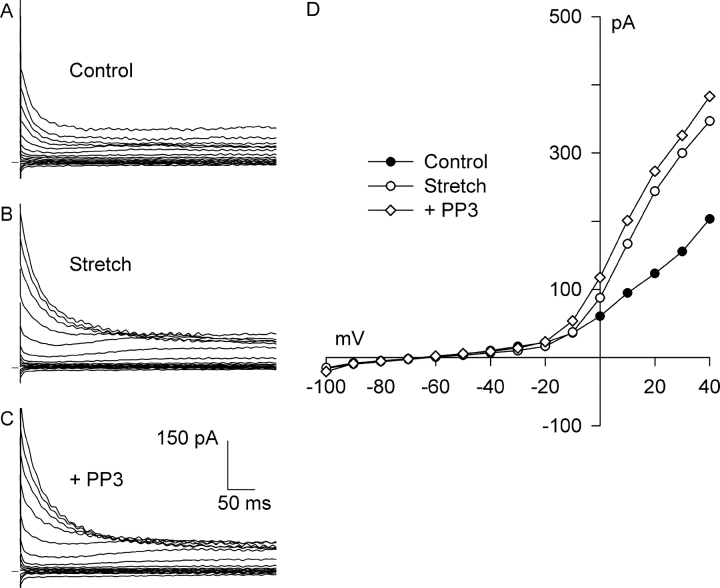
PP3, an inactive analogue of PP2, did not affect Cl SAC or background Cl current. Current records before (A, Control) and after (B, Stretch) activation of Cl SAC by 5 min of integrin stretch and after application of 10 μM PP3 for 10 min with continued stretch (C, +PP3). (D) I-V relationships for A–C. Each reversed near −50 mV. At +40 mV, PP3 did not significantly alter the stretch-induced current, −1 ± 11% (n = 4).
F<sc>igure</sc> 10.
Figure 10.
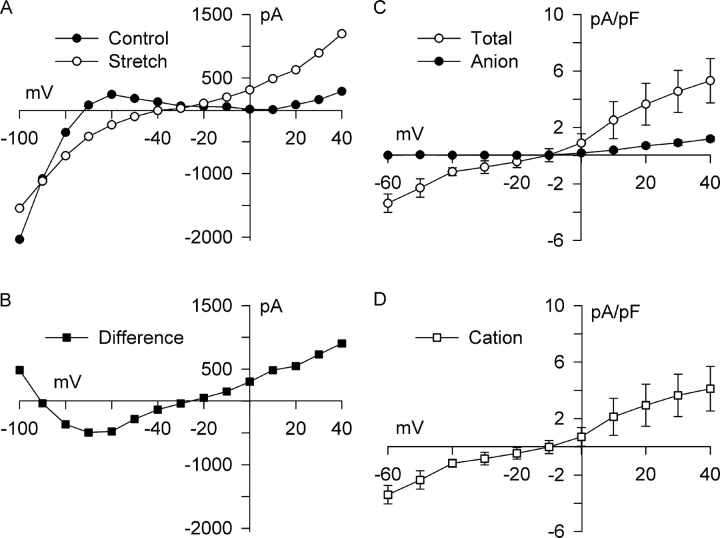
β1-integrin stretch activates a nonselective cation current and suppresses IK1. Recordings were made using physiological bath and pipette solutions using the same voltage-clamp protocol as in previous figures. (A) I-V relationships for steady-state current before (Control, •) and after (Stretch, ○) 5 min of integrin stretch, and (B) for the stretch-induced difference current (Difference, ▪). Integrin stretch increased current over most of the voltage range, attenuated inward rectification, and shifted reversal potential positive. The difference current (B) reversed at −91 and −23 mV, suggesting that stretch modulated multiple currents. This is consistent with suppression of inwardly rectifying IK1 (appears inverted; difference current = stretch − control) and augmentation of a linear poorly selective current. (C) To characterize the stretch-activated cation component and minimize contributions from IK1, steady-state I-V relationships were obtained between −60 and +40 mV in physiological solutions (n = 3; Total, ○) and in solutions designed to isolate anion currents (n = 3; Anion, •). Stretch-activated total current was significantly greater than Cl SAC both at +40 mV (5.30 ± 1.56 vs. 1.19 ± 0.17 pA/pF; P < 0.05) and −60 mV (−3.37 ± 0.65 vs. −0.02 ± 0.01 pA/pF; P < 0.02). (D) The stretch-activated cation current (Cation, □) was estimated as the difference between the total and anion currents in C assuming independence. The I-V relationship for the cation SAC was linear and reversed at −10 mV.

References

    1. Babbitt, C.J., S.Y. Shai, A.E. Harpf, C.G. Pham, and R.S. Ross. 2002. Modulation of integrins and integrin signaling molecules in the pressure-loaded murine ventricle. Histochem. Cell Biol. 118:431–439. - PubMed
    1. Baumgarten, C.M., and H.F. Clemo. 2003. Swelling-activated chloride channels in cardiac physiology and pathophysiology. Prog. Biophys. Mol. Biol. 82:25–42. - PubMed
    1. Bendall, J.K., C. Heymes, P. Ratajczak, and J.L. Samuel. 2002. Extracellular matrix and cardiac remodelling. Arch. Mal. Coeur Vaiss. 95:1226–1229. - PubMed
    1. Bénitah, J.P., A.M. Gomez, C. Delgado, P. Lorente, and W.J. Lederer. 1997. A chloride current component induced by hypertrophy in rat ventricular myocytes. Am. J. Physiol. 272:H2500–H2506. - PubMed
    1. Borg, T.K., E.C. Goldsmith, R. Price, W. Carver, L. Terracio, and A.M. Samarel. 2000. Specialization at the Z line of cardiac myocytes. Cardiovasc. Res. 46:277–285. - PubMed

Publication types