. 2003 Dec;77(23):12795-806.
doi: 10.1128/jvi.77.23.12795-12806.2003.

Relationship between RNA lariat debranching and Ty1 element retrotransposition

Affiliations

Relationship between RNA lariat debranching and Ty1 element retrotransposition

Laura A Salem et al. J Virol. 2003 Dec.

Abstract

The Saccharomyces cerevisiae DBR1 gene encodes a 2'-5' phosphodiesterase that debranches intron RNA lariats following splicing. Yeast dbr1 mutants accumulate intron lariats and are also defective for mobility of the retrotransposons Ty1 and Ty3. We used a mutagenic PCR method to generate a collection of dbr1 mutant alleles to explore the relationship between the roles of DBR1 in transposition and debranching. Eight mutants defective for Ty1 transposition contained single amino acid changes in Dbr1p. Two mutations, G84A and N85D, are in a conserved phosphoesterase motif that is believed to be part of the active site of the enzyme, supporting a connection between enzymatic activity and Ty1 transposition. Two other mutations, Y68F and Y68D, occur at a potential phosphorylation site, and we have shown that Dbr1p is phosphorylated on tyrosine. We have developed an RNase protection assay to quantitate intron RNA accumulation in cells. The assay uses RNA probes that hybridize to ACT1 intron RNA. Protection patterns confirm that sequences from the 5' end of the intron to the lariat branch point accumulate in dbr1 mutants in a branched (lariat) conformation. RNase protection assays indicate that all of the newly generated dbr1 mutant alleles are also deficient for debranching, further supporting a role for 2'-5' phosphodiesterase activity in Ty1 transposition. A Ty1 element lacking most of its internal sequences transposes independently of DBR1. The existence of Dbr1p-dependent Ty1 sequences raises the possibility that Dbr1p acts on Ty1 RNA.


Figures
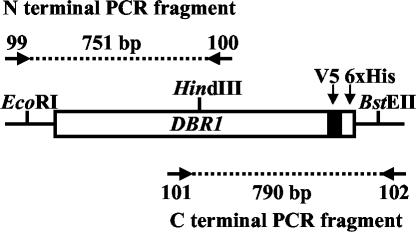
FIG. 1.
FIG. 1.
PCR mutagenesis of DBR1. The pTM235 plasmid was linearized and used for PCR with either primers 99 and 100 or primers 101 and 102 for the N- and C-terminal regions of DBR1, respectively. Sizes of PCR products are shown. Most point mutations form a fusion with V5 and a six-His tag (6xHis), facilitating Western analysis and protein purification.
FIG. 2.
FIG. 2.
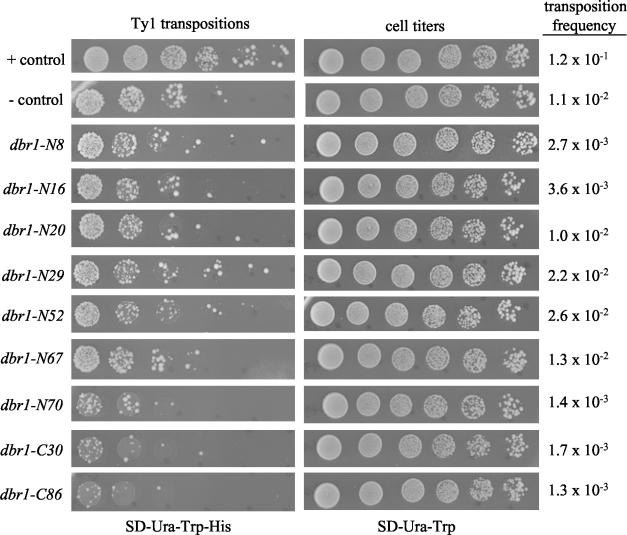
Ty1 transposition phenotypes of dbr1 mutants. Transposition of Ty1 was measured with the pGAL1-Ty1::his3AI element as described in Materials and Methods. Individual transformants containing pDG784 and a derivative of pTM235 (with mutagenized dbr1 DNA) were grown in SD-Ura-Trp before induction of transcription of Ty1 and DBR1 with galactose for 16 to 20 h. Serial dilutions were spotted on either SD-Ura-Trp-His (to select for transpositions) or SD-Ura-Trp (for cell titers). The calculated transposition frequency of each mutant is the average of three independent experiments. The positive (+) control is pTM235 (DBR1) cotransformed with pDG784. The negative (−) control is pYES2.1 (vector) cotransformed with pDG784.
FIG. 3.
FIG. 3.
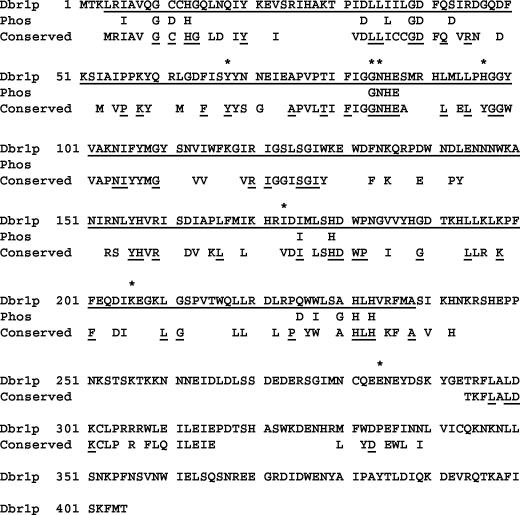
Single-point mutations in dbr1 lie mostly in conserved residues of Dbr1p. The amino acid sequence of S. cerevisiae Dbr1p is shown on the top line of each sequence block. Positions of amino acid changes in the point mutations are indicated by asterisks above the Dbr1p sequence. The phosphoesterase domain is indicated by underlined residues in Dbr1p (amino acids 4 to 238). Residues conserved in phosphoesterases are indicated on the “Phos” line. The GD/GNH phosphoesterase signature domain is part of this conserved sequence. Residues conserved in debranching enzymes are indicated on the “Conserved” line. The 12 organisms for which Dbr1p sequences are available are S. cerevisiae, S. pombe, Neurospora crassa, Plasmodium falciparum, Arabidopsis thaliana, D. melanogaster, Anopheles gambiae, C. elegans, Xenopus laevis, Rattus norvegicus, M. musculus, and H. sapiens. Residues identical in all 12 proteins are underlined in the “Conserved” row, while residues conserved in at least 10 of the 12 proteins are shown without underlining.
FIG. 4.
FIG. 4.
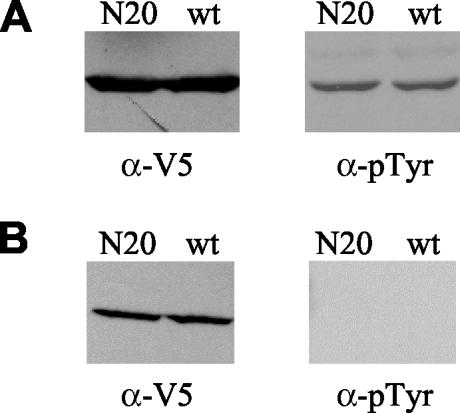
Dbr1p is a phosphoprotein. (A) Western blots of Dbr1p-V5-6xHis following purification of the protein in the presence of phosphatase inhibitors. The left half shows purified wild-type (wt) and N20 mutant Dbr1p probed with anti-V5 antibody (α-V5). The right half shows the same samples probed with antiphosphotyrosine antibody (α-pTyr). (B) Western blots of purified Dbr1p-V5-6xHis after treatment with λ protein phosphatase.
FIG. 5.
FIG. 5.
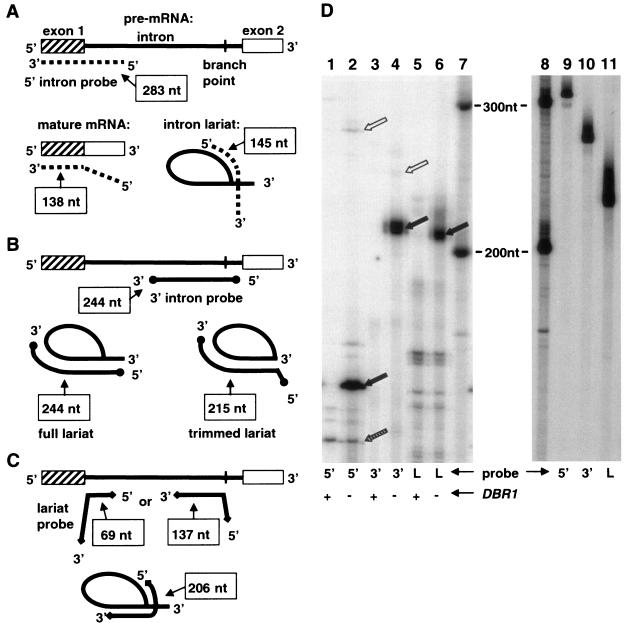
RNase protection assay. (A) Diagram of the 5′ intron probe annealing to different ACT1 RNA species. The three different ACT1 RNA species are pre-mRNA, mature mRNA, and the intron lariat. The different RNA species are not drawn to scale. The extents of probe annealing are indicated in boxes and reflect the sizes of the probe fragments protected in RNase protection assays. The relative amounts of the different RNA species are reflected by the amounts of protected probe fragments in the RNase protection assay. (B) Diagram of the 3′ intron probe annealing to different ACT1 RNA species. The ACT1 RNA species are the pre-mRNA and the intron lariat. The intron lariat is also depicted in a form in which all of the nucleotides of the 3′ tail but one have been removed by nucleases (trimmed lariat). (C) Diagram of the lariat probe annealing to different ACT1 RNA species. The ACT1 RNA species are the pre-mRNA and the intron lariat. (D) Results of the RNase protection assay for ACT1 RNA species. Lanes: 1 and 2, protection of 5′ intron probe (indicated by 5′ at bottom of gel); 3 and 4, protection of 3′ intron probe (indicated by 3′ at bottom of gel); 5 and 6, protection of lariat probe (indicated by L at bottom of gel); 7, RNA size markers. Reactions run in lanes 1, 3, and 5 used 2 μg of total RNA from DBR1 cells (wild type) (indicated by plus sign at bottom of gel). Reactions run in lanes 2, 4, and 6 used 2 μg of total RNA from dbr1 mutant cells (indicated by minus sign at bottom of gel). Solid black arrows in lanes 2 (156 nt), 4 (215 nt), and 6 (211 nt) indicate fragments protected by ACT1 intron lariat. Stippled arrow in lane 2 indicates fragment of 5′ intron probe protected by ACT1 mature mRNA (143 nt). White arrow in lane 2 indicates fragment of 5′ intron probe protected by ACT1 pre-mRNA (283 nt). White arrow in lane 4 indicates fragment of 3′ intron probe protected by ACT1 intron RNA containing its full 3′ tail (250 nt). Lanes 9, 10, and 11 are undigested probes: 5′ intron probe, 3′ intron probe, and lariat probe, respectively. Lane 8 contains RNA size markers.
FIG. 6.
FIG. 6.
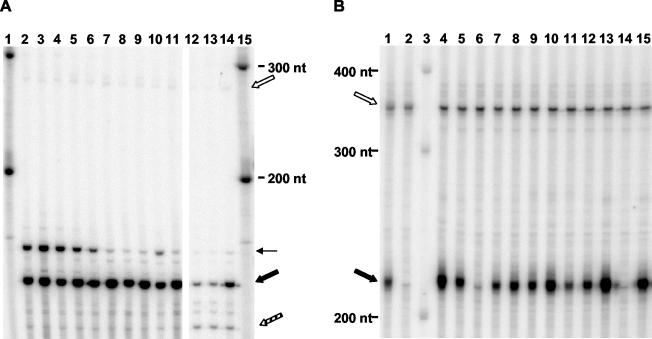
Intron lariat accumulation in dbr1 mutant strains. (A) RNase protection assay with the 5′ intron probe and 1.5 μg of total RNA from transformants of dbr1 strain TMY60 carrying different plasmids. Lanes: 2 and 3, pTM431 (N14 mutant); 4 and 5, pTM432 (N16 mutant); 6 and 7, pTM434 (N20 mutant); 8 and 9, pTM435 (N29 mutant); 10 and 11, pTM436 (C30 mutant); 12, pTM235 (pGAL1-DBR1-V5-6xHis); 13, pTM263 (DBR1-V5-6xHis); 14, pYES2.1 (vector); 1 and 15, RNA size markers. Reaction mixtures loaded into lanes 2, 4, 6, 8, 10, 12, 13, and 14 contained total RNA from cells grown in galactose for 18 h. Reaction mixtures loaded into lanes 3, 5, 7, 9, and 11 contained total RNA from cells grown in glucose. The solid black arrow indicates fragments protected by the ACT1 intron lariat (156 nt). The stippled arrow indicates the fragment of the 5′ intron probe protected by ACT1 mature mRNA (143 nt). The white arrow indicates the fragment of the 5′ intron probe protected by ACT1 pre-mRNA (283 nt). The band of variable intensity indicated by the thin horizontal arrows is most likely an incompletely digested product of protection by the ACT1 intron. (B) RNase protection assay with 3′ intron probe and 1 μg of total RNA from control strains and transformants of dbr1 mutant strain TMY60 carrying different plasmids. Lanes: 1, TMY60 (dbr1); 2, TMY30 (DBR1), 3, RNA size markers; 4, TMY60 plus pTM442 (N52 mutant); 5, TMY60 plus pTM428 (N8 mutant); 6, TMY60 plus pTM235 (pGAL1-DBR1-V5-6xHis); 7, TMY60 plus pTM444 (N70 mutant); 8, TMY60 plus pTM454 (C86 mutant); 9, TMY60 plus pTM436 (C30 mutant); 10, TMY60 plus pTM435 (N29 mutant); 11, TMY60 plus pTM434 (N20 mutant); 12, TMY60 plus pTM432 (N16 mutant); 13, TMY60 plus pTM431 (N14 mutant); 14, TMY60 plus pTM235 (pGAL1-DBR1-V5-6xHis); 15, TMY60 plus pYES2.1 (vector). All cultures were grown in galactose for 18 h prior to RNA isolation. The solid black arrow indicates the part of the ACT1 3′ intron probe protected by the ACT1 intron lariat (215 nt). The white arrow indicates the control reaction product, showing protection of the ACT1 3′ exon probe by ACT1 mature mRNA (333 nt). The C30 mutant has a nonsense mutation and does not make full-length Dbr1p.
FIG. 7.
FIG. 7.
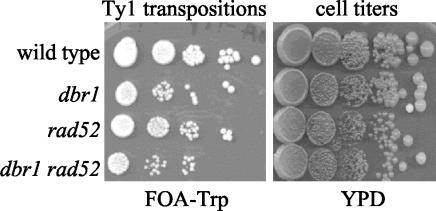
Ty1 cDNA from a dbr1 mutant can interact with IN protein. Transposition rates were measured by a dilution-spotting method. Strains YPH499 (wild type), TMY60 (dbr1), TMY176 (rad52), and TMY344 (dbr1 rad52) were spotted onto FOA-Trp (to select for transpositions) and YPD (to indicate cell titers). The dilution factor between adjacent spots is fivefold.

References

    1. Ausubel, F. M., R. Brent, R. E. Kingston, D. D. Moore, J. G. Seidman, J. A. Smith, and K. Struhl (ed.). 2003. Current protocols in molecular biology on CD-ROM. Current Protocols Inc., Brooklyn, N.Y.
    1. Boeke, J., and J. Stoye. 1997. Retrotransposons, endogenous retroviruses and the evolution of retroelements, p. 343-435. In J. Coffin, S. Hughes, and H. Varmus (ed.), Retroviruses. Cold Spring Harbor Laboratory Press, Plainview, N.Y. - PubMed
    1. Boeke, J. D., F. Lacroute, and G. R. Fink. 1984. A positive selection for mutants lacking orotidine-5′-phosphate decarboxylase activity in yeast: 5-fluoro-orotic acid resistance. Mol. Gen. Genet. 197:345-346. - PubMed
    1. Cadwell, R. C., and G. F. Joyce. 1994. Mutagenic PCR. PCR Methods Appl. 3:S136-S140. - PubMed
    1. Cadwell, R. C., and G. F. Joyce. 1992. Randomization of genes by PCR mutagenesis. PCR Methods Appl. 2:28-33. - PubMed

Publication types

LinkOut - more resources