. 2003 Nov;133(3):1051-71.
doi: 10.1104/pp.103.026484.

Genome-wide characterization of the lignification toolbox in Arabidopsis

Affiliations

Genome-wide characterization of the lignification toolbox in Arabidopsis

Jeroen Raes et al. Plant Physiol. 2003 Nov.

Abstract

Lignin, one of the most abundant terrestrial biopolymers, is indispensable for plant structure and defense. With the availability of the full genome sequence, large collections of insertion mutants, and functional genomics tools, Arabidopsis constitutes an excellent model system to profoundly unravel the monolignol biosynthetic pathway. In a genome-wide bioinformatics survey of the Arabidopsis genome, 34 candidate genes were annotated that encode genes homologous to the 10 presently known enzymes of the monolignol biosynthesis pathway, nine of which have not been described before. By combining evolutionary analysis of these 10 gene families with in silico promoter analysis and expression data (from a reverse transcription-polymerase chain reaction analysis on an extensive tissue panel, mining of expressed sequence tags from publicly available resources, and assembling expression data from literature), 12 genes could be pinpointed as the most likely candidates for a role in vascular lignification. Furthermore, a possible novel link was detected between the presence of the AC regulatory promoter element and the biosynthesis of G lignin during vascular development. Together, these data describe the full complement of monolignol biosynthesis genes in Arabidopsis, provide a unified nomenclature, and serve as a basis for further functional studies.


Figures
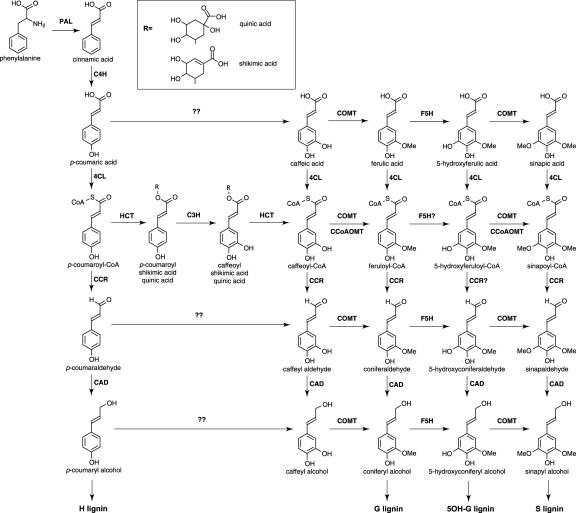
Figure 1.
Figure 1.
The monolignol biosynthetic pathway. All the enzymatic reactions presented in the pathway have been demonstrated at least in vitro. Because of the variety in isoenzymes and kinetic properties, alternative routes through the metabolic pathway may exist. A question mark after an enzyme name means that the substrate has not been tested yet with this enzyme. For reactions with a single question mark, direct conversion has been detected, but the respective enzyme is unknown, whereas for those with a double question mark, no direct conversion has been detected.
Figure 2.
Figure 2.
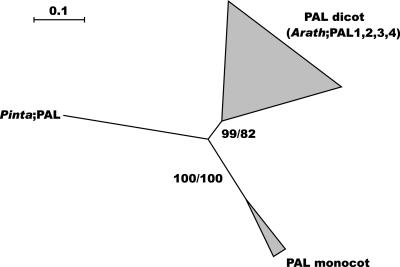
Neighbor-joining tree of the PAL family, inferred from Kimura corrected evolutionary distances. Bootstrap values (Neighbor-Joining/Maximum Likelihood; NJ/ML) above 50% are shown at the internodes. The scale measures evolutionary distance in substitutions per nucleic acid. Clusters of sequences are represented as triangles with a height equal to the average distance separating the terminal nodes from the deepest branching point in the cluster and a base proportional to the number of sequences composing it. Species and GenBank identification numbers of non-Arabidopsis sequences included in this tree are: dicots, Populus (169453, 485808, and 1109640), Glycine (18376), Trifolium (437711), Citrus (4808125, 4808127, and 1276902), Rubus (7208613 and 7208615), Camellia (662270), Petroselinum (534892), Nicotiana (170349), Digitalis (2631994), and Lactuca (18001006); monocots, Oryza (20280 and 871493); and gymnosperms, Pinus (1143311). Arath, Arabidopsis; Pinta, pine (Pinus taeda).
Figure 3.
Figure 3.
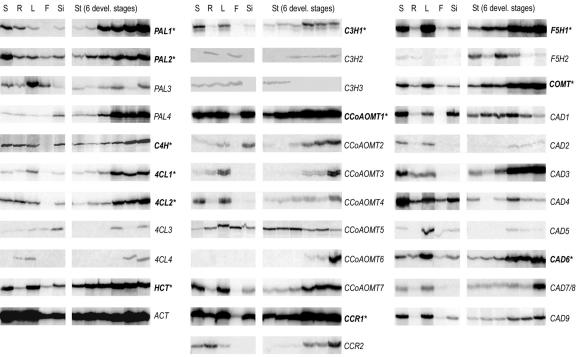
Expression profiles of all 34 monolignol biosynthesis genes. Semiquantitative expression was determined using reverse transcription (RT)-PCR (see “Materials and Methods”). Due to different PCR dynamics of shorter or longer amplification products, only different tissues for a particular gene may be compared. It should be noted that CAD7 and CAD8 arose during a recent duplication event (described in detail by Tavares et al., 2000) and could not be distinguished in the RT-PCR analysis because of their high sequence similarity: 98% and 94% identity in the coding regions and putative 3′-untranslated regions, respectively. S, Seedling; R, root; L, leaf; F, flower; Si, green siliques; St, stem (at 1-, 3-, 5-, 10-, 15-, and 20-cm length).
Figure 4.
Figure 4.
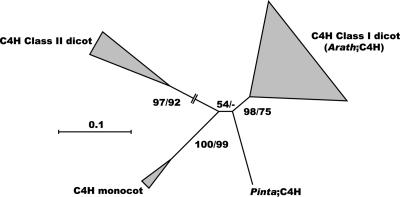
Neighbor-joining tree of the C4H family, inferred from Kimura corrected evolutionary distances. Bootstrap values (NJ/ML) above 50% are shown at the internodes. The scale measures evolutionary distance in substitutions per amino acid. Clusters of sequences are represented as described in Figure 2. Species and GenBank Identifier numbers of non-Arabidopsis sequences included in this tree are: Class I dicots, Populus (12276037, 3915089, and 3915096), Gossypium (9965899 and 9965897), Petroselinum (3915088), Ruta (13548653), Citrus (8572559 and 14210375), Catharanthus (1351206), Lithospermum (16555879 and 16555877), Capsicum (3603454 and 12003968), Zinnia (3915112), Helianthus (417863), Glycine (3915111), Phaseolum (586082), Glycyrrhiza (3915095), Cicer (14917048), Medicago (586081), and Pisum (3915077 and 9957081); Class II dicots, Mesembryanthemum (4206116), Citrus (7650489), Phaseolus (7430650), and Nicotiana (14423323 and 14423325); monocots, Triticum (10442761) and Sorghum (14192803); and gymnosperms, Pinus (4566493). Arath, Arabidopsis; Pinta, pine.
Figure 5.
Figure 5.
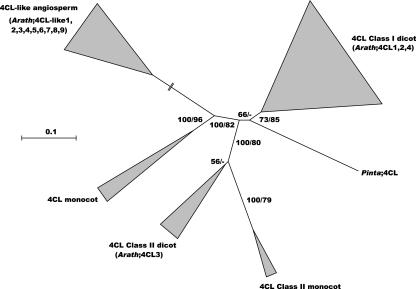
Consensus of two neighbor-joining trees of the 4CL and 4CL-like proteins, inferred from Kimura corrected evolutionary distances. Bootstrap values (NJ/ML) above 50% are shown at the internodes. The scale measures evolutionary distance in substitutions per amino acid. Clusters of sequences are represented as described in Figure 2. Species and GenBank identification numbers of non-Arabidopsis sequences included in this tree are: Class I dicots, Solanum (398963, 398965, and 5163399), Capsicum (12003966), Nicotiana (12229631, 7428495, and 12229632), Lithospermum (1117778), Petroselinum (112800 and 112801), Rubus (9651915 and 9651917), Populus (7437854, 7437855, 14289344, 18032806, 7437852, and 15636677), and Amorpha (17063848); gymnosperms, Pinus 4CL (7437872); Class II monocots, Lolium (7188335) and Oryza (12229650); Class II dicots, Lithospermum (9988455), Glycine (18266852), and Populus (7437853 and 14289346); monocots, Oryza (112802), Lolium (7188337 and 7188339); and 4CL-like, Oryza (12039389). Arath, Arabidopsis; Pinta, pine.
Figure 6.
Figure 6.
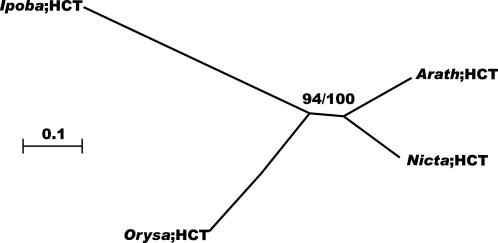
Neighbor-joining tree of the HCT family, inferred from Kimura corrected evolutionary distances. Bootstrap values (NJ/ML) above 50% are shown at the internodes. The scale measures evolutionary distance in substitutions per amino acid. Species and GenBank identification numbers of non-Arabidopsis sequences included in this tree are: Ipomoea (6469032), Oryza (21740518), and Nicotiana (27475615). Arath, Arabidopsis; Ipoba, Ipomoea batatas; Nicta, tobacco; Orysa, rice (Oryza sativa).
Figure 7.
Figure 7.
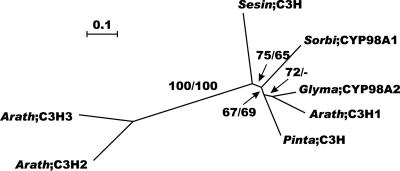
Neighbor-joining tree of the C3H family, inferred from Kimura corrected evolutionary distances. Bootstrap values (NJ/ML) above 50% are shown at the internodes. The scale measures evolutionary distance in substitutions per amino acid. Species and GenBank identification numbers of non-Arabidopsis sequences included in this tree are: Sesamum (17978831), Sorghum (5915857), Pinus (17978651), and Glycine (5915858). Arath, Arabidopsis; Glyma, soybean; Sesin, Sesamum indicum; Sorbi, Sorghum bicolor; Pinta, pine.
Figure 8.
Figure 8.
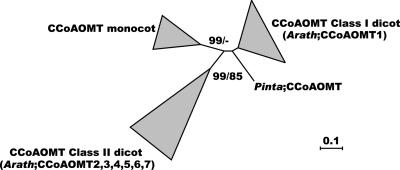
Neighbor-joining tree of the CCoAOMT family, inferred from Kimura corrected evolutionary distances. Bootstrap values (NJ/ML) above 50% are shown at the internodes. The scale measures evolutionary distance in substitutions per nucleic acid. Clusters of sequences are represented as described in Figure 2. Species and GenBank identification numbers of non-Arabidopsis sequences included in this tree are: Class I dicots, Populus (2960355, 857577, 13249170, and 2960357), Zinnia (533120), Petroselinum (169648), Nicotiana (2511736), Citrus (6561880), Vitis (1000518), and Eucalyptus (5739372 and 1934858); gymnosperms, Pinus CCoAOMT (4104458); Class II dicots, Stellaria (438896) and Populus (1785476); and monocots, Zea (5101869, 5101867) and Oryza (5091496 and 5257255 [three genes]). Arath, Arabidopsis; Pinta, pine.
Figure 9.
Figure 9.
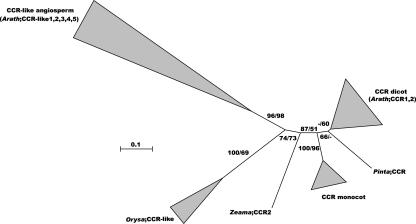
Neighbor-joining tree of the CCR family, inferred from Kimura corrected evolutionary distances. Bootstrap values (NJ/ML) above 50% are shown at the internodes. The scale measures evolutionary distance in substitutions per amino acid. Clusters of sequences are represented as described in Figure 2. Species and GenBank identification numbers of non-Arabidopsis sequences included in this tree are: CCR dicots, Eucalyptus (7431407, 7431408, and 10304406) and Populus (7239228, 2960364, and 9998901); CCR monocots, Lolium (9964087), Saccharum (3341511 and 17978549), and Zea (7431410 and 3242328); gymnosperms, Pinus CCR (17978649), Zea CCR2 (3668115), and Oryza CCR-like (13486725, 13486726, and 18307514); and CCR-like angiosperms, Oryza (15624051). Arath, Arabidopsis; Orysa, rice; Pinta, pine; Zeama, maize (Zea mays).
Figure 10.
Figure 10.
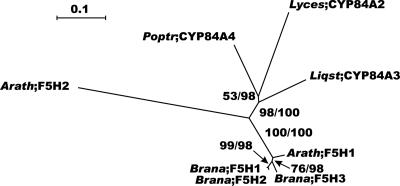
Neighbor-joining tree of the F5H family, inferred from Kimura corrected evolutionary distances. Bootstrap values (NJ/ML) above 50% are shown at the internodes. The scale measures evolutionary distance in substitutions per amino acid. GenBank identification numbers of non-Arabidopsis sequences included in this tree are: Populus CYP84A4 (6688937), Lycopersicon CYP84A2 (5002354), Liquidambar CYP84A3 (5731998), and Brassica F5H1, F5H2, and F5H3 (10197650, 10197652, and 10197654). Arath, Arabidopsis; Brana, Brassica napus; Liqst, Liquidambar styraciflua; Lyces, tomato (Lycopersicon esculentum); Poptr, Populus trichocarpa.
Figure 11.
Figure 11.
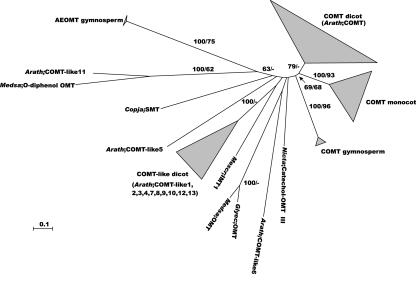
Neighbor-joining tree of the COMT family, inferred from Kimura corrected evolutionary distances. Bootstrap values (NJ/ML) above 50% are shown at the internodes. The scale measures evolutionary distance in substitutions per amino acid. Clusters of sequences are represented as described in Figure 2. Species and GenBank Identifier numbers of non-Arabidopsis sequences included in this tree are: COMT dicots, Populus (7528266, 762870, 231757, 444327, 7332271, 7447887, and 762872), Stylosanthes (1582580), Medicago (116908), Prunus (3913295), Fragaria (6760443), Liquidambar (5732000), Chrysosplenium (1184041 and 567077), Vitis (7271883), Capsicum (3421382, 7488967, and 12003964), Nicotiana (480082 and 480083), Eucalyptus (1169009 and 5739365), Clarkia (2832224 and 3913289), Mesembryanthemum (7447880), Thalictrum (4808522, 4808524, 4808526, 4808528, and 4808530), Catharanthus (18025321), Ocimum (5031492, 5031494), and Zinnia (642952); COMT monocots, Lolium (4104220, 4104222, 4104224, and 2388664), Sorghum (18033964), Saccharum (3341509), Zea (729135), and Festuca (14578611, 14578613, 14578615, and 14578617); COMT gymnosperms, Pinus (15524083), Picea (COMT-C7 and COMT-C16; M.H. Walter, personal communication); Nicotiana Catechol-OMT III (542050); Glycyrrhiza OMT (1669591), Medicago OMT (7447884), Mesembryanthemum IMT1 (1170555), Coptis sinapoyl-Glc:malate sinapoyltransferase (SMT; 758580), and Medicago O-diphenol OMT (6688808); and AEOMT gymnosperms, Pinus (7447883, 1777386, and 4574324). Arath, Arabidopsis; Copja, Coptis japonica; Glyec, Glycyrrhiza echinata; Medsa, alfalfa; Mescr, Mesembryanthemum crystallinum; Nicta, tobacco.
Figure 12.
Figure 12.
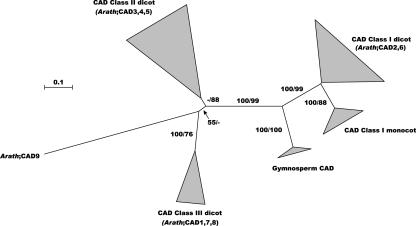
Neighbor-joining tree of the CAD family, inferred from Kimura corrected evolutionary distances. Bootstrap values (NJ/ML) above 50% are shown at the internodes. The scale measures evolutionary distance in substitutions per amino acid. Clusters of sequences are represented as described in Figure 2. Species and GenBank Identifier numbers of non-Arabidopsis sequences included in this tree are: Class I dicots, Populus (421814, 1168734, 9998899, and 7239226), Nicotiana (231676 and 231675), Medicago (399168), Aralia (1168727), Zinnia (1944403), Eucalyptus (1705554, 10281656, 399165, 10719920, and 3913185); Class I monocots, Saccharum (10719916), Zea (3913182 and 7430938), Lolium (3913181), Festuca (15428276, 15428278, 15428280, and 15428282); gymnosperm CAD, Picea (584872 and 10719915), Pinus (107623, 3334135, 1168733, and 3372645); Class II dicots, Stylosanthes (3913194), Apium (12643507), Petroselinum (1168732), Lycopersicon (8099340 and 7430935), Mesembryanthemum (10720090), Fragaria (10720093, 13507210), and Populus (14279694); and Class III dicots: Stylosanthus (3913193) and Medicago (10720088). Arath, Arabidopsis.

References

    1. Achnine L, Rasmussen S, Blancaflor E, Dixon RA (2002) Metabolic channeling at the entry point into the phenylpropanoid pathway: physical association between l-phenylalanine ammonia-lyase and cinnamate 4-hydroxylase. In I El Hadrami, ed, Proceedings of the XXI International Conference on Polyphenols, Imprimerie El-Watania, Marrakech, Morocco, pp 7–8
    1. AGI (2000) Analysis of the genome sequence of the flowering plant Arabidopsis thaliana. Nature 408: 796–815 - PubMed
    1. Altschul SF, Madden TL, Schäffer AA, Zhang J, Zhang Z, Miller W, Lipman DJ (1997) Gapped BLAST and PSI-BLAST: a new generation of protein database search programs. Nucleic Acids Res 25: 3389–3402 - PMC - PubMed
    1. Anterola AM, Jeon J-H, Davin LB, Lewis NG (2002) Transcriptional control of monolignol biosynthesis in Pinus taeda: factors affecting monolignol ratios and carbon allocation in phenylpropanoid metabolism. J Biol Chem 277: 18272–18280 - PubMed
    1. Anterola AM, Lewis NG (2002) Trends in lignin modification: a comprehensive analysis of the effects of genetic manipulations/mutations on lignification and vascular integrity. Phytochemistry 61: 221–294 - PubMed

Publication types

MeSH terms

LinkOut - more resources