


Procalcitonin serum levels in tertian malaria
- PMID: 14613513
- PMCID: PMC269987
- DOI: 10.1186/1475-2875-2-34
Procalcitonin serum levels in tertian malaria
Abstract
Background: Procalcitonin (PCT) is closely correlated with parasite burden and clinical outcome in falciparum malaria. The role of PCT in tertian malaria has not previously been investigated.
Patients and methods: PCT serum levels in 37 patients with tertian malaria were analysed. Clinical and laboratory parameters were assessed and statistically correlated both to the initial PCT levels and during the course of the disease.
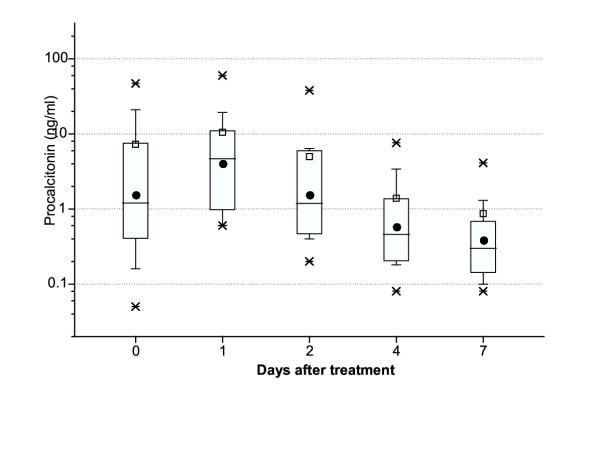
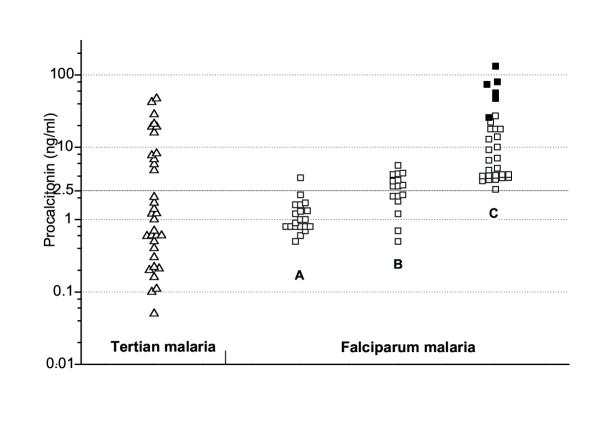
Results: PCT levels rose for one day after commencing treatment and declined thereafter. However, there was no significant correlation with parasite burden, clinical parameters, laboratory values, or the presence of semi-immunity. Before treatment, the majority of patients showed normal or slightly elevated PCT levels (< 2.5 ng/ml), but PCT was markedly elevated (4.8-47 ng/ml) in one third of the population. The two groups did not differ by any other of the assessed parameters. Thus, while the post-treatment course of PCT resembles falciparum malaria, the lack of correlation between disease severity and even high PCT levels in a large proportion of patients is intriguing.
Conclusions: There is a fundamental difference in the relationship of PCT with tertian malaria not seen in other infectious diseases in which elevated PCT levels have been observed. This suggests distinct pathophysiological pathways in malaria.
Figures
References
-
- Al-Nawas B, Shah P. Procalcitonin in acute malaria. Eur J Med Res. 1997;2:206–208. - PubMed
-
- Davis TM, Assicot M, Bohuon C, St John A, Li GQ, Anh TK. Serum procalcitonin concentrations in acute malaria. Trans R Soc Trop Med Hyg. 1994;88:670–671. - PubMed
-
- Hollenstein U, Looareesuwan S, Aichelburg A, Thalhammer F, Stoiser B, Amradee S, Chullawichit S, El M, Burgmann IH. Serum procalcitonin levels in severe Plasmodium falciparum malaria. Am J Trop Med Hyg. 1998;59:860–863. - PubMed
MeSH terms
Substances
LinkOut - more resources
Full Text Sources
