


Health related quality of life in pregeriatric patients with chronic diseases at urban, public supported clinics
- PMID: 14613559
- PMCID: PMC280701
- DOI: 10.1186/1477-7525-1-63
Health related quality of life in pregeriatric patients with chronic diseases at urban, public supported clinics
Abstract
Background: Understanding health-related quality of life (HRQOL) leads to more effective and focused healthcare. America's growing health disparities makes it is increasingly necessary to understand the HRQOL of pregeriatric individuals who are now 55-64 years old, i.e. before they are eligible for federally mandated health care at age 65. Our study measured the self-perceived HRQOL of pregeriatric, poor patients with multiple chronic diseases treated at 2 public clinics.
Methods: Consecutive patients aged 55-64 years, many with multiple chronic diseases, responded in an interview to the 36-Item Short-Form Health Survey (SF-36) as a general measure of HRQOL during a regular visit to one of two university-staffed urban public clinics.
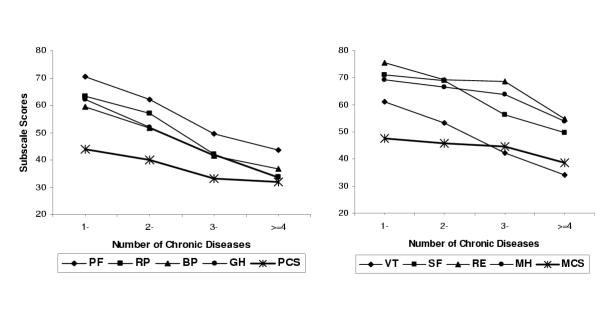
Results: The perceived physical and mental functioning of 316 pregeriatric patients was tabulated from SF-36 scores to yield their HRQOL. Their scores were statistically significantly lower than those of the general US pregeriatric population and lower than averages for US patients with multiple chronic diseases. All eight subscale scores of SF-36 were 16% to 36% lower compared with the averages of the general US pregeriatric population. Further, as the number of chronic diseases increased, the lower was the HRQOL. Lower physical and mental scores were associated with a lower income, unemployment, and higher numbers of multiple chronic diseases.
Conclusion: Chronic diseases have a powerful negative impact on perceived mental and physical functioning in pregeriatric patients. HRQOL information can assist health care providers to gain a more complete picture of their pregeriatric patients' health.
Figures
References
-
- Pearlman RA, Jonsen A. The use of quality-of-life considerations in medical decision-making. J Am Geriatr Soc. 1985;33:344–352. - PubMed
-
- Starr TJ, Pearlman RA, Uhlmann RF. Quality of life and resuscitation decisions in elderly patients. J Gen Intern Med. 1986;1:373–379. - PubMed
-
- US Department of Health and Human Services, Public Health Service . Healthy People 2000: Midcourse Review and 1995 Revisions. Boston, Jones and Bartlet Press; 1996.
Publication types
MeSH terms
LinkOut - more resources
Full Text Sources
Medical
