. 2003 Nov 12;23(32):10258-64.
doi: 10.1523/JNEUROSCI.23-32-10258.2003.

Lidocaine inactivation of ventral subiculum attenuates cocaine-seeking behavior in rats

Affiliations

Lidocaine inactivation of ventral subiculum attenuates cocaine-seeking behavior in rats

WenLin Sun et al. J Neurosci. .

Abstract

The role of the ventral subiculum in cocaine- or cue-induced cocaine-seeking behavior was investigated in rats tested on a between-session reinstatement model. Rats were trained to self-administer cocaine (0.25 mg/infusion, i.v.) in a lever-pressing operant task in a daily 2 hr session. Responding was reinforced contingent on a modified fixed-ratio 5 schedule. Reinstatement tests began after the lever-pressing behavior was extinguished in the absence of cocaine and conditioned cues (light and tone). Bilateral microinjections of lidocaine (100 microg) into the ventral subiculum decreased cocaine- or cue-induced reinstatement of cocaine-seeking behavior compared with saline microinjections into the same area in another group of rats. Lidocaine microinjections, however, had no effect on cocaine self-administration behavior or food-maintained or food-reinstated responding. Collectively, these results suggest that the ventral subiculum plays an important role in cocaine-seeking behavior. Considering the role of this structure in context learning, our data suggest that the full expression of cocaine- or cue-induced reinstatement may depend on the context in which the cocaine experience occurred.


Figures
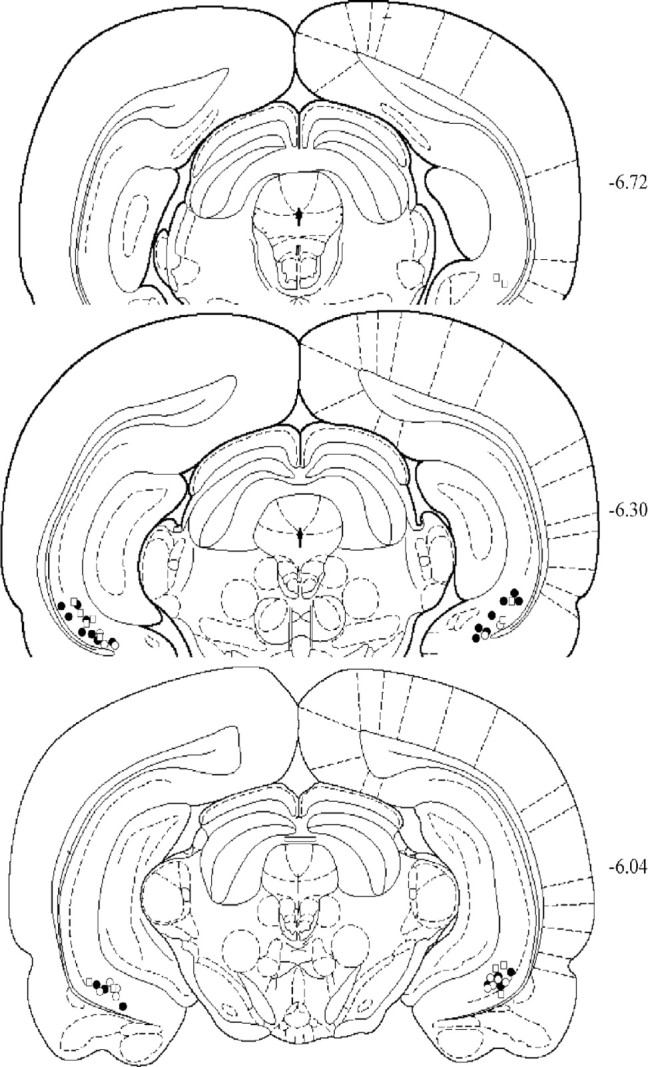
Figure 1.
Figure 1.
Schematic representations of injection sites in vSUB. Coronal brain section images were adapted from the atlas of Paxinos and Watson (1998). Filled circles and open circles represent the injection sites in saline and lidocaine groups, respectively. The injection sites for the food-training group are represented by open squares.
Figure 2.
Figure 2.
Effects of bilateral microinjections of lidocaine (100 μg/side) or saline (0.5 μl/side) into vSUB on CS-reinstated responding. The session began with a noncontingent delivery of the CS followed by a time-out as in the cocaine self-administration training sessions. Responding was reinforced only by the CS contingent on an FR 5 schedule in a 1 hr session, except for the first response, which was reinforced by CS. Open and closed bars indicate data obtained from rats assigned to the saline and lidocaine groups, respectively. SA indicates the last day of the cocaine self-administration. Ext indicates the extinction session before reinstatement. Reinstate+Microinjection indicates the reinstatement session in which saline or lidocaine was microinjected into vSUB. Data are represented as mean ± SEM responses per hour. Reinstatement responding was significantly decreased by lidocaine (n = 10) compared with the saline microinjections (n = 6) (Bonferroni test; p < 0.05).
Figure 3.
Figure 3.
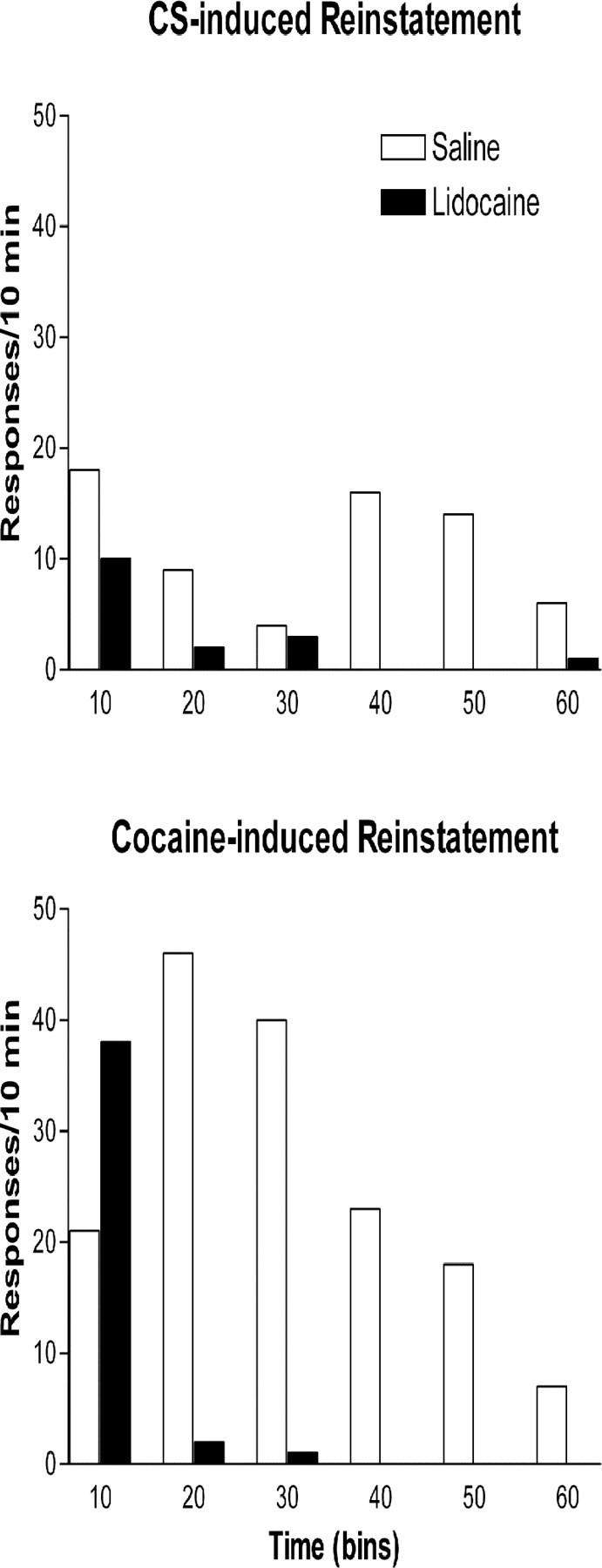
Representative records of lever presses by individual rats during the CS (top) or cocaine reinstatement session (bottom) after vSUB microinfusion of saline or lidocaine as indicated in the legend. The 1 hr reinstatement session was divided into six 10 min bins. In both sessions, responding was reinforced only by the CS. Note that reduced responding to vSUB lidocaine was evident in both sessions by the second bin.
Figure 4.
Figure 4.
Effects of bilateral microinjections of lidocaine (100 μg/side) or saline (0.5 μl/side) into vSUB on cocaine-reinstated responding. Data are presented as in Figure 2, which also shows performance on the last day of cocaine self-administration. Responding was reinforced only by the CS in the reinstatement session contingent on an FR 5 schedule. Ext indicates the extinction session before reinstatement. Reinstate indicates the reinstatement session in which the rats received cocaine (10 mg/kg, i.p.) but did not have any vSUB pretreatment. Reinstate+Microinjection indicates the reinstatement session in which the rats received microinjections of saline or lidocaine into vSUB before cocaine (10 mg/kg, i.p.). Responding was reinforced only by the CS contingent on an FR 5 schedule in a 1 hr session. There was a significant difference between the lidocaine (n = 10) and saline (n = 7) groups (Bonferroni post test; p < 0.05).
Figure 5.
Figure 5.
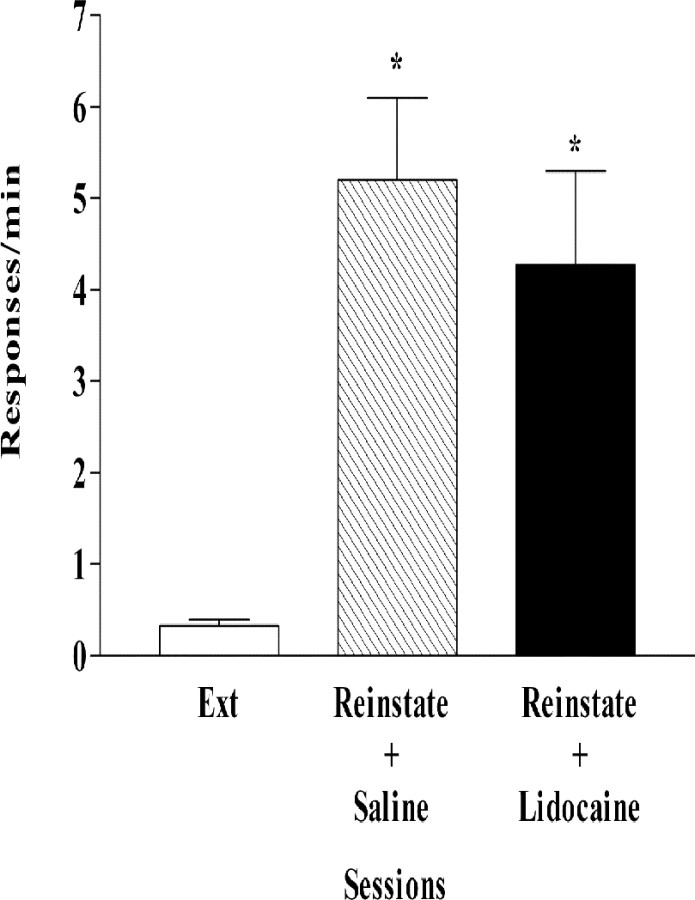
Effects of bilateral microinjections of lidocaine (100 μg/side) or saline (0.5 μl/side) into vSUB on food-reinstated responding. Thirty minute reinstatement sessions (Reinstate) started with a noncontingent delivery of a train of three food pellets; another train was delivered every 5 min thereafter. Responding had no programmed consequences. Ext indicates the extinction session before reinstatement. Pretreatments with saline or lidocaine were counterbalanced among rats. There was no significant difference in responding between saline and lidocaine microinjections (n = 7), but responding after either type of pretreatment was significantly higher than during extinction (Tukey's test; p < 0.05). Baseline data on food self-administration is presented in Table 2.

References

    1. Akirav I, Richter-Levin G ( 2002) Mechanisms of amygdala modulation of hippocampal plasticity. J Neurosci 22: 9912-9921. - PMC - PubMed
    1. Blaha CD, Yang CR, Floresco SB, Barr AM, Phillips AG ( 1997) Stimulation of the ventral subiculum of the hippocampus evokes glutamate receptor-mediated changes in dopamine efflux in the rat nucleus accumbens. Eur J Neurosci 9: 902-911. - PubMed
    1. Boeijinga PH, Pennartz CM, Lopes da Silva FH ( 1990) Paired-pulse facilitation in the nucleus accumbens following stimulation of subicular inputs in the rat. Neuroscience 35: 301-11. - PubMed
    1. Bouton ME ( 2002) Context, ambiguity, and unlearning: sources of relapse after behavioral extinction. Biol Psychiatry 52: 976-986. - PubMed
    1. Bouton ME, Bolles RC ( 1979) Role of conditioned contextual stimuli in reinstatement of extinguished fear. J Exp Psychol Anim Behav Process 5: 368-378. - PubMed

Publication types

MeSH terms