. 2003 Nov 25;100(24):14211-6.
doi: 10.1073/pnas.2336140100. Epub 2003 Nov 12.

Human adipocytes secrete mineralocorticoid-releasing factors

Affiliations

Human adipocytes secrete mineralocorticoid-releasing factors

M Ehrhart-Bornstein et al. Proc Natl Acad Sci U S A. .

Abstract

Obesity has become an epidemic problem in western societies, contributing to metabolic diseases, hypertension, and cardiovascular disease. Overweight and obesity are frequently associated with increased plasma levels of aldosterone. Recent evidence suggests that human fat is a highly active endocrine tissue. Therefore, we tested the hypothesis that adipocyte secretory products directly stimulate adrenocortical aldosterone secretion. Secretory products from isolated human adipocytes strongly stimulated steroidogenesis in human adrenocortical cells (NCI-H295R) with a predominant effect on mineralocorticoid secretion. Aldosterone secretion increased 7-fold during 24 h of incubation. This stimulation was comparable to maximal stimulation of these cells with forskolin (2 x 10(-5) M). On the molecular level, there was a 10-fold increase in the expression of steroid acute regulatory peptide mRNA. This effect was independent of adipose angiotensin II as revealed by the stimulatory effect of fat cell-conditioned medium even in the presence of the angiotensin type 1 receptor antagonist, valsartan. None of the recently defined adipocytokines accounted for the effect. Mineralocorticoid-stimulating activity was heat sensitive and could be blunted by heating fat cell-conditioned medium to 99 degrees C. Centrifugal filtration based on molecular mass revealed at least two releasing factors: a heat sensitive fraction (molecular mass >50 kDa) representing 60% of total activity, and an inactive fraction (molecular mass <50 kDa). However, the recovery rate increased to 92% when combining these two fractions, indicating the interaction of at least two factors. In conclusion, human adipocytes secrete potent mineralocorticoid-releasing factors, suggesting a direct link between obesity and hypertension.


Figures
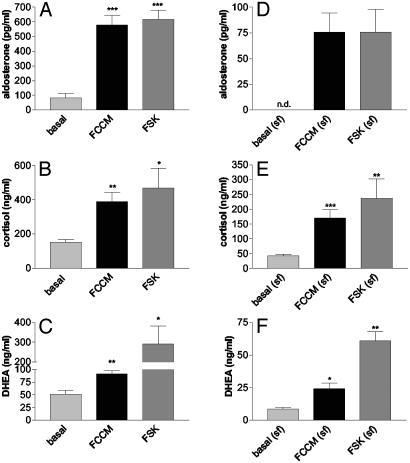
Fig. 1.
Fig. 1.
Secretion of aldosterone (A and D), cortisol (B and E), and DHEA (C and F) from NCI-H295R cells in medium containing 10% FBS (AC) or in serum-free conditions (DF). Stimulation with FCCM was compared with the maximal stimulation with forskolin 2 × 10⁻⁵ M (FSK). Cells were incubated for 24 h. n.d., not detectable. Mean ± SEM, n = 4 separate fat cell preparations, four wells per experiment. Differences significant from basal secretion are indicated: ***, P < 0.001; **, P < 0.01; *, P < 0.05.
Fig. 2.
Fig. 2.
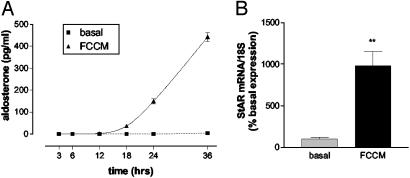
(A) Time-dependency of the FCCM effect on aldosterone secretion from H295R cells under serum free conditions. Mean ± SEM, n = 4 wells per time point. (B) Effect of FCCM on the mRNA expression for StAR in NCI-H295R cells under serum-free conditions. FCCM significantly up-regulated the mRNA levels of StAR as detected by quantitative TaqMan PCR. Data represent mean ± SEM, n = 3; **, P < 0.01.
Fig. 3.
Fig. 3.
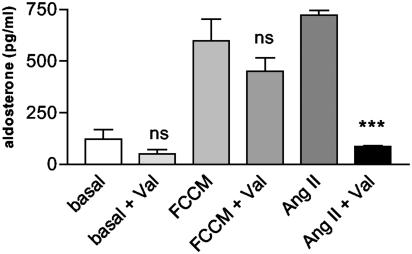
Angiotensin II (10–5 M) stimulated aldosterone secretion (AngII) is significantly inhibited (***, P < 0.001) by addition of the angiotensin type 1 receptor antagonist valsartan (Val) (10–5 M), whereas it had no significant (ns) effect on basal and FCCM-stimulated aldosterone secretion. FCCM contained 10% FBS. Mean ± SEM, n = 3 separate fat cell preparations, four wells per experiment.
Fig. 4.
Fig. 4.
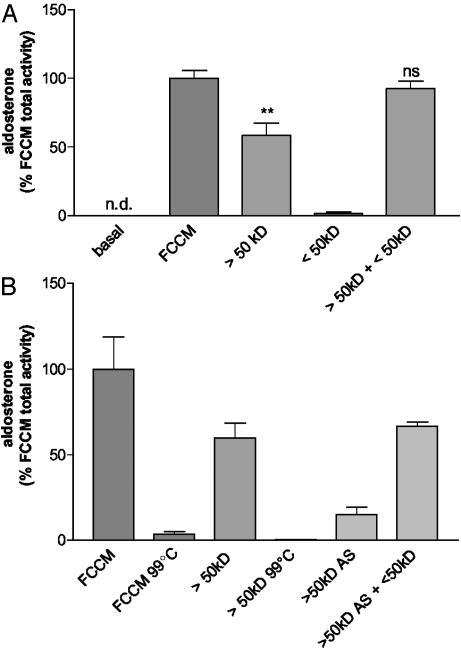
(A) Fractionation of FCCM (serum free) revealed the existence of at least two releasing factors: an active (MW >50kD) and an inactive (MW <50kD) fraction. Stimulation with >50-kDa fraction alone leads to a significant decrease to 58.4 ± 9.14% of total FCCM activity (**, P < 0.005), whereas the recovery rate increased to 92.4 ± 5.5% (not significantly different from FCCM; ns) when combining these two fractions. Data represent mean ± SEM. (B) FCCM is heat-sensitive and precipitates with ammonium sulfate. Heating FCCM (FCCM 99°C) and the active >50-kDa fraction (>50kD 99°C) blunted the stimulatory effect on aldosterone secretion. After ammonium sulfate precipitation of the >50-kDa fraction (>50kD AS), 15.0% of the FCCM total activity were recovered. By adding the <50-kDa fraction (>50kD AS +<50kD), 66.7% activity were recovered. n = 3 experiments, four wells per experiment.
Fig. 5.
Fig. 5.
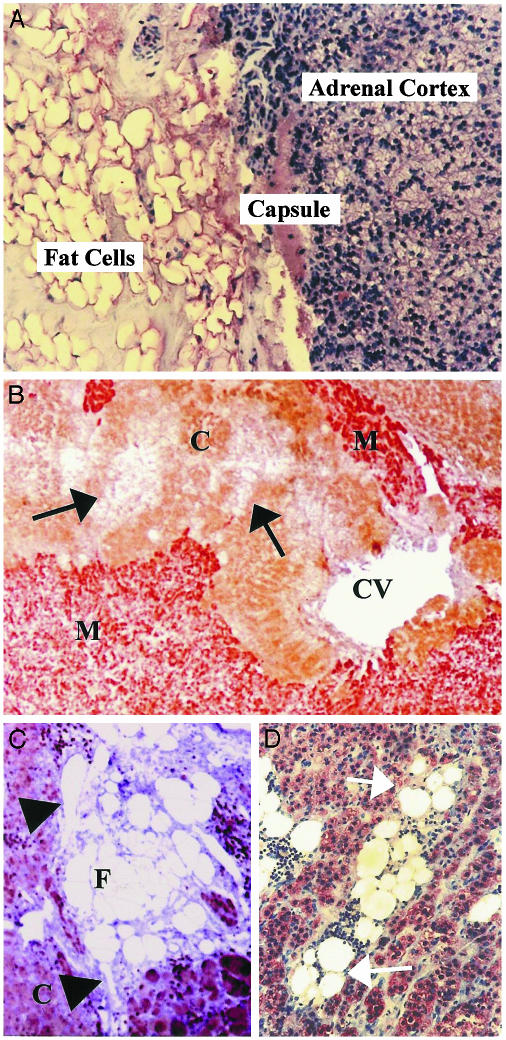
Paraffin sections of normal human adrenal gland. (A) Human adrenals are embedded in periadrenal fat. (BD) Adrenocortical cells are immunostained (brown) with an antibody against 17α-hydroxylase; in B, chromaffin cells are immunostained with an antibody against chromogranin A (red staining). (C) Adipose tissue may accompany adrenal vessels (arrow heads) or occur within the adrenal cortex in direct contact with adrenocortical cells (arrows in B and D). C, adrenal cortex; M, adrenal medulla; CV, central vein; arrows demonstrate clusters of fat cells.
Fig. 6.
Fig. 6.
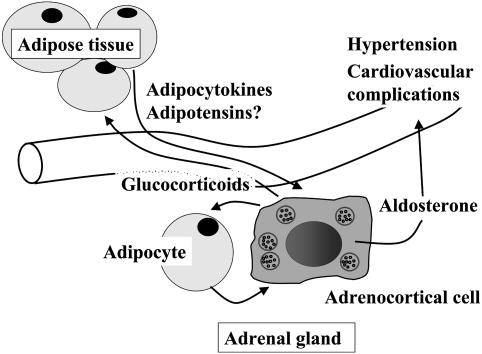
Adipocytes release secretagogues that stimulate adrenocortical steroidogenesis with a potent effect on mineralocorticoid secretion. Enhanced aldosterone levels may be responsible for hypertension and cardiovascular complications associated with obesity. Adrenal glucocorticoids stimulate fat cell growth and proliferation. Arrows indicate stimulation.

References

    1. World Health Organization (1998) Obesity—Preventing and Managing the Global Epidemic: Report of a WHO Consultation on Obesity (W.H.O., Geneva). - PubMed
    1. Flegal, K. M., Carroll, M. D., Ogden, C. L. & Johnson, C. L. (2002) J. Am. Med. Assoc. 288, 1723–1727. - PubMed
    1. Cameron, A. J., Welborn, T. A., Zimmet, P. Z., Dunstan, D. W., Owen, N., Salmon, J., Dalton, M., Jolley, D. & Shaw, J. E. (2003) Med. J. Aust. 178, 427–432. - PubMed
    1. Kopelman, P. G. (2000) Nature 404, 635–643. - PubMed
    1. Calle, E. E., Rodriguez, C., Walker-Thurmond, K. & Thun, M. J. (2003) N. Engl. J. Med. 348, 1625–1638. - PubMed

Publication types

MeSH terms

LinkOut - more resources