Measuring the health of nations: analysis of mortality amenable to health care
- PMID: 14615335
- PMCID: PMC261807
- DOI: 10.1136/bmj.327.7424.1129
Measuring the health of nations: analysis of mortality amenable to health care
Erratum in
- BMJ. 2004 Feb 28;328(7438):494
Abstract
Objective: To assess whether and how the rankings of the world's health systems based on disability adjusted life expectancy as done in the 2000 World Health Report change when using the narrower concept of mortality amenable to health care, an outcome more closely linked to health system performance.
Design: Analysis of mortality amenable to health care (including and excluding ischaemic heart disease).
Main outcome measure: Age standardised mortality from causes amenable to health care
Setting: 19 countries belonging to the Organisation for Economic Cooperation and Development.
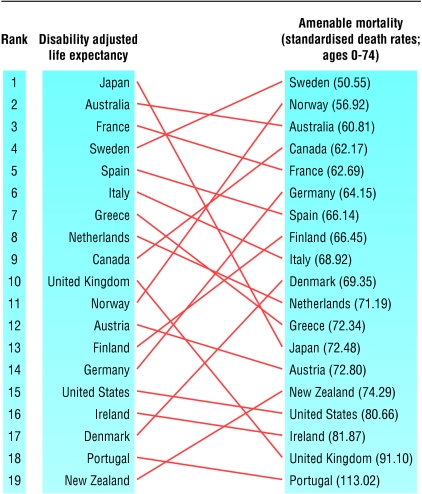
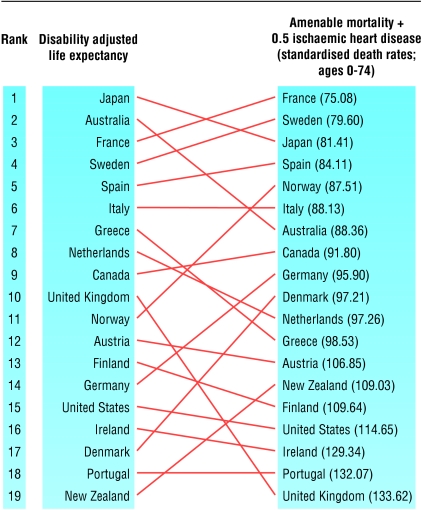
Results: Rankings based on mortality amenable to health care (excluding ischaemic heart disease) differed substantially from rankings of health attainment given in the 2000 World Health Report. No country retained the same position. Rankings for southern European countries and Japan, which had performed well in the report, fell sharply, whereas those of the Nordic countries improved. Some middle ranking countries (United Kingdom, Netherlands) also fell considerably; New Zealand improved its position. Rankings changed when ischaemic heart disease was included as amenable to health care.
Conclusion: The 2000 World Health Report has been cited widely to support claims for the merits of otherwise different health systems. High levels of health attainment in well performing countries may be a consequence of good fortune in geography, and thus dietary habits, and success in the health effects of policies in other sectors. When assessed in terms of achievements that are more explicitly linked to health care, their performance may not be as good.
Figures
References
-
- World Health Organization. The world health report 2000. Health systems: improving performance. Geneva: WHO, 2000.
-
- Navarro V. The new conventional wisdom: an evaluation of the WHO report, Health systems: improving performance. Int J Health Serv 2001;31: 23-33. - PubMed
-
- Almeida C, Braveman P, Gold MR, Schwarcwald CL, Riberio JM, Miglionico A, et al. Methodological concerns and recommendations on policy consequences of the World Health Report 2000. Lancet 2001;357: 1692-7. - PubMed
-
- Pedersen K. The World Health Report 2000: dialogue of the deaf? Health Econ 2002;11: 93-101. - PubMed
Publication types
MeSH terms
LinkOut - more resources
Full Text Sources
Medical