Screening for depression in primary care with two verbally asked questions: cross sectional study
- PMID: 14615341
- PMCID: PMC261815
- DOI: 10.1136/bmj.327.7424.1144
Screening for depression in primary care with two verbally asked questions: cross sectional study
Abstract
Objective: To determine the diagnostic accuracy of two verbally asked questions for screening for depression.
Design: Cross sectional criterion standard validation study.
Setting: 15 general practices in New Zealand.
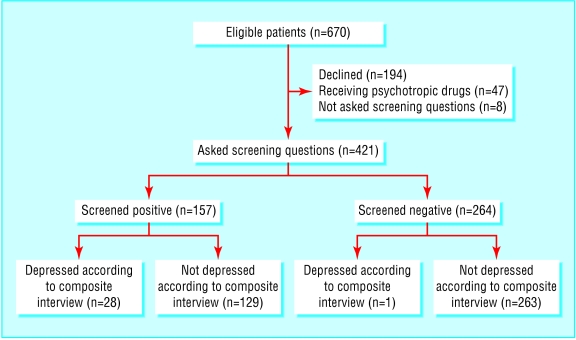
Participants: 421 consecutive patients not taking psychotropic drugs.
Main outcome measures: Sensitivity, specificity, and likelihood ratios of the two questions compared with the computerised composite international diagnostic interview.
Results: The two screening questions showed a sensitivity and specificity of 97% (95% confidence interval, 83% to 99%) and 67% (62% to 72%), respectively. The likelihood ratio for a positive test was 2.9 (2.5 to 3.4) and the likelihood ratio for a negative test was 0.05 (0.01 to 0.35). Overall, 37% (157/421) of the patients screened positive for depression.
Conclusion: Two verbally asked questions for screening for depression would detect most cases of depression in general practice. The questions have the advantage of brevity. As treatment is more likely when doctors make the diagnosis, these questions may have even greater utility.
Comment in
-
How many conditions can a GP screen for?BMJ. 2003 Nov 15;327(7424):1117. doi: 10.1136/bmj.327.7424.1117. BMJ. 2003. PMID: 14615305 Free PMC article. No abstract available.
References
-
- Katon W, Schulberg H. Epidemiology of depression in primary care. Gen Hosp Psychiatry 1992;14: 237-47. - PubMed
-
- Pignone MP, Gaynes BN, Rushton JL, Burchell CM, Orleans CT, Mulrow CD, et al. Screening for depression in adults: a summary of the evidence for the US preventive services task force. Ann Intern Med 2002;136: 765-76. - PubMed
-
- Andersen SM, Harthorn BH. The recognition, diagnosis, and treatment of mental disorders by primary care physicians. Med Care 1989;27: 869-86. - PubMed
-
- Spitzer RL, Williams JB, Kroenke K, Linzer M, deGruy III FV, Hahn SR, et al. Utility of a new procedure for diagnosing mental disorders in primary care. The prime-MD1000 study. JAMA 1994;14: 1749-56. - PubMed
Publication types
MeSH terms
LinkOut - more resources
Full Text Sources