


doi: 10.1172/JCI20364.
Pseudomonas aeruginosa quorum sensing as a potential antimicrobial target
Affiliations
- PMID: 14617745
- PMCID: PMC259138
- DOI: 10.1172/JCI20364
Item in Clipboard
Pseudomonas aeruginosa quorum sensing as a potential antimicrobial target
J Clin Invest.
2003 Nov.
Abstract
Pseudomonas aeruginosa has two complete quorum-sensing systems. Both of these systems have been shown to be important for Pseudomonas virulence in multiple models of infection. Thus, these systems provide unique targets for novel antimicrobial drugs.
Figures
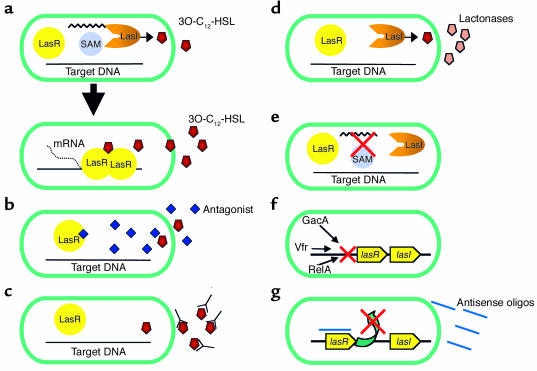
Potential QS targets for the inhibition of P. aeruginosa virulence. For simplicity, only the las QS system is shown; however, similar mechanisms could be used to inhibit the rhl system as well. (a) P. aeruginosa LasI synthase utilizes S-adenosyl methionine (SAM) and acyl-ACP to form 3O-C12-HSL. As the density of the bacteria, and thus of 3O-C12-HSL, increases, the 3O-C12-HSL molecule binds to the LasR regulator, resulting in dimerization, DNA binding, and transcription of multiple genes. (b) Antagonistic analogues of cognate AHLs compete for binding to LasR but do not result in activation of the protein. (c) Specific antibodies bind to AHLs as they exit the bacteria, inhibiting their re-entry and thus inhibiting activation of LasR as well as their interaction with host cells. (d) Lactonases degrade AHLs as they leave the bacteria, thus inhibiting their activation of LasR and host cells. (e) Targeting the expression of LasI substrates would prevent the production of 3O-C12-HSL, and thus QS activation. (f) Multiple factors have been shown to regulate lasR and lasI. Drugs that inhibit these factors would result in altered QS activation. (g) Specific antisense oligonucleotides (oligos) pair with lasR or lasI RNA and inhibit gene translation and thus protein production.
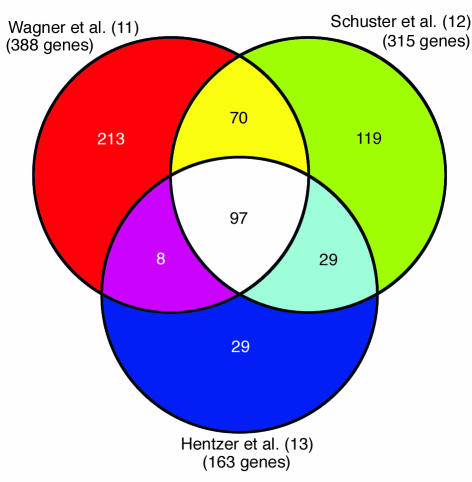
Analyses of the QS-regulated transcriptome of P. aeruginosa. A comparison of QS-induced genes from microarray experiments performed by three different research groups is shown. The data reported by Hentzer et al. (13) represent only those genes that were induced fivefold or more. The studies by Wagner et al. (11) and Schuster et al. (12) include all induced genes. A total of 97 QS-regulated genes were common to all three studies.
References
MeSH terms
Substances
LinkOut - more resources
Full Text Sources
Other Literature Sources
