. 2004 Feb;13(1):61-8.
doi: 10.1007/s00586-003-0590-3. Epub 2003 Nov 14.

Injury of the anterior longitudinal ligament during whiplash simulation

Affiliations

Injury of the anterior longitudinal ligament during whiplash simulation

P C Ivancic et al. Eur Spine J. 2004 Feb.

Abstract

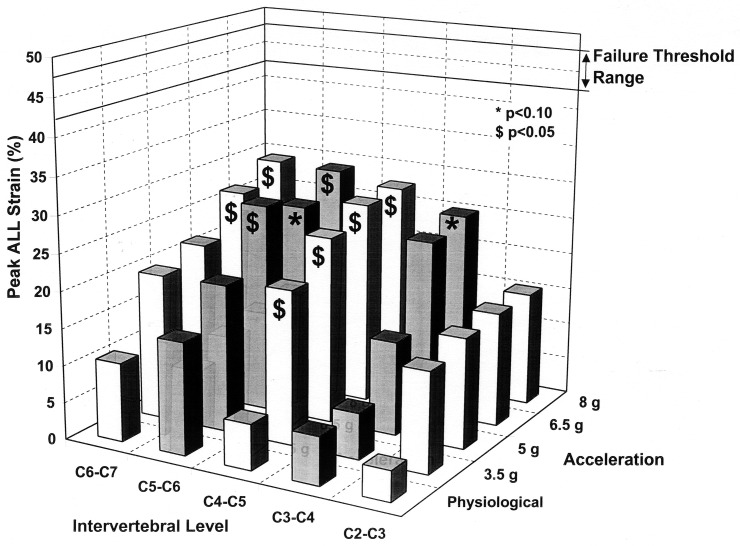
Anterior longitudinal ligament (ALL) injuries following whiplash have been documented both in vivo and in vitro; however, ALL strains during the whiplash trauma remain unknown. A new in vitro whiplash model and a bench-top trauma sled were used in an incremental trauma protocol to simulate whiplash at 3.5, 5, 6.5 and 8 g accelerations, and peak ALL strains were determined for each trauma. Following the final trauma, the ALLs were inspected and classified as uninjured, partially injured or completely injured. Peak strain, peak intervertebral extension and increases in flexibility parameters were compared among the three injury classification groups. Peak ALL strains were largest in the lower cervical spine, and increased with impact acceleration, reaching a maximum of 29.3% at C6-C7 at 8 g. Significant increases ( P<0.05) over the physiological strain limits first occurred at C4-C5 during the 3.5 g trauma and spread to lower intervertebral levels as impact severity increased. The complete ligament injuries were associated with greater increases in ALL strain, intervertebral extension, and flexibility parameters than were observed at uninjured intervertebral levels ( P<0.05).


Figures
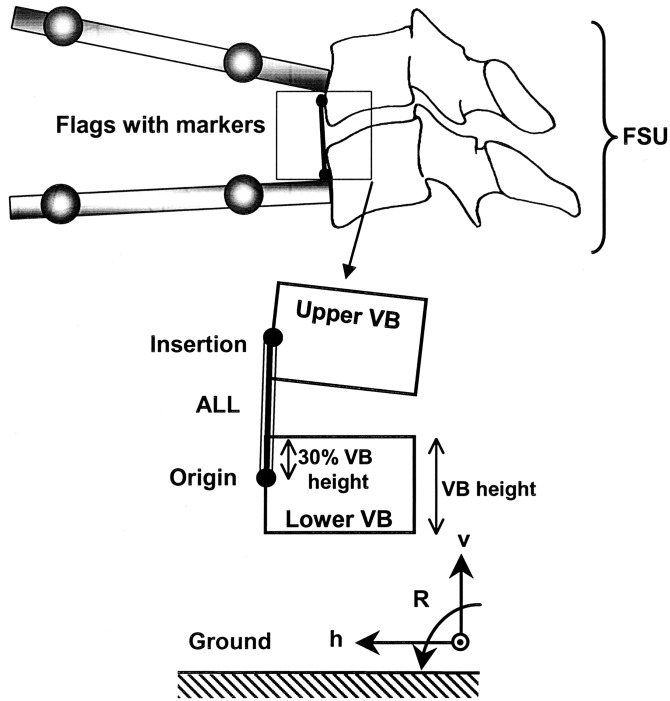
Fig. 1
Fig. 1
Schematic of functional spinal unit (FSU), as seen on a lateral radiograph, showing the motion-tracking flags on the upper and lower vertebral bodies (VBs) of the FSU and the anterior longitudinal ligament (ALL). ALL Origin represents the inferior end of the ALL located at 30% of the lower VB height inferior to the anterosuperior corner of the lower VB along its anterior edge [28, 29] and ALL Insertion represents the superior end of the ALL located at 30% of the upper VB height superior to the anteroinferior corner of the upper VB along its anterior edge [28, 29]. The ground coordinate system (h-v) was fixed to the ground throughout the trauma. Rotation (R) was defined with flexion positive and extension negative
Fig. 2
Fig. 2
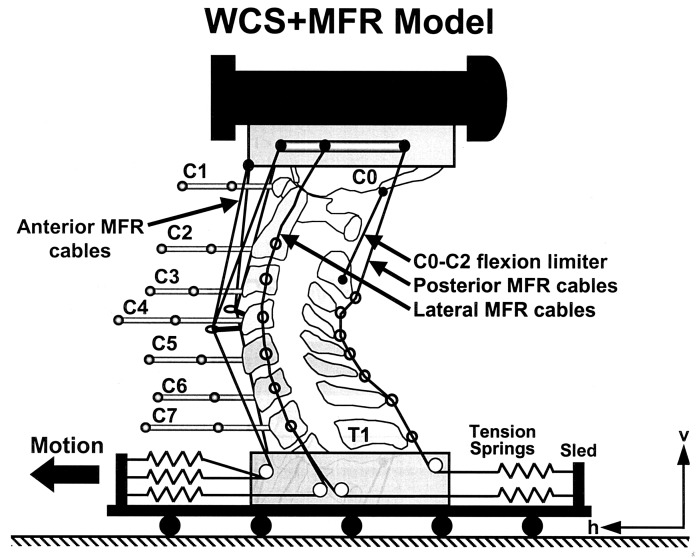
The biofidelic whole cervical spine model with muscle force replication (WCS+MFR). Anterior, posterior and bilateral MFR cables stabilized the head during simulated whiplash. The C0–C2 flexion limiter restricted upper cervical spine flexion to within physiological limits. For additional details, please see the text
Fig. 3
Fig. 3
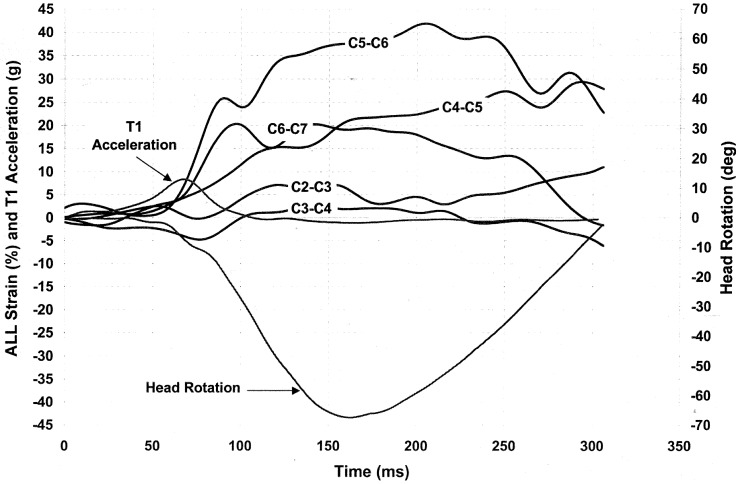
Anterior longitudinal ligament (ALL) strains at various spinal levels (C2-C3 to C6-C7) during simulated whiplash (specimen 3, 8 g trauma). Sled (T1) acceleration and head rotation are also shown
Fig. 4
Fig. 4
Average peak ALL strains at C2-C3 to C6-C7 during physiological loading and simulated whiplash (3.5 g to 8.0 g). The failure threshold range was adapted from Yoganandan et al. 2000 [45]
Fig. 5
Fig. 5
Examples of the three ALL injury classes. A Class 0: macroscopically uninjured ALL (C6-C7). B Class I: partial ALL injury without involvement of the underlying annulus (C3-C4). C Class II: complete ALL injury with injury to underlying disc (C5-C6)

References

    1. Barnsley Pain. 1994;58:283. - PubMed
    1. Braakman R, Penning L (1971) Injuries of the cervical spine. Excerpta Medica, Amsterdam
    1. Bunketorp Eur Spine J. 2002;11:227. doi: 10.1007/s00586-002-0393-y. - DOI - PMC - PubMed
    1. Buonocore JAMA. 1966;198:143. doi: 10.1001/jama.198.1.143. - DOI - PubMed
    1. Butler Spine. 1990;15:111.

Publication types

LinkOut - more resources