Case Reports
Infantile refsum disease: case report
Affiliations
- PMID: 14625237
- PMCID: PMC8148918
Item in Clipboard
Case Reports
Infantile refsum disease: case report
AJNR Am J Neuroradiol.
2003 Nov-Dec.
Erratum in
- AJNR Am J Neuroradiol. 2004 Jun-Jul;25(6):1125
Abstract
Infantile Refsum disease is a rare inborn error of phytanic acid metabolism. It is inherited in an autosomal recessive manner and frequently causes signs and symptoms in the neonate period. The only source of phytanic acid in humans is exogenous, from diet. We report the MR imaging findings in two cases of infantile Refsum disease and note the MR imaging changes that occurred over time because of further progression of the disease. The initial diagnosis in both patients was made on basis of history, clinical findings, and biochemical studies.
Figures
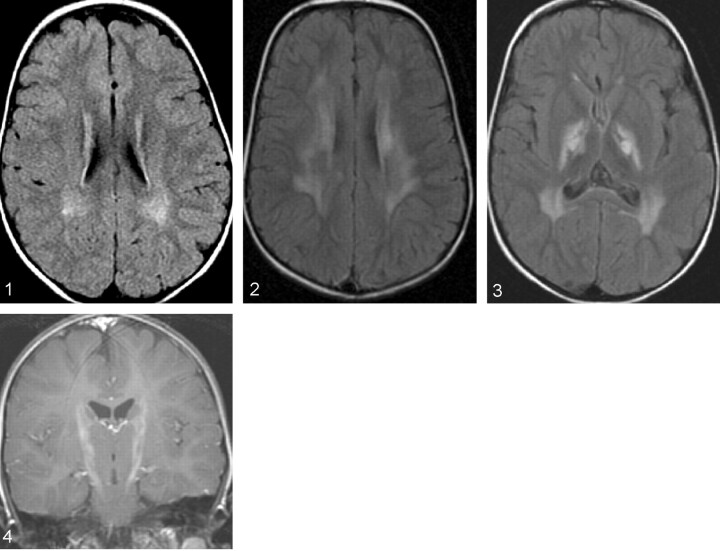
FLAIR image in the initial MR imaging series, showing patchy periventricular white matter hyperintensities.
Follow-up MR image, revealing increase in the periventricular white matter hyperintensities.
Follow-up FLAIR image, revealing increased signal intensity abnormality along the corticospinal tract in the internal capsules bilaterally along with hyperintense signal intensity in the periventricular white matter.
T1-weighted image in the recent MR imaging series, revealing mild enhancement along the corticospinal tracts.
References
Publication types
MeSH terms
LinkOut - more resources
Full Text Sources
Medical