. 2003 Dec 1;31(23):6873-81.
doi: 10.1093/nar/gkg910.

The Frog Prince: a reconstructed transposon from Rana pipiens with high transpositional activity in vertebrate cells

Affiliations

The Frog Prince: a reconstructed transposon from Rana pipiens with high transpositional activity in vertebrate cells

Csaba Miskey et al. Nucleic Acids Res. .

Abstract

Members of the Tc1/mariner superfamily of transposable elements isolated from vertebrates are transpositionally inactive due to the accumulation of mutations in their transposase genes. A novel open reading frame-trapping method was used to isolate uninterrupted transposase coding regions from the genome of the frog species Rana pipiens. The isolated clones were approximately 90% identical to a predicted transposase gene sequence from Xenopus laevis, but contained an unpredicted, approximately 180 bp region encoding the N-terminus of the putative transposase. None of these native genes was found to be active. Therefore, a consensus sequence of the transposase gene was derived. This engineered transposase and the transposon inverted repeats together constitute the components of a novel transposon system that we named Frog Prince (FP). FP has only approximately 50% sequence similarity to Sleeping Beauty (SB), and catalyzes efficient cut-and-paste transposition in fish, amphibian and mammalian cell lines. We demonstrate high-efficiency gene trapping in human cells using FP transposition. FP is the most efficient DNA-based transposon from vertebrates described to date, and shows approximately 70% higher activity in zebrafish cells than SB. Frog Prince can greatly extend our possibilities for genetic analyses in vertebrates.


Figures
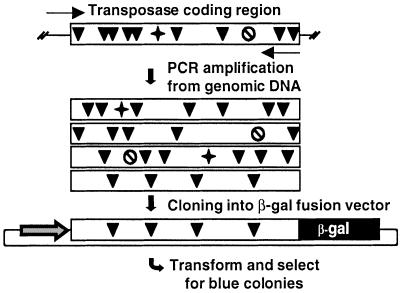
Figure 1
Figure 1
Strategy for trapping transposase ORFs from the R.pipiens genome. Transposase genes are PCR-amplified from genomic DNA (arrows show primers). A collection of transposase coding regions (boxes) can be amplified. The vast majority of these genes are defective due to point mutations (black arrowhead), frameshifts (star) and premature translational stop codons (crossed circle). ORFs can be selected by cloning the PCR products in fusion with the lacZ gene driven by the CMV promoter, transformation into E.coli, and plating on X-gal-containing plates.
Figure 2
Figure 2
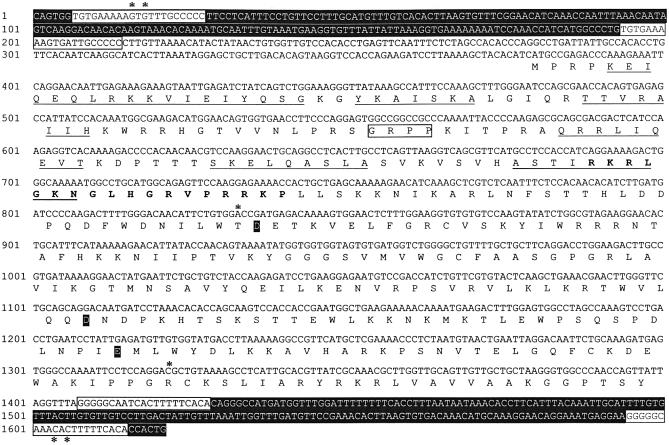
Consensus sequence of the full-length Frog Prince transposable element. The IRs are displayed in black background. The DRs are indicated in white boxes. The encoded amino acid sequence of the transposase is displayed below the DNA sequence. The amino acids that are predicted by PredictProtein to form the α-helices within the two helix–turn–helix motifs in the N-terminal DNA-binding domain are underlined. The AT-hook motif is boxed, the NLS sequence is typed bold and the DDE residues are typed against a black background. The asterisks indicate base pair positions where sequences between the R.pipiens and X.laevis elements are different within the transposase binding sites, and where replacements were introduced in the transposase gene.
Figure 3
Figure 3
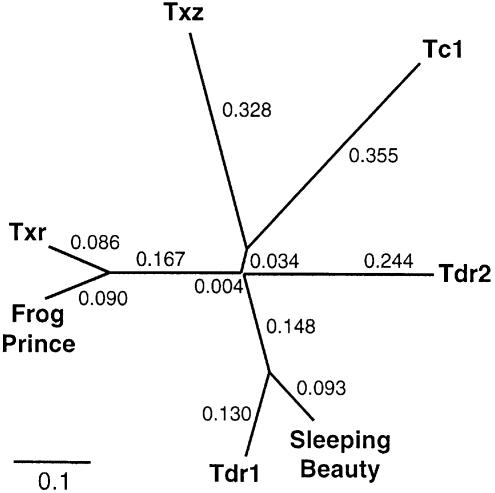
Phylogenetic position of Frog Prince among Tc1-like transposons. Consensus transposase sequences used for the unrooted cladogram were the following: for C.elegans Tc1, GenBank NP-493808; for Danio rerio Tdr1, sequence published in (31); for D.rerio Tdr2 (Tzf), sequence published in (37); for X.laevis TXr and TXz sequences published in (27); for Sleeping Beauty, sequence published in (23); and for Frog Prince, sequence in Figure 2. Numbers at the branches indicate the phylogenetic distances calculated by ClustalX.
Figure 4
Figure 4
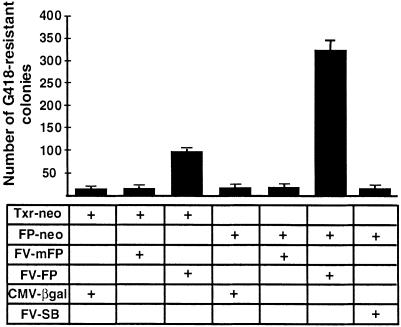
Transposition and substrate recognition of Frog Prince in human HeLa cells. Different combinations of donor and helper plasmids indicated in the table were cotransfected into HeLa cells. Transfection of pCMV-βgal with the donor plasmids served as control. The efficiency of transgene integration was estimated by counting G418-resistant colonies. The numbers on the left represent the mean values of the numbers of colonies per 105 cells plated after three independent transfections. The error bars indicate SEM.
Figure 5
Figure 5
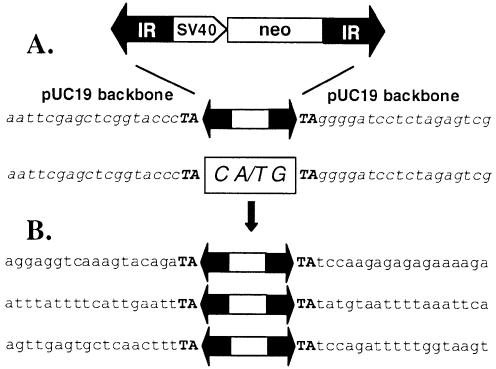
Frog Prince-mediated cut-and-paste transposition into human chromosomes. (A) Excision. On top, a schematic of the FP-neo element is shown. IRs are represented by black arrows, the SV40 promoter and the neomycin-resistance marker gene (neo) are indicated. pUC19 vector backbone sequences that flank the element in the donor construct are shown in italics. The transposon footprints are depicted in the white box. (B) Integration. Three regions of human genomic sequences that served as target sites for the transposase are illustrated below. Flanking TA target site duplications are typed in bold.
Figure 6
Figure 6
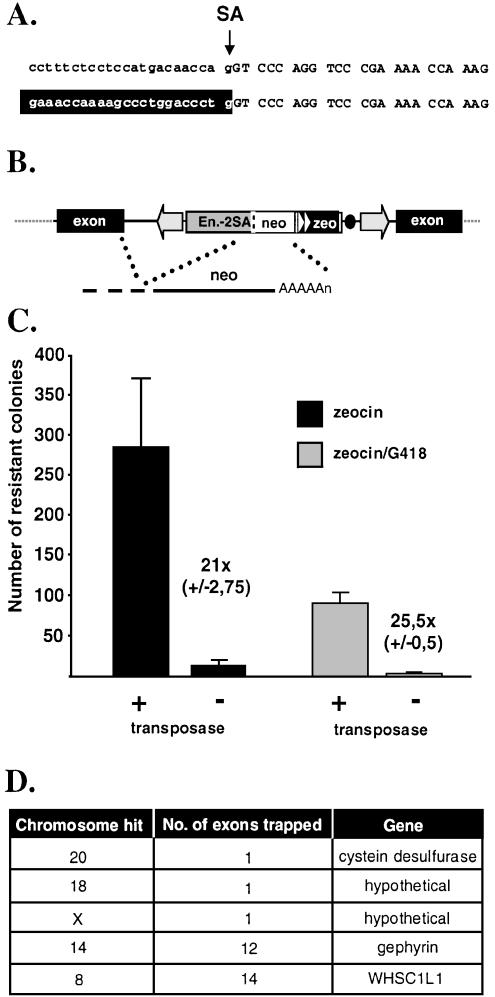
Gene trapping with Frog Prince in human HeLa cells. (A) Fusion transcript. On top, nucleotide sequences of the engrailed-2/lacZ junction in pFP/GT-geo are shown. Intron sequences are typed in lowercase, exon sequences are in uppercase. The arrow indicates the splice acceptor site (SA). Human transcript sequences (depicted against black background) are fused to the engrailed-2 exon due to correct splicing at the SA. (B) Gene trapping with pFP/GT-neo. Engrailed-2 sequences are depicted by the gray box. Triangles indicate the eukaryotic and prokaryotic promoters. The black dot represents the bacterial origin of replication. As stand for polyadenylation signal. (C) Efficiency of gene trapping with FP. Numbers of antibiotic-resistant colonies are indicated on the y-axis. Zeocin selection was used to deduce the transpositional efficiency in the presence of the helper (pFV-FP) versus the control (pCMV-β) plasmid (black columns). Gene trapping efficiencies were determined by using zeocin/G418 double selection (gray columns). Numbers next to the columns indicate the fold difference in numbers of colonies obtained in the presence versus absence of the transposase. (D) Gene trapping events identified by transposon rescue.
Figure 7
Figure 7
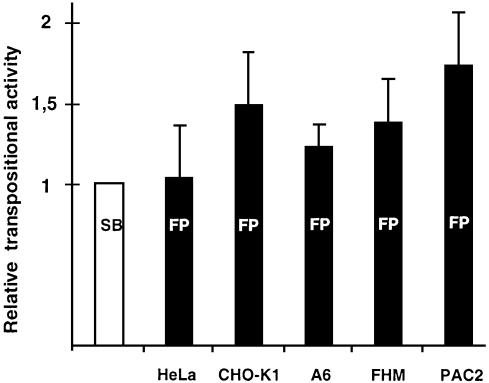
Activity of Frog Prince in comparison with Sleeping Beauty in diverse vertebrate species. The donor and helper plasmids of FP and SB were cotransfected in HeLa (human), CHO-K1 (hamster), A6 (X.laevis), FHM (fathead minnow) and PAC2 (zebrafish) cell lines. Transposition efficiencies were calculated by deriving ratios between the numbers of G418-resistant cell clones obtained in the presence versus in the absence of the transposases. Activities of FP (indicated by black columns) were compared to those of SB (white column). Mean values of relative efficiencies are derived from at least three independent transfections, and are indicated on the y-axis. Transpositional efficiency of SB was normalized to the value 1 for each cell line. The error bars show SEM.

References

    1. Driever W., Solnica-Krezel,L., Schier,A., Neuhauss,S., Maliki,J., Stemple,D., Stainier,D., Zwartkruis,F., Abdelilah,S., Rangini,Z., Belak,J. and Boggs,C. (1996) A genetic screen for mutations affecting embryogenesis in zebrafish. Development, 123, 37–46. - PubMed
    1. Haffter P., Granato,M., Brand,M., Mullins,M.C., Hammerschmidt,M., Kane,D.A., Odenthal,J., van Eeden,F.J., Jiang,Y.J., Heisenberg,C.P., Kelsh,R.N., Furutani-Seiki,M., Vogelsang,E., Beuchle,D., Schach,U., Fabian,C. and Nusslein-Volhard,C. (1996) The identification of genes with unique and essential functions in the development of the zebrafish, Danio rerio. Development, 123, 1–36. - PubMed
    1. Anderson K.V. (2000) Finding the genes that direct mammalian development: ENU mutagenesis in the mouse. Trends Genet., 16, 99–102. - PubMed
    1. Amsterdam A., Burgess,S., Golling,G., Chen,W., Sun,Z., Townsend,K., Farrington,S., Haldi,M. and Hopkins,N. (1999) A large-scale insertional mutagenesis screen in zebrafish. Genes Dev., 13, 2713–2724. - PMC - PubMed
    1. Zambrowicz B.P., Friedrich,G.A., Buxton,E.C., Lilleberg,S.L., Person,C. and Sands,A.T. (1998) Disruption and sequence identification of 2,000 genes in mouse embryonic stem cells. Nature, 392, 608–611. - PubMed

Publication types

Associated data