


Observations on the vomeronasal organ of prenatal Tarsius bancanus borneanus with implications for ancestral morphology
- PMID: 14635801
- PMCID: PMC1571184
- DOI: 10.1046/j.1469-7580.2003.00229.x
Observations on the vomeronasal organ of prenatal Tarsius bancanus borneanus with implications for ancestral morphology
Abstract
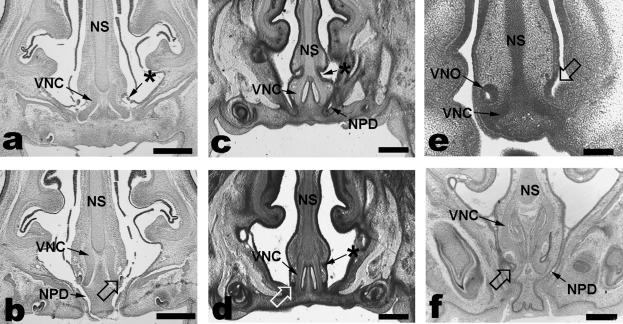
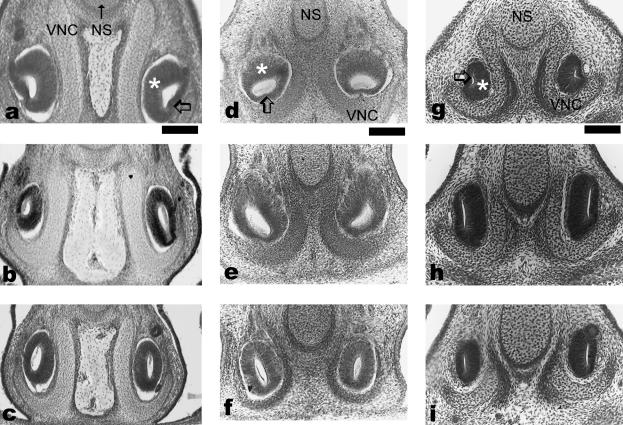
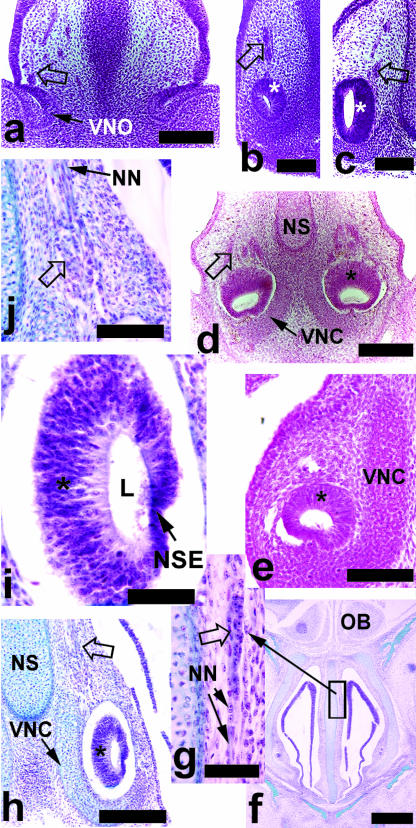
Adult primates have at least five known phenotypes of vomeronasal organ (VNO), ranging from the typical morphology seen in most other mammals to complete absence. With such morphological disparity, the phylogenetic value and any inferences on ancestral VNO morphology of the primate VNO are left uncertain. The present study investigated the VNO of embryonic and fetal Tarsius bancanus borneanus (n = 4) in comparison with prenatal specimens from four other species of primates in an effort to clarify adult morphological variations. In all except one of the fetal primates, the VNO communicated to the nasopalatine duct. One exception occurred in the largest fetal Tarsius (25 mm crown-rump length), in which the VNO communicated with the nasal cavity alone. The vomeronasal neuroepithelium was well differentiated from a thinner, non-sensory epithelium in all Tarsius and New World monkeys studied, as well as late embryonic and fetal Microcebus myoxinus. In anterior sections, this neuroepithelium was found in a more superior location in Tarsius and New World monkeys compared with Microcebus myoxinus. In all primates, masses of cell bodies were found superior to the VNO, intermingled with nerve fibres. These morphologically resembled luteinizing hormone-releasing hormone neurons described in other mammals, including humans, suggesting that a primitive association of these neurons with the VNO may exist in all primate taxa. The present study revealed that prenatal similarities exist in Tarsius and New World primates in VNO epithelial morphology. However, these are transient stages of morphology. If tarsiers and anthropoids do represent a clade (Haplorhini), then the atypical morphology seen in adult tarsiers and New World monkeys probably represents the adult VNO morphology of a haplorhine common ancestor.
Figures
References
-
- Ankel-Simons F. Primate Anatomy: an Introduction. New York: Academic Press; 2000.
-
- Bhatnagar KP, Kallen FC. Morphology of the nasal cavities and associated structures in. Artibeus jamaicensis and Myotis lucifugus. Am. J. Anat. 1974;139:167–190. - PubMed
-
- Bhatnagar KP, Meisami E. Vomeronasal organ in bats and primates: extremes of structural variability and its phylogenetic implications. Microsc. Res. Techn. 1998;43:465–475. - PubMed
-
- Boehm N, Roos J, Gasser B. Luteinizing hormone-releasing hormone (LHRH)-expressing cells in the nasal septum of human fetuses. Dev. Brain Res. 1994;82:175–180. - PubMed
-
- Breipohl W, Bhatnagar KP, Mendoza A. Fine structure of the receptor-free epithelium in the vomeronasal organ of the rat. Cell Tissue Res. 1979;200:383–395. - PubMed
Publication types
MeSH terms
LinkOut - more resources
Full Text Sources
