


The site of Leishmania major infection determines disease severity and immune responses
- PMID: 14638769
- PMCID: PMC308923
- DOI: 10.1128/IAI.71.12.6830-6834.2003
The site of Leishmania major infection determines disease severity and immune responses
Abstract
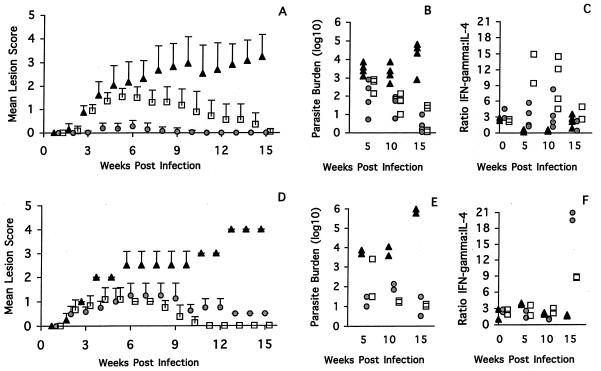
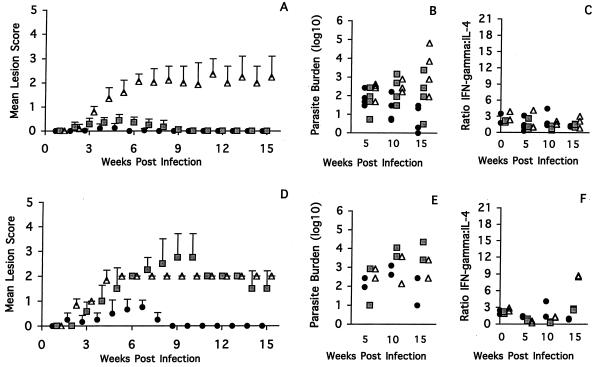
Inbred strains of mice infected with Leishmania major have been classified as genetically resistant or susceptible on the basis of their ability to cure their lesions, the parasite burden in the draining lymph nodes, and their type of T helper cell immune responses to the parasite. Using the intradermal infection at the base of the tail and the ear pinna, we compared for the first time the above-mentioned parameters in six strains of mice infected with metacyclic promastigotes, and we show that the severity of disease depends greatly on the site of infection. Although the well-documented pattern of disease susceptibility of BALB/c and C57BL/6 mice described for the footpad and base-of-the-tail models of leishmaniasis were confirmed, C3H/HeN and DBA/2 mice, which are intermediate and susceptible, respectively, in the tail and other models, were resistant to ear infection. Moreover, in the CBA/H, C3H/HeN, C57BL/6J, and DBA/2 mouse strains, there was little correlation between the pattern of cytokines produced and the disease phenotype observed at the ear and tail sites. We conclude that the definition of susceptibility and the immune mechanisms leading to susceptibility or resistance to infection may differ substantially depending on the route of infection.
Figures
References
-
- Belkaid, Y., S. Kamhawi, G. Modi, J. Valenzuela, N. Noben-Trauth, E. Rowton, J. Ribeiro, and D. L. Sacks. 1998. Development of a natural model of cutaneous Leishmaniasis: powerful effects of vector saliva and saliva preexposure on the long-term outcome of Leishmania major infection in the mouse ear dermis. J. Exp. Med. 188:1941-1953. - PMC - PubMed
-
- Belkaid, Y., S. Mendez, R. Lira, N. Kadambi, G. Milon, and D. Sacks. 2000. A natural model of Leishmania major infection reveals a prolonged “silent” phase of parasite amplification in the skin before the onset of lesion formation and immunity. J. Immunol. 165:969-977. - PubMed
-
- Biedermann, T., S. Zimmermann, H. Himmelrich, A. Gumy, O. Egeter, A. K. Sakrauski, I. Seegmuller, H. Voigt, P. Launois, A. D. Levine, H. Wagner, K. Heeg, J. A. Louis, and M. Rocken. 2001. IL-4 instructs TH1 responses and resistance to Leishmania major in susceptible BALB/c mice. Nat. Immunol. 2:1054-1060. - PubMed
-
- Bretscher, P. A., G. Wei, J. N. Menon, and H. Bielefeldt-Ohmann. 1992. Establishment of stable, cell-mediated immunity that makes “susceptible” mice resistant to Leishmania major. Science 257:539-542. - PubMed
-
- Chretien, S., A. Dubart, D. Beaupain, N. Raich, B. Grandchamp, J. Rosa, M. Goossens, and P. H. Romeo. 1988. Alternative transcription and splicing of the human porphobilinogen deaminase gene result either in tissue-specific or in housekeeping expression. Proc. Natl. Acad. Sci. USA 85: 6-10. - PMC - PubMed
Publication types
MeSH terms
LinkOut - more resources
Full Text Sources
