


doi: 10.1128/IAI.71.12.7173-7177.2003.
CD8+-T-cell responses of Mycobacterium-infected mice to a newly identified major histocompatibility complex class I-restricted epitope shared by proteins of the ESAT-6 family
Affiliations
- PMID: 14638811
- PMCID: PMC308897
- DOI: 10.1128/IAI.71.12.7173-7177.2003
Item in Clipboard
CD8+-T-cell responses of Mycobacterium-infected mice to a newly identified major histocompatibility complex class I-restricted epitope shared by proteins of the ESAT-6 family
Infect Immun.
2003 Dec.
Abstract
Here we describe the identification of a new CD8(+)-T-cell epitope, the GYAGTLQSL nonamer, shared by the TB10.3 and TB10.4 proteins of the Mycobacterium tuberculosis ESAT-6 family. Cytotoxic T cells from mycobacterium-infected mice efficiently recognized this epitope. GYAGTLQSL-specific T-cell hybridomas, which were able to recognize Mycobacterium bovis BCG-infected macrophages, were generated and now allow investigation of mycobacterial-antigen processing through the major histocompatibility complex class I pathway.
Figures
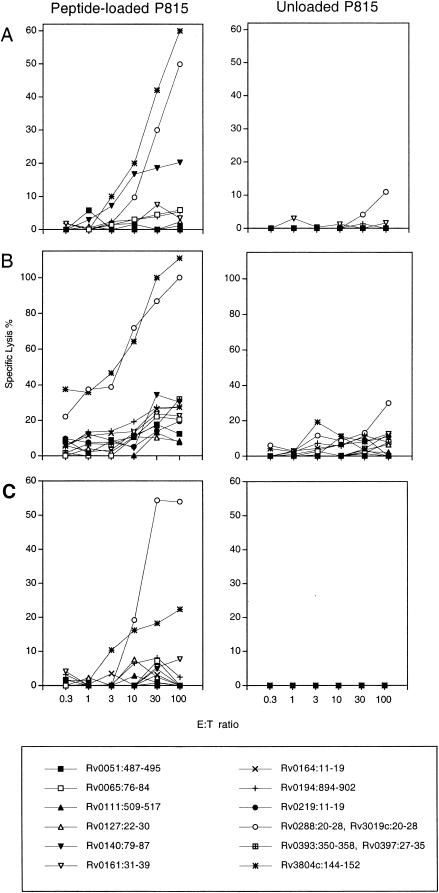
CTL
responses to mycobacterial nonamers predicted to bind to
H-2Kd. CTL activity in the lymph nodes of BALB/c mice
(n = 3) immunized s.c. with individual peptides
emulsified in incomplete Freund adjuvant (A), in the splenocytes of
mice (n = 4) injected s.c. with 107 CFU of
BCG Pasteur 1173P2 (B), or in the splenocytes of mice infected s.c.
with 106 CFU of M. tuberculosis (H37Rv)
(C) is shown. Eight days after the last injection of
H37Rv-derived peptides or 4 weeks after infection with BCG or H37Rv,
CTL activity against unloaded or peptide-loaded P815 targets was
measured in a standard 5-h 51Cr release assay run in
duplicate. The percentage of specific lysis was calculated with the
formula 100 × (experimental release − spontaneous
release)/(maximum release − spontaneous release). Maximum
release was obtained by the addition of 1% Triton X-405 to
labeled target cells. Results are representative of at least two
independent experiments. Standard deviations were always
<5%.
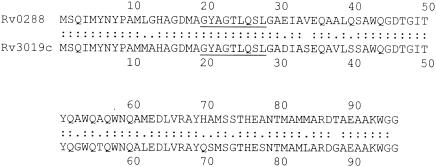
Alignment
of the protein sequences of Rv0288 (TB10.4) and Rv3019c (TB10.3). The
sequence of the TB10.3/4:20-28 epitope is
underlined.
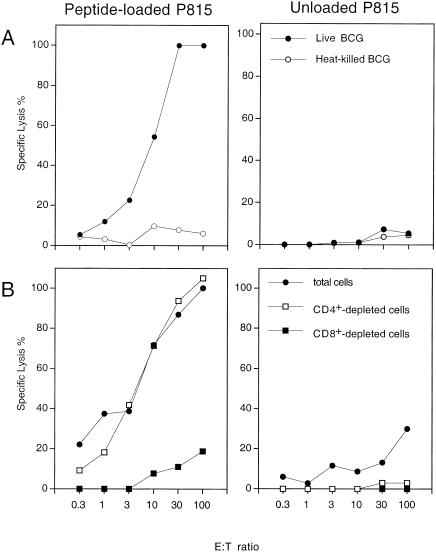
Requirement
of immunization with live BCG for induction of TB10.3/4:20-28-specific
CD8+ CTLs. (A) TB10.3/4:20-28-specific CTL
responses. BALB/c mice were immunized by a single s.c. injection of
107 CFU of live BCG or by two injections at a 15-day
interval of 107 CFU of heat-killed BCG. Splenocytes were
harvested at day 21 for CTL assay. (B)
TB10.3/4:20-28-specific CTL activity of total CD4+-
or CD8+-T-cell-depleted splenocytes of BCG-immunized
BALB/c mice. T-subset depletion was assessed by negative selection with
biotinylated anti-CD4 (GK1.5) or anti-CD8 (H35-17-2) monoclonal
antibodies and streptavidin-coupled magnetic beads (Miltenyi Biotec
GmbH, Bergisch Gladbach,
Germany).
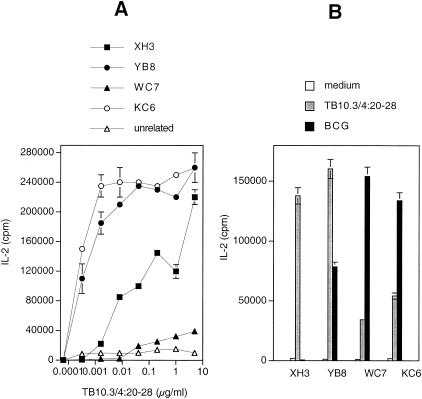
Generation
of H-2Kd-restricted TB10.3/4:20-28-specific T-cell
hybridomas from BCG-immunized BALB/c mice. (A) Specific IL-2
production by four TB10.3/4:20-28-specific T-cell hybridomas (XH3, YB8,
WC7, and KC6) (105 cells/well) subsequent to overnight
stimulation with various concentrations of TB10.3/4:20-28 peptide in
the presence of syngeneic bone marrow-derived dendritic cells
(105 cells/well) used as an antigen-presenting cell.
(B) Specific IL-2 production (monitored by CTLL-2 bioassay)
by XH3, YB8, WC7, and KC6 T-cell hybridomas in response to stimulation
by Raw 264.7 macrophages incubated with 1 μg of TB10.3/4:20-28
peptide per ml or previously infected with BCG at a final concentration
of 5 × 10⁵ CFU/ml under antibiotic-free conditions
for 4
days.
References
-
- Berthet, F. X., P. B. Rasmussen, I. Rosenkrands, P. Andersen, and B. Gicquel. 1998. A Mycobacterium tuberculosis operon encoding ESAT-6 and a novel low-molecular-mass culture filtrate protein (CFP-10). Microbiology 144:3195-3203. - PubMed
-
- Cole, S. T., R. Brosch, J. Parkhill, T. Garnier, C. Churcher, D. Harris, S. V. Gordon, K. Eiglmeier, S. Gas, C. E. Barry III, F. Tekaia, K. Badcock, D. Basham, D. Brown, T. Chillingworth, R. Connor, R. Davies, K. Devlin, T. Feltwell, S. Gentles, N. Hamlin, S. Holroyd, T. Hornsby, K. Jagels, B. G. Barrell, et al. 1998. Deciphering the biology of Mycobacterium tuberculosis from the complete genome sequence. Nature 393:537-544. - PubMed
-
- Denis, O., A. Tanghe, K. Palfliet, F. Jurion, T.-P. van den Berg, A. Vanonckelen, J. Ooms, E. Saman, J. B. Ulmer, J. Content, and K. Huygen. 1998. Vaccination with plasmid DNA encoding mycobacterial antigen 85A stimulates a CD4+ and CD8+ T-cell epitopic repertoire broader than that stimulated by Mycobacterium tuberculosis H37Rv infection. Infect. Immun. 66:1527-1533. - PMC - PubMed
-
- Fayolle, C., P. Sebo, D. Ladant, A. Ullmann, and C. Leclerc. 1996. In vivo induction of CTL responses by recombinant adenylate cyclase of Bordetella pertussis carrying viral CD8+ T cell epitopes. J. Immunol. 156:4697-4706. - PubMed
-
- Feng, C., C. Demangel, A. Kamath, M. Macdonald, and W. Britton. 2001. Dendritic cells infected with Mycobacterium bovis bacillus Calmette Guerin activate CD8+ T cells with specificity for a novel mycobacterial epitope. Int. Immunol. 13:451-458. - PubMed
Publication types
MeSH terms
Substances
LinkOut - more resources
Full Text Sources
Other Literature Sources
Molecular Biology Databases
Research Materials
