


doi: 10.1128/IAI.71.12.7183-7187.2003.
Inducible nitric oxide synthase regulates production of isoprostanes in vivo during chlamydial genital infection in mice
Affiliations
- PMID: 14638813
- PMCID: PMC308939
- DOI: 10.1128/IAI.71.12.7183-7187.2003
Item in Clipboard
Inducible nitric oxide synthase regulates production of isoprostanes in vivo during chlamydial genital infection in mice
Infect Immun.
2003 Dec.
Abstract
Urinary nitrite and F(2)-isoprostanes, an index of oxidant stress, were elevated during chlamydial genital infection of mice. Enhancement of urinary nitrite and F(2)-isoprostanes was observed in phagocyte oxidase-deficient mice. Inhibition of inducible nitric oxide synthase reduced isoprostane excretion. We conclude that nitrogen radicals induce F(2)-isoprostane production and excretion during murine chlamydial genital infection.
Figures
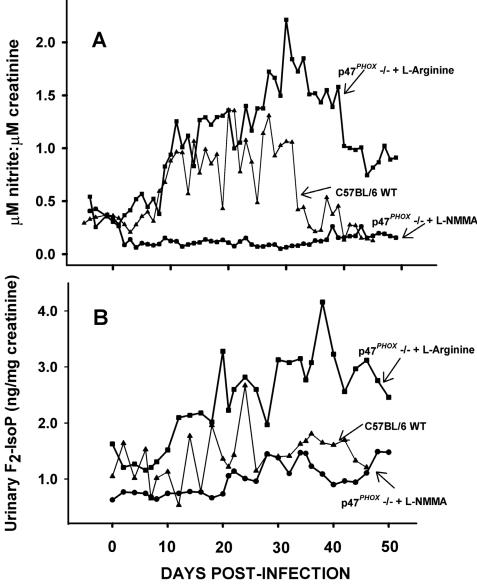
(A) Urine nitrite excretion in response to C. trachomatis urogenital infection in p47phox−/− and wild-type mice (reproduced from reference 22). Urine was collected daily from 6 days prior to infection until day 55 postinfection. Nitrite levels are standardized according to creatinine concentration as described in the text. The lines represent the data from the various groups as labeled in the figure. Significantly elevated excretion of nitrite was observed in the p47phox−/− l -arginine-treated mice compared to that in wild-type mice treated with l -arginine (P < 0.00001; Kruskal-Wallis one-way analysis of variance on ranks). This response was significantly blunted by treatment of the p47phox−/− mice with l -NMMA compared to the response in either the wild-type or p47phox−/− l -arginine-treated controls (P < 0.00001; Kruskal-Wallis one-way analysis of variance on ranks). (B) Excretion of F2-isoprostanes in urine in response to C. trachomatis urogenital infection in p47phox−/− and wild-type mice. Using separate aliquots of the same urine samples assessed for nitrite concentration as described for panel A, F2-isoprostane was assessed at 2-day intervals throughout the course of infection until day 48 (wild-type group) or 52 (p47phox−/− group) postinfection. F2-isoprostane levels were standardized to creatinine concentration. Lines represent data from the experimental groups as labeled in this panel and in panel A. Significantly elevated F2-isoprostane levels were observed in the p47phox−/− l -arginine-treated group compared to those in wild-type mice treated with l -arginine (P < 0.00001; Kruskal-Wallis one-way analysis of variance on ranks). This response was significantly blunted by treatment of the p47phox−/− mice with l -NMMA compared to the response in the p47phox−/− l -arginine-treated controls (P < 0.00001; Kruskal-Wallis one-way analysis of variance on ranks).
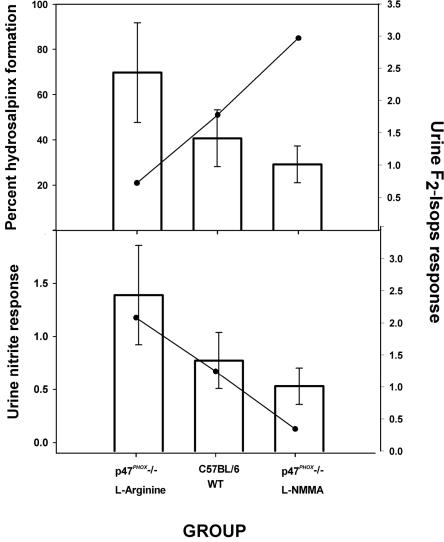
Urinary excretion of F2-isoprostanes correlates inversely with the rate of hydrosalpinx formation and directly with urine nitrite excretion. (A) The mean rates of hydrosalpinx formation in the various experimental groups are summarized and shown here as a line graph. The mean urine F2-isoprostane level (day 6 through day 48 postinfection) was calculated for each group and is displayed as the open bars. A negative correlation between F2-isoprostane levels and the rate of hydrosalpinx formation was observed when the mean F2-isoprostane levels and rates of hydrosalpinx were compared among the groups (correlation coefficient = −0.95204). (B) The mean urine nitrite excretion (also days 6 through 48 postinfection) was calculated for each experimental group from the data displayed in panel A and is shown here as the solid line graph in panel B. The bar graph in panel B is the same as that in panel A and represents mean urine F2-isoprostane excretion from day 6 to day 48 postinfection. A positive correlation was found between the mean urine nitrite excretion during the infection and urine F2-isoprostane excretion (correlation coefficient = 0.8843).
References
-
- Allione, A., P. Bernabei, M. Bosticardo, S. Ariotti, G. Forni, and F. Novelli. 1999. Nitric oxide suppresses human T lymphocyte proliferation through IFN-gamma-dependent and IFN-gamma-independent induction of apoptosis. J. Immunol. 163:4182-4191. - PubMed
-
- Clark, S., M. Coffey, R. Maclean, P. Collins, M. Lewis, A. Cross, and V. O'Donnell. 2002. Characterization of nitric oxide consumption pathways by normal, chronic granulomatous disease and myeloperoxidase-deficient human neutrophils. J. Immunol. 169:5889-5896. - PubMed
-
- Cotter, T. W., Q. Meng, Z. Shen, Y. Zhang, H. Su, and H. D. Caldwell. 1996. Protective efficacy of major outer membrane protein specific immunoglobulin A (IgA) and IgG monoclonal antibodies in a murine model of Chlamydia trachomatis genital tract infection. Infect. Immun. 63:4704-4714. - PMC - PubMed
-
- Cracowski, J. L., T. Durand, and G. Bessard. 2002. Isoprostanes as a biomarker of lipid peroxidation in humans: physiology, pharmacology and clinical implications. Trends Pharmacol. Sci. 23:360-366. - PubMed
Publication types
MeSH terms
Substances
Grants and funding
LinkOut - more resources
Full Text Sources
