Mediators of the relation between maternal depressive symptoms and child internalizing and disruptive behavior disorders
- PMID: 14640804
- PMCID: PMC2764265
- DOI: 10.1037/0893-3200.17.4.545
Mediators of the relation between maternal depressive symptoms and child internalizing and disruptive behavior disorders
Abstract
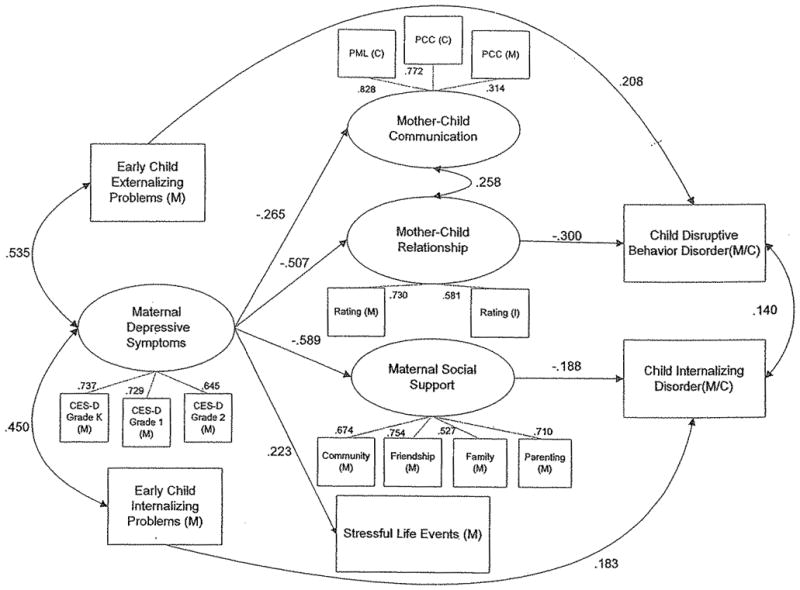
Drawing on a normative sample of 224 youth and their biological mothers, this study tested 4 family variables as potential mediators of the relationship between maternal depressive symptoms in early childhood and child psychological outcomes in preadolescence. The mediators examined included mother-child communication, the quality of the mother-child relationship, maternal social support, and stressful life events in the family. The most parsimonious structural equation model suggested that having a more problematic mother-child relationship mediated disruptive behavior-disordered outcomes for youths, whereas less maternal social support mediated the development of internalizing disorders. Gender and race were tested as moderators, but significant model differences did not emerge between boys and girls or between African American and Caucasian youths.
((c) 2003 APA, all rights reserved)
Figures
References
-
- Achenbach TM. Manual for the Child Behavior Checklist 14–18 and 1991 Profile. Burlington, VT: University of Vermont, Department of Psychiatry; 1991.
-
- Adrian C, Hammen C. Stress exposure and stress generation in children of depressed mothers. Journal of Consulting and Clinical Psychology. 1993;61:354–359. - PubMed
-
- Albright MB, Tamis-LeMonda CS. Maternal depressive symptoms in relation to dimensions of parenting in low-income mothers. Applied Developmental Science. 2002;6:24–34.
-
- Anderson CA, Hammen CL. Psychosocial outcomes of children of unipolar depressed, bipolar, medically ill, and normal women: A longitudinal study. Journal of Consulting and Clinical Psychology. 1993;61:448–454. - PubMed
-
- Anderson JC, Gerbing DW. Structural equation modeling in practice: A review and recommended two-step approach. Psychological Bulletin. 1988;103:411–423.
Publication types
MeSH terms
Grants and funding
- R18 MH50953/MH/NIMH NIH HHS/United States
- R18 MH048043/MH/NIMH NIH HHS/United States
- K05MH00797/MH/NIMH NIH HHS/United States
- R18 MH50952/MH/NIMH NIH HHS/United States
- R18 MH49043/MH/NIMH NIH HHS/United States
- R18 MH050953/MH/NIMH NIH HHS/United States
- R18 MH50951/MH/NIMH NIH HHS/United States
- K05MH01027/MH/NIMH NIH HHS/United States
- K05 MH001027/MH/NIMH NIH HHS/United States
- R18 MH050952/MH/NIMH NIH HHS/United States
- R18 MH050951/MH/NIMH NIH HHS/United States
- R01 MH048043/MH/NIMH NIH HHS/United States
- K05 MH000797/MH/NIMH NIH HHS/United States
- K05 DA015226/DA/NIDA NIH HHS/United States