. 2003 Dec;23(24):9245-50.
doi: 10.1128/MCB.23.24.9245-9250.2003.

While K-ras is essential for mouse development, expression of the K-ras 4A splice variant is dispensable

Affiliations

While K-ras is essential for mouse development, expression of the K-ras 4A splice variant is dispensable

Sarah J Plowman et al. Mol Cell Biol. 2003 Dec.

Abstract

In mammals, the three classical ras genes encode four highly homologous proteins, N-Ras, H-Ras, and the isoforms K-Ras 4A and 4B. Previous studies have shown that K-ras is essential for mouse development and that while K-ras 4A and 4B are expressed during development, K-ras 4A expression is regulated temporally and spatially and occurs in adult kidney, intestine, stomach, and liver. In the present study, the pattern of K-ras 4A expression was examined in a wide range of wild-type adult mouse tissues, and gene targeting was used to generate K-ras 4A-deficient mice to examine its role in development. It was found that K-ras 4A is also expressed in uterus, lung, pancreas, salivary glands, seminal vesicles, bone marrow cells, and cecum, where it was the major K-Ras isoform expressed. Mating between K-ras(tmDelta4A/+) mice produced viable K-ras(tmDelta4A/tmDelta4A) offspring with the expected Mendelian ratios of inheritance, and these mice expressed the K-ras 4B splice variant only. K-ras(tmDelta4A/tmDelta4A) mice were fertile and showed no histopathological abnormalities on inbred (129/Ola) or crossbred (129/Ola x C57BL/6) genetic backgrounds. The results demonstrate that K-Ras 4A, like H- and N-Ras, is dispensable for normal mouse development, at least in the presence of functional K-Ras 4B.


Figures

FIG. 1.
FIG. 1.
Targeted deletion of the K-ras 4A splice variant in embryonic stem cells. (A) Schematic representation of the mouse K-ras locus and the targeting vector used to replace exon 4A. The exons are indicated by open boxes. The neomycin resistance cassette and the herpes simplex virus thymidine kinase gene cassette were employed as selectable markers. In the targeting vector, the thin line denotes plasmid DNA. The positions of the 5′ external and 3′ internal probes (solid boxes) and PCR primers (arrows) used for genotyping are indicated. Restriction enzyme sites: E, EcoRI; P, PvuII; H, HindIII. (B) Embryonic stem cells were genotyped by PCR with the primer set neo22 and Px4BA, which amplify a 2.1-kb product in clones that harbor the targeted allele (clones 173, 187, 194, 196, 221, 226, and 248). +/+, wild-type embryonic stem cells; −, PCR negative control; M, 1-kb DNA ladder showing the 2.0- and 2.1-kb size markers. (C) Confirmation of homologous recombination in embryonic stem cells by Southern blotting. Following digestion with HindIII, a wild-type 2-kb and a targeted 6-kb fragment were detected with the 3′ internal probe (upper panel). Following digestion with PvuII, a wild-type 5-kb and a targeted 4-kb band were detected with the 5′ external probe (lower panel). +/+, wild-type embryonic stem cells.
FIG. 2.
FIG. 2.
Genotyping of mice. (A) The upper panel shows amplification of K-ras exon 4A by PCR. The 72-bp product is present in wild-type (+/+, lanes 9 and 10) and K-rastmΔ4A/+ (+/−,lanes 14 and 15) mice, but not in K-rastmΔ4A/tmΔ4A mice (−/−, lanes 5 and 11). The lower panel shows amplification of the neomycin cassette by PCR. The 206-bp product is present in K-rastmΔ4A/+ and K-rastmΔ4A/tmΔ4A mice but not in wild-type mice. (B) Confirmation of genotypes by Southern blotting. Tail DNA digested with HindIII and hybridized with the 3′ internal probe (upper panel) gave a 2-kb fragment for the wild-type allele and a 6-kb fragment from the targeted allele. Only the 6-kb fragment is present in K-rastmΔ4A/tmΔ4A mice. Digestion with PvuII and hybridization with the 5′ external probe (lower panel) gave a 5-kb band for the wild-type allele and a 4-kb fragment for the targeted allele. Only the 4-kb fragment is present in K-rastmΔ4A/tmΔ4A mice.
FIG. 3.
FIG. 3.
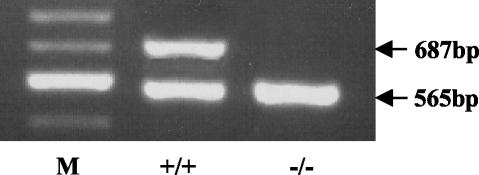
Expression of K-ras in the large intestine from wild-type and K-rastmΔ4A/tmΔ4A mice. RT-PCR analysis of K-ras 4A and 4B mRNAs with primers positioned in exons 1 and 4B that amplify both splice variants in the same reaction (22). The 687-bp band corresponds to K-ras 4A, and the 565-bp band corresponds to K-ras 4B. Wild-type (+/+) but not K-rastmΔ4A/tmΔ4A (−/−) mice express K-ras 4A. Lane M, 100-bp size markers; the major band shown is 600 bp.
FIG. 4.
FIG. 4.
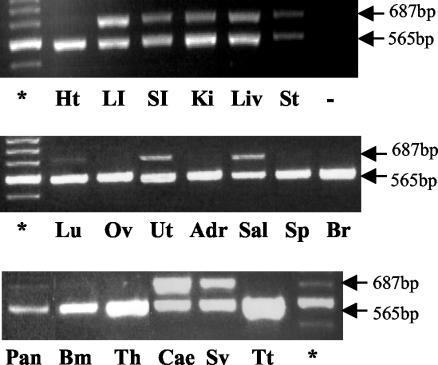
K-ras 4A and 4B expression in adult mouse tissues. The PCR primers used amplify both K-ras splice variants in the same reaction (22). The K-ras 4A and 4B mRNAs generate PCR products of 687 and 565 bp, respectively. Tissues: Ht, heart; LI, large intestine; SI, small intestine; Ki, kidney; Liv, liver; St, stomach; Lu, lung; Ov, ovary; Ut, uterus; Adr, adrenal gland; Sg, salivary gland; Sp, spleen; Br, brain; Pan, pancreas; Bm, bone marrow; Th, thymus; Cae, cecum; Sv, seminal vesicles; Tt, testis. −, PCR negative control. *, 100-bp ladder; the major band shown is 600 bp.

References

    1. Adjei, A. A. 2001. Blocking oncogenic Ras signalling for cancer therapy. J. Natl. Cancer Inst. 93:1062-1074. - PubMed
    1. Ahmadian, M. R. 2002. Prospects for anti-ras drugs. Br. J. Hematol. 116:511-518. - PubMed
    1. Apolloni, A. I., A. Prior, M. Lindsay, R. G. Parton, and J. F. Hancock. 2000. H-Ras but not K-Ras traffics to the plasma membrane through the exocytic pathway. Mol. Cell. Biol. 20:2475-2487. - PMC - PubMed
    1. Brooks, D. J., R. M. James, C. E. Patek, J. Williamson, and M. J. Arends. 2001. Mutant K-ras enhances apoptosis in embryonic stem cells in combination with DNA damage and is associated with increased levels of p19 (ARF). Oncogene 20:2144-2152. - PubMed
    1. Capon, D. J., P. H. Seeburg, J. P. McGrath, J. S. Hayflick, U. Edman, A. D. Levinson, and D. V. Goeddel. 1983. Activation of Ki-ras2 gene in human colon and lung carcinomas by two different point mutations. Nature 304:507-513. - PubMed

Publication types

LinkOut - more resources