. 2003 Dec;23(24):9318-26.
doi: 10.1128/MCB.23.24.9318-9326.2003.

Organization of mammalian cytoplasm

Affiliations

Organization of mammalian cytoplasm

Alice Hudder et al. Mol Cell Biol. 2003 Dec.

Abstract

Although the role of macromolecular interactions in cell function has attracted considerable attention, important questions about the organization of cells remain. To help clarify this situation, we used a simple protocol that measures macromolecule release after gentle permeabilization for the examination of the status of endogenous macromolecules. Treatment of Chinese hamster ovary cells with saponin under carefully controlled conditions allowed entry of molecules of at least 800 kDa; however, there were minimal effects on internal cellular architecture and protein synthesis remained at levels comparable to those seen with intact cells. Most importantly, total cellular protein and RNA were released from these cells extremely slowly. The release of actin-binding proteins and a variety of individual cytoplasmic proteins mirrored that of total protein, while marker proteins from subcellular compartments were not released. In contrast, glycolytic enzymes leaked rapidly, indicating that cells contain at least two distinct populations of cytoplasmic proteins. Addition of microfilament-disrupting agents led to rapid and extensive release of cytoplasmic macromolecules and a dramatic reduction in protein synthesis. These observations support the conclusion that mammalian cells behave as highly organized, macromolecular assemblies (dependent on the actin cytoskeleton) in which endogenous macromolecules normally are not free to diffuse over large distances.


Figures
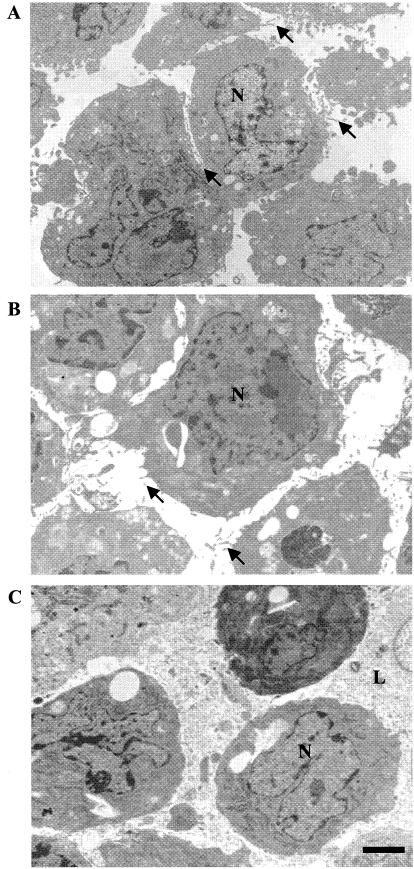
FIG. 1.
FIG. 1.
Ultrastructural characterization of intact and permeabilized cells. Intact cells (A), permeabilized cells (B), and latrunculin-treated permeabilized cells (C) were examined by electron microscopy. Arrows indicate microvilli. N, nucleus; L, lysed cell. Bar, 2 μm.
FIG. 2.
FIG. 2.
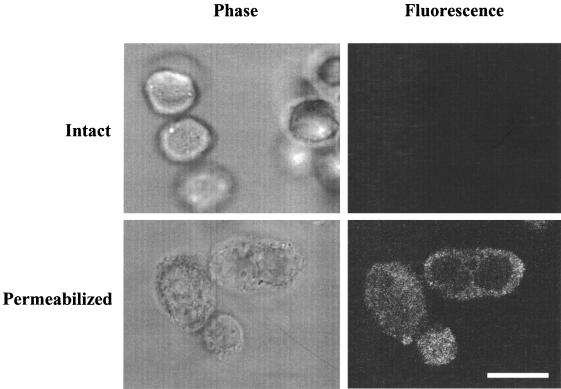
Entry of fluorescent molecules into permeabilized CHO cells. Intact and permeabilized cells were treated with various fluorescent immunoglobulins as described in Materials and Methods. In the experiment whose results are shown, cells were incubated with fluorescent IgM and examined by phase contrast and fluorescence confocal microscopy. The exposure times for the fluorescence photographs were the same for both intact and permeabilized cells. The fluorescent confocal image is an optical section through the cell at the level of the nucleus. Bar, 10 microns.
FIG. 3.
FIG. 3.
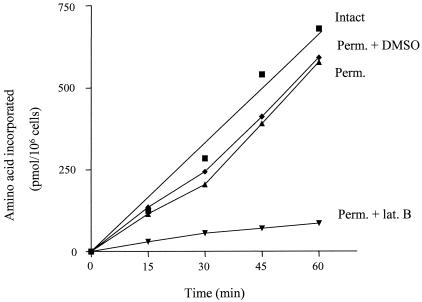
Protein synthesis in intact cells and in permeabilized (Perm.) cells in the presence and absence of latrunculin B (lat. B). Cells were harvested, permeabilized, and incubated for protein synthesis as described in Materials and Methods. The time course of amino acid incorporation into protein over 60 min was determined with a mixture of five 3H-labeled amino acids. Latrunculin B, when present, was at 100 μg/ml.
FIG. 4.
FIG. 4.
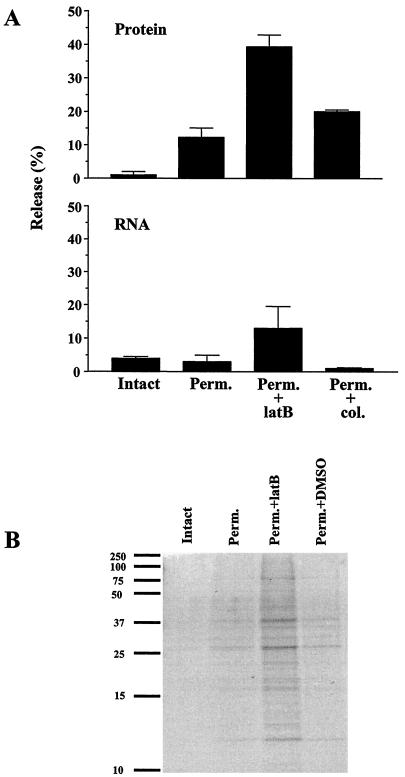
(A) Release of protein and RNA from permeabilized cells. Cells were labeled, harvested, and permeabilized as described in Materials and Methods. Acid-precipitable radioactivity present in supernatant and pellet fractions was measured in a scintillation counter. The activity present in the supernatant fraction divided by the total activity in the intact cell is indicated as percent leakage. The upper panel shows the results for the release of 3H-labeled protein, and the lower panel shows the results for the release of 3H-labeled RNA. The values shown represent the averages of two experiments. (B) SDS-PAGE analysis of protein release. Supernatant fractions from intact cells, permeabilized cells (Perm.), permeabilized cells treated with latrunculin B (Perm.+latB), and permeabilized cells treated with DMSO (Perm.+DMSO) were analyzed. A 1/20 volume of each supernatant fraction was fractionated on a 14% polyacrylamide gel. Bands were visualized with Coomassie blue. The positions of prestained broad range protein markers (Bio-Rad) are shown on the left side of the panel.
FIG. 5.
FIG. 5.
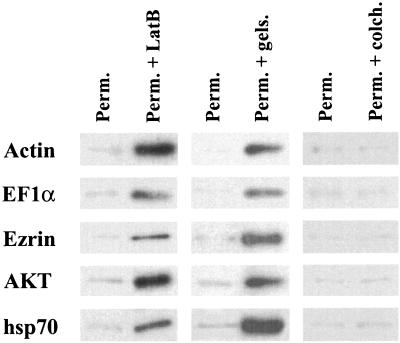
Release of cytoplasmic proteins from permeabilized cells. A 1/20 volume of each indicated supernatant fraction was fractionated on SDS-PAGE, transferred to a PVDF membrane, and probed with antibodies against actin, EF1α, ezrin, AKT and hsp70. Horseradish peroxidase-conjugated anti-rabbit or anti-mouse IgG was used as a secondary antibody, and bands were visualized by enhanced chemiluminescence (see Materials and Methods). Abbreviations: Perm., permeabilized cells; Perm. + LatB, permeabilized cells treated with latrunculin B; Perm. + gels., permeabilized cells treated with gelsolin; Perm. + colch., permeabilized cells treated with colchicine.
FIG. 6.
FIG. 6.
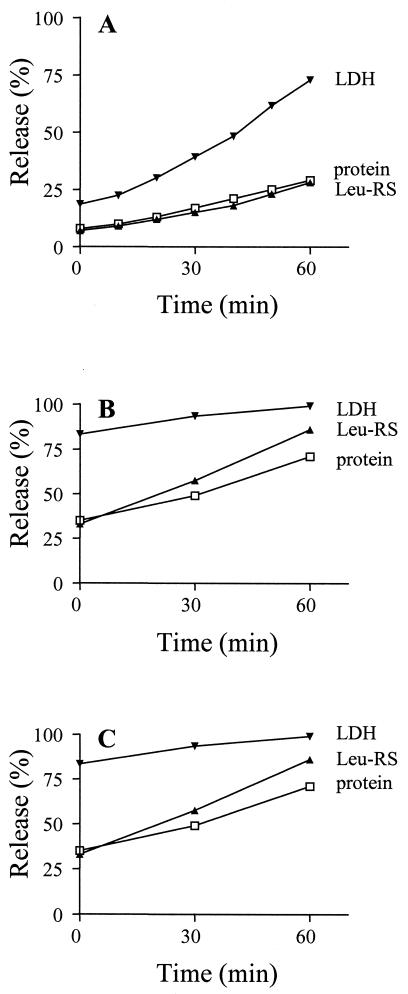
Time course of protein release. Samples of supernatant fractions were taken at 10-min intervals and assayed for total protein, leucyl-tRNA synthetase (Leu-RS) activity, and lactate dehydrogenase (LDH) activity as described in Materials and Methods. Values represent the averages of two experiments. The percentages of release are relative to those in an equal amount of intact cells. (A) Permeabilized cells; (B) permeabilized cells treated with latrunculin B; (C) permeabilized cells treated with both latrunculin B and colchicine.

References

    1. Bandyopadhyay, A. K., and M. P. Deutscher. 1971. Complex of aminoacyl-transfer RNA synthetases. J. Mol. Biol. 60:113-122. - PubMed
    1. Cameron, I. L., K. E. Hunter, N. K. Smith, C. F. Hazelwood, A. Ludany, and M. Kellermayer. 1988. Role of plasma membrane and of cytomatrix in maintenance of intracellular to extracellular ion gradients in chicken erythrocytes. J. Cell. Physiol. 137:299-304. - PubMed
    1. Cande, W. Z., K. McDonald, and R. L. Meeusen. 1981. A permeabilized cell model for studying cell division: a comparison of anaphase chromosome movement and cleavage furrow constriction in lysed Ptk1 cells. J. Cell Biol. 88:618-629. - PMC - PubMed
    1. Chen, P. S., T. Y. Toribara, and H. Warner. 1956. Microdetermination of phosphorus. Anal. Chem. 28:1756-1758.
    1. Clegg, J. S., and S. A. Jackson. 1988. Glycolysis in permeabilized L-929 cells. Biochem. J. 255:335-344. - PMC - PubMed

Publication types