


Cu nanocrystal growth on peptide nanotubes by biomineralization: size control of Cu nanocrystals by tuning peptide conformation
- PMID: 14645717
- PMCID: PMC299758
- DOI: 10.1073/pnas.2433456100
Cu nanocrystal growth on peptide nanotubes by biomineralization: size control of Cu nanocrystals by tuning peptide conformation
Abstract
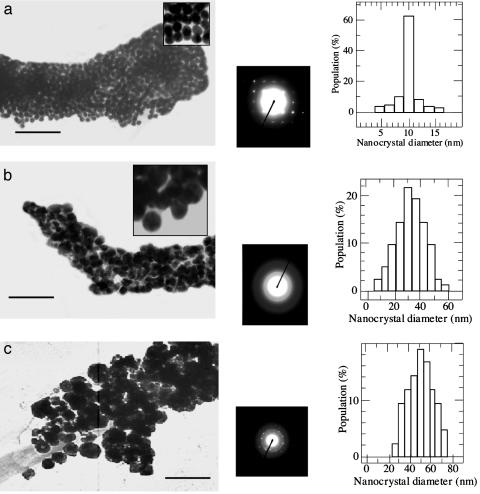
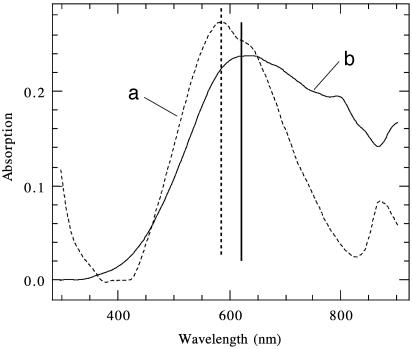
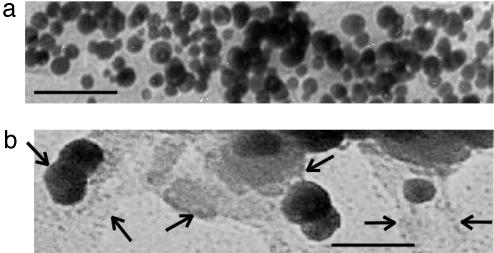
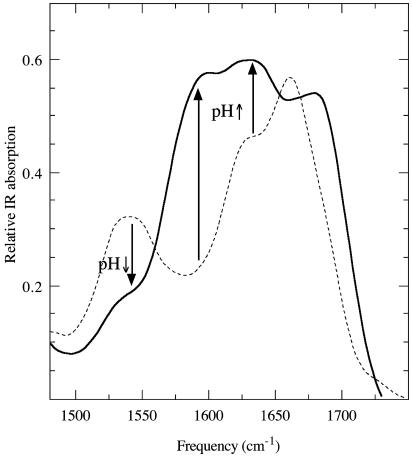
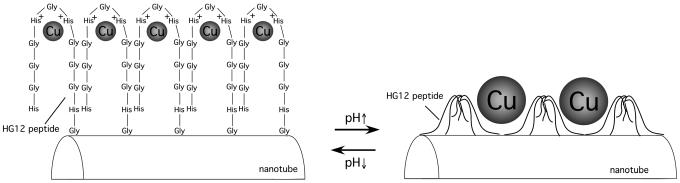
With recent interest in seeking new biologically inspired device-fabrication methods in nanotechnology, a new biological approach was examined to fabricate Cu nanotubes by using sequenced histidine-rich peptide nanotubes as templates. The sequenced histidine-rich peptide molecules were assembled as nanotubes, and the biological recognition of the specific sequence toward Cu lead to efficient Cu coating on the nanotubes. Cu nanocrystals were uniformly coated on the histidine-incorporated nanotubes with high packing density. In addition, the diameter of Cu nanocrystal was controlled between 10 and 30 nm on the nanotube by controlling the conformation of histidine-rich peptide by means of pH changes. Those nanotubes showed significant change in electronic structure by varying the nanocrystal diameter; therefore, this system may be developed to a conductivity-tunable building block for microelectronics and biological sensors. This simple biomineralization method can be applied to fabricate various metallic and semiconductor nanotubes with peptides whose sequences are known to mineralize specific ions.
Figures

References
-
- Puntes, V. F., Krishnan, K. M. & Alivisatos, A. P. (2001) Science 291, 2115–2117. - PubMed
-
- Puntes, V. F., Zanchet, D., Erdonmez, C. K. & Alivisatos, A. P. (2002) J. Am. Chem. Soc. 124, 12874–12880. - PubMed
-
- El-Sayed, M. A. (2001) Acc. Chem. Res. 34, 257–264. - PubMed
-
- Sun, Y. & Xia, Y. (2002) Science 298, 2176–2179. - PubMed
-
- Ertl, G. & Knozinger, H. (1997) Handbook of Heterogeneous Catalysis (Wiley, New York).
Publication types
MeSH terms
Substances
LinkOut - more resources
Full Text Sources
Other Literature Sources
