


P130Cas-associated protein (p140Cap) as a new tyrosine-phosphorylated protein involved in cell spreading
- PMID: 14657239
- PMCID: PMC329393
- DOI: 10.1091/mbc.e03-09-0689
P130Cas-associated protein (p140Cap) as a new tyrosine-phosphorylated protein involved in cell spreading
Abstract
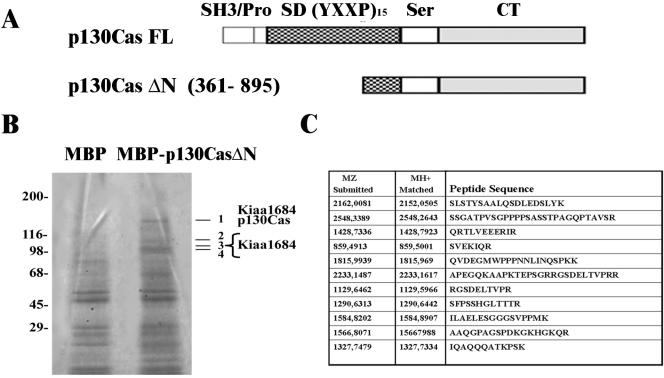
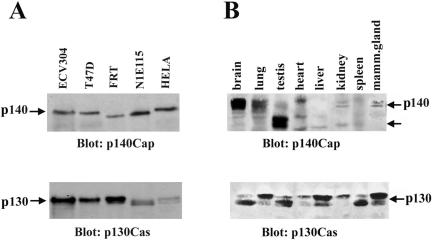
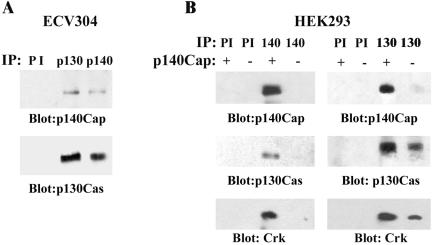
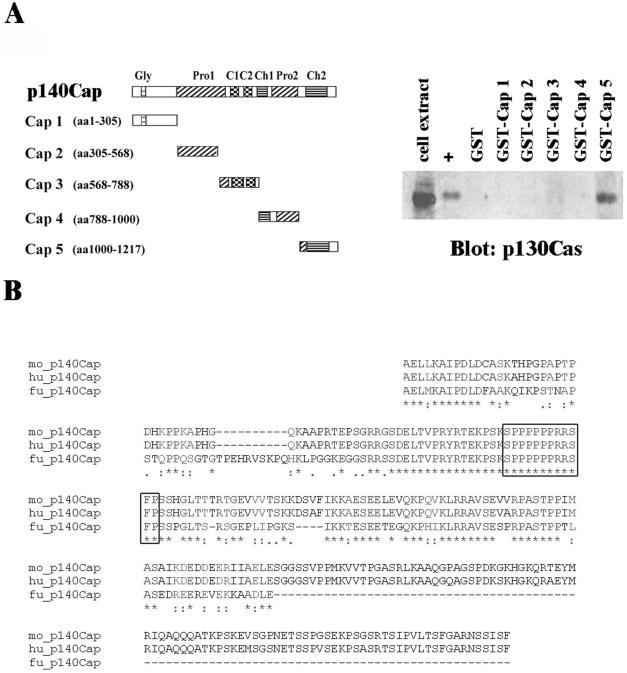
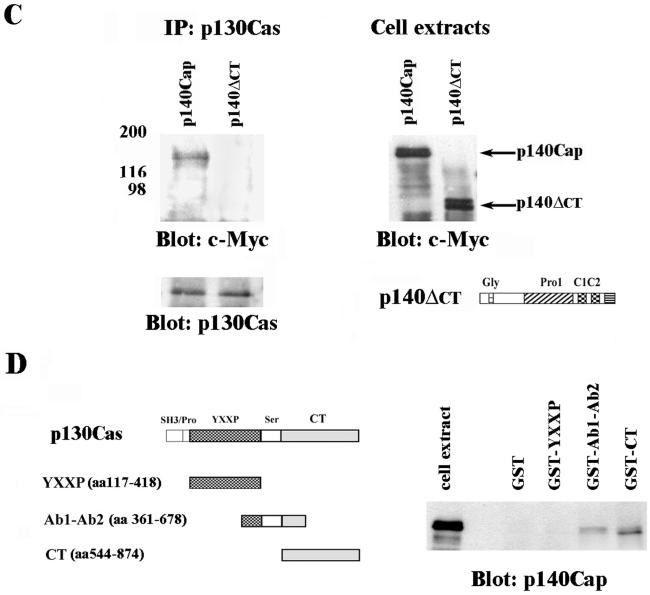
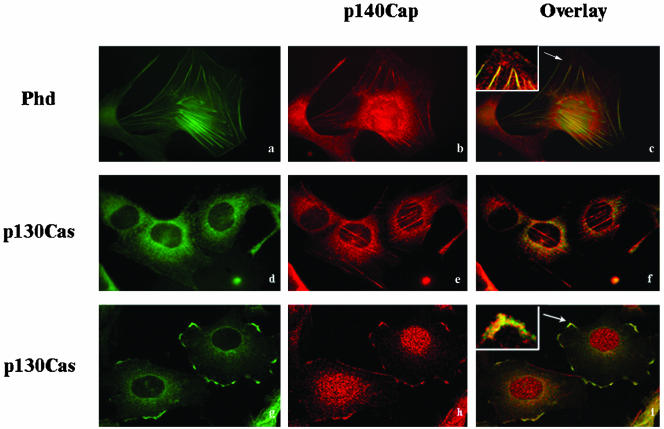
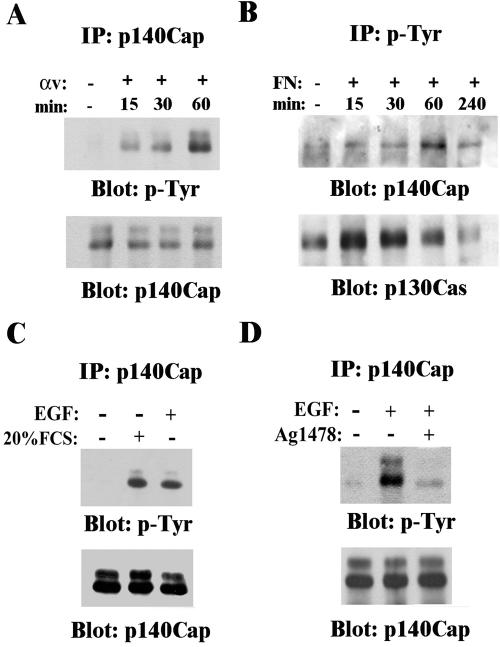
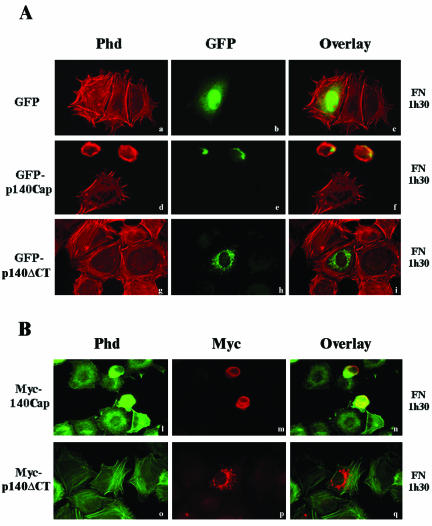
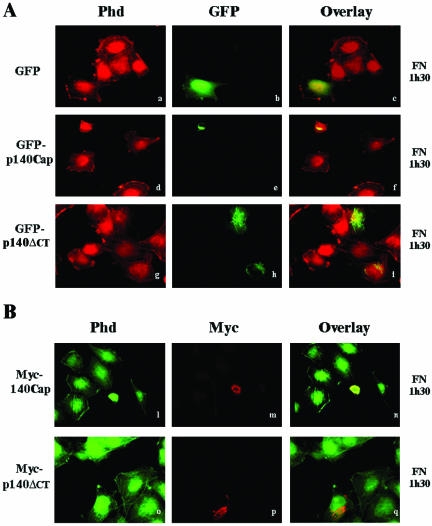
Integrin-mediated cell adhesion stimulates a cascade of signaling pathways that control cell proliferation, migration, and survival, mostly through tyrosine phosphorylation of signaling molecules. p130Cas, originally identified as a major substrate of v-Src, is a scaffold molecule that interacts with several proteins and mediates multiple cellular events after cell adhesion and mitogen treatment. Here, we describe a novel p130Cas-associated protein named p140Cap (Cas-associated protein) as a new tyrosine phosphorylated molecule involved in integrin- and epidermal growth factor (EGF)-dependent signaling. By affinity chromatography of human ECV304 cell extracts on a MBP-p130Cas column followed by mass spectrometry matrix-assisted laser desorption ionization/time of flight analysis, we identified p140Cap as a protein migrating at 140 kDa. We detected its expression in human, mouse, and rat cells and in different mouse tissues. Endogenous and transfected p140Cap proteins coimmunoprecipitate with p130Cas in ECV304 and in human embryonic kidney 293 cells and associate with p130Cas through their carboxy-terminal region. By immunofluorescence analysis, we demonstrated that in ECV304 cells plated on fibronectin, the endogenous p140Cap colocalizes with p130Cas in the perinuclear region as well as in lamellipodia. In addition p140Cap codistributes with cortical actin and actin stress fibers but not with focal adhesions. We also show that p140Cap is tyrosine phosphorylated within 15 min of cell adhesion to integrin ligands. p140Cap tyrosine phosphorylation is also induced in response to EGF through an EGF receptor dependent-mechanism. Interestingly expression of p140Cap in NIH3T3 and in ECV304 cells delays the onset of cell spreading in the early phases of cell adhesion to fibronectin. Therefore, p140Cap is a novel protein associated with p130Cas and actin cytoskeletal structures. Its tyrosine phosphorylation by integrin-mediated adhesion and EGF stimulation and its involvement in cell spreading on matrix proteins suggest that p140Cap plays a role in controlling actin cytoskeleton organization in response to adhesive and growth factor signaling.
Figures
References
-
- Assoian, R.K., and Schwartz, M.A. (2001). Coordinate signaling by integrins and receptor tyrosine kinases in the regulation of G1 phase cell-cycle progression. Curr. Opin. Genet. Dev. 11, 48-53. - PubMed
-
- Astier, A., Avraham, H., Manie, S.N., Groopman, J., Canty, T., Avraham, S., and Freedman, A.S. (1997). The related adhesion focal tyrosine kinase is tyrosine-phosphorylated after beta1-integrin stimulation in B cells and binds to p130cas. J. Biol. Chem. 272, 228-232. - PubMed
-
- Bouton, A.H., Riggins, R.B., and Bruce-Staskal, P.J. (2001). Functions of the adapter protein Cas: signal convergence and the determination of cellular responses. Oncogene 20, 6448-6458. - PubMed
-
- Burridge, K., and Chrzanowska-Wodnicka, M. (1996). Focal adhesions, contractility, and signaling. Annu. Rev. Cell Dev. Biol. 12, 463-518. - PubMed
-
- Casamassima, A., and Rozengurt, E. (1997). Tyrosine phosphorylation of p130(cas) by bombesin, lysophosphatidic acid, phorbol esters, and platelet-derived growth factor. Signaling pathways and formation of a p130(cas)-Crk complex. J. Biol. Chem. 272, 9363-9370. - PubMed
Publication types
MeSH terms
Substances
LinkOut - more resources
Full Text Sources
Other Literature Sources
Molecular Biology Databases
Miscellaneous
