


How much blue light should an IOL transmit?
- PMID: 14660465
- PMCID: PMC1920564
- DOI: 10.1136/bjo.87.12.1523
How much blue light should an IOL transmit?
Abstract
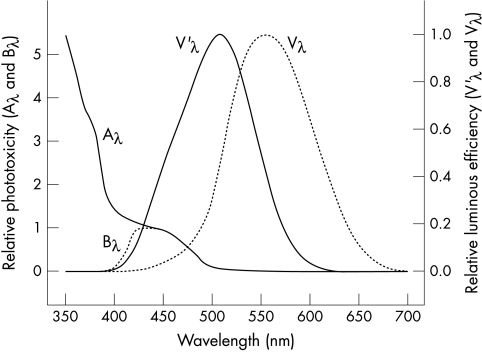
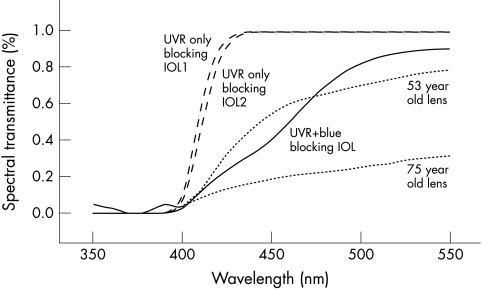
Older, and even some modern, intraocular lenses (IOLs) transmit potentially hazardous ultraviolet radiation (UVR) to the retina. In addition, IOLs transmit more blue and green light to the retina for scotopic vision than the crystalline lenses they replace, light that is also potentially hazardous. The severity of UVR-blue type phototoxicity increases with decreasing wavelength, unlike the action spectrum of blue-green type retinal phototoxicity and the luminous efficiency of scotopic vision which both peak in the blue-green part of the optical spectrum around 500 nm. Theoretically, UVR+blue absorbing IOLs provide better retinal protection but worse scotopic sensitivity than UVR-only absorbing IOLs, but further study is needed to test this analysis. UVR is potentially hazardous and not useful for vision, so it is prudent to protect the retina from it with chromophores in IOLs. Determining authoritatively how much blue light an optimal IOL should block requires definitive studies to determine (1) the action spectrum of the retinal phototoxicity potentially involved in human retinal ageing, and (2) the amount of shorter wavelength blue light required for older adults to perform essential activities in dimly lit environments.
Figures
Comment in
-
Blue light and the circadian clock.Br J Ophthalmol. 2004 Oct;88(10):1353; author reply 1353. doi: 10.1136/bjo.2004.042861/045120. Br J Ophthalmol. 2004. PMID: 15377569 Free PMC article. No abstract available.
References
-
- Ruffolo JJ Jr, Ham WT Jr, Mueller HA, et al. Photochemical lesions in the primate retina under conditions of elevated blood oxygen. Invest Ophthalmol Vis Sci 1984;25:893–8. - PubMed
-
- Crockett RS, Lawwill T. Oxygen dependence of damage by 435 nm light in cultured retinal epithelium. Curr Eye Res 1984;3:209–15. - PubMed
-
- Beatty S, Koh H, Phil M, et al. The role of oxidative stress in the pathogenesis of age-related macular degeneration. Surv Ophthalmol 2000;45:115–34. - PubMed
-
- Robison WG, Kuwabara T, Bieri JG. The roles of vitamin E and unsaturated fatty acids in the visual process. Retina 1982;2:263–81. - PubMed
-
- Marshall J. The ageing retina: physiology or pathology. Eye 1987;1(Pt 2):282–95. - PubMed
Publication types
MeSH terms
Grants and funding
LinkOut - more resources
Full Text Sources
Other Literature Sources
