


Review
doi: 10.1172/JCI20430.
Quorum sensing and biofilm formation in Streptococcal infections
Affiliations
- PMID: 14660736
- PMCID: PMC281653
- DOI: 10.1172/JCI20430
Item in Clipboard
Review
Quorum sensing and biofilm formation in Streptococcal infections
J Clin Invest.
2003 Dec.
Abstract
Members of the bacterial genus Streptococcus are responsible for causing a wide variety of infections in humans. Many Streptococci use quorum-sensing systems to regulate several physiological properties, including the ability to incorporate foreign DNA, tolerate acid, form biofilms, and become virulent. These quorum-sensing systems are primarily made of small soluble signal peptides that are detected by neighboring cells via a histidine kinase/response regulator pair.
Figures
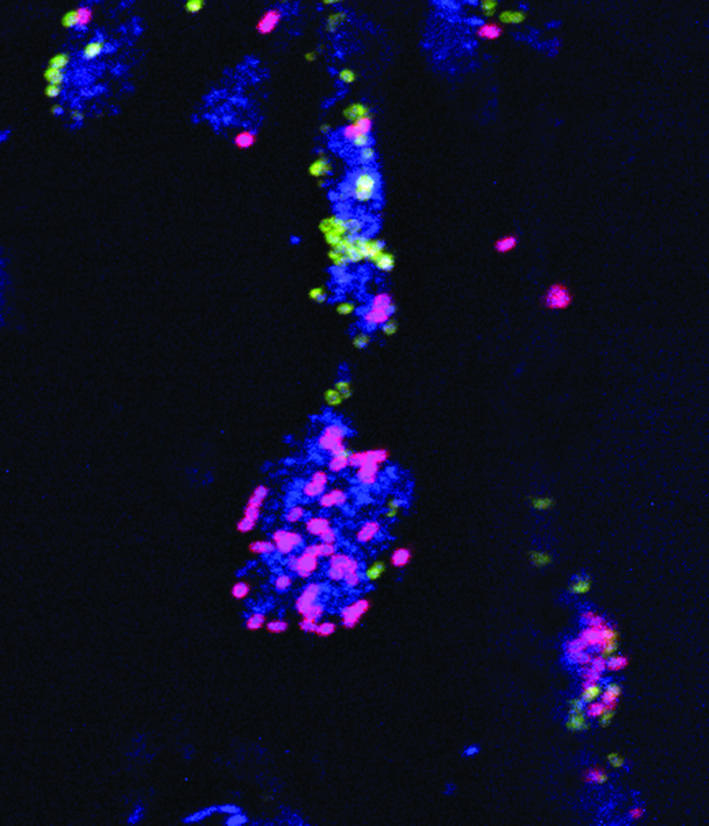
Eight-hour-old dental plaque was visualized using confocal scanning laser microscopy. Antibodies against Streptococcus gordonii DL1 and anti-receptor polysaccharides (RPS), commonly found on Streptococcus oralis, were used for indirect immunofluorescence along with the stain Syto 59. At least two staining types are seen within the aggregates: antibody-reactive (anti-DL1 [green], anti-RPS [purple]) cells found in direct association with antibody-unreactive (blue Syto 59–stained) cells. Single colonies containing all three staining types (anti-DL1, anti-RPS, and antibody unreactive) were frequently seen. Reproduced with permission from The Journal of Bacteriology (2).
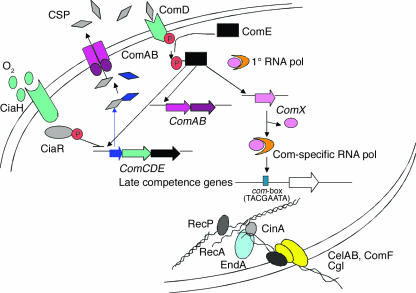
In Streptococcus pneumoniae, the induction of genetic competence (and potentially virulence) is regulated by a CSP–mediated quorum-sensing system (5, 9). Quorum sensing involves the expression of early gene products encoded by two genetic loci, comAB and comCDE. Genes in the operon, comAB, encode an ATP-binding cassette transporter (ComA) and an accessory protein to ComA (ComB). These secretory proteins are involved in the processing and export of the CSP. The loci, comCDE, respectively encode the precursor to the CSP, a histidine kinase that acts as a CSP receptor, and a response regulator that activates both comAB and comCDE operons. A second two-component regulatory system, CiaH-CiaR, affects the development of competence by negatively regulating comCDE expression. Quorum-sensing signals initiate competence through activity of ComX, a global transcription modulator, which was shown to act as an alternate sigma factor (40). This sigma factor initiates the transcription of competence-specific operons involved in DNA uptake and recombination by recognizing a com-box (also referred to as cin-box) consensus sequence (TACGAATA) in their promoter regions (9, 41, 42). Several of these late competence-specific operons include cilA (ssb2), cilB (dal, like dprA in Haemophilus influenzae), cilC (like comC in Bacillus subtilis), cilD (or cglABCDE), cilE (or celAB), coi, cinA-recA, cfl (like comF in B. subtilis), and dpnA of the DpnII restriction system. pol, polymerase; P, phosphate.
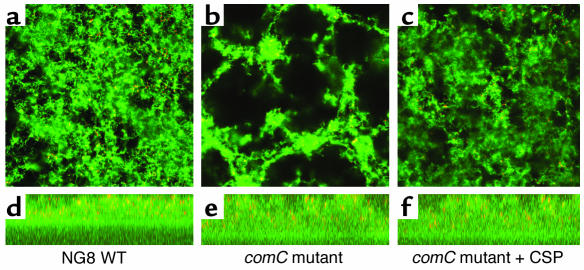
Scanning confocal laser microscope images of 16 h S. mutans biofilms. Panels a–c show the X-Y planes (top view), while the panels d–f show the X-Z planes (side view). The panels illustrate (a, d) a normal biofilm formed by the parent strain NG8 and (b, e) an aberrant biofilm formed by the comC– mutant defective in making a CSP. The wild-type appearance of the biofilm is restored by addition of synthetic CSP (c, f). Reproduced with permission from The Journal of Bacteriology (12).
References
-
- Carlsson J, Soderholm G, Almfeldt I. Prevalence of Streptococcus sanguis and Streptococcus mutans in the mouth of persons wearing full-dentures. Arch. Oral Biol. 1969; 14:243–249. - PubMed
-
- Burne RA. Oral streptococci . . . products of their environment. J. Dent. Res. 1998; 77:445–452. - PubMed
-
- Kleerebezem M, et al. Quorum sensing by peptide pheromones and two-component signal-transduction systems in Gram-positive bacteria. Mol. Microbiol. 1997; 24:895–904. - PubMed
Publication types
MeSH terms
Substances
LinkOut - more resources
Full Text Sources
Other Literature Sources
Medical
