


Comment
doi: 10.1172/JCI20309.
Complement system on the attack in autoimmunity
Affiliations
- PMID: 14660739
- PMCID: PMC281650
- DOI: 10.1172/JCI20309
Item in Clipboard
Comment
Complement system on the attack in autoimmunity
J Clin Invest.
2003 Dec.
Abstract
The antiphospholipid syndrome is characterized clinically by fetal loss and thrombosis and serologically by the presence of autoantibodies to lipid-binding proteins. In a model of this procoagulant condition in which these antibodies are injected into pregnant mice, fetal loss was prevented by blocking of complement activation. Specifically, interaction of complement component 5a (C5a) with its receptor is necessary for thrombosis of placental vasculature. Inhibition of complement activation may have a therapeutic role in this disease.
Figures
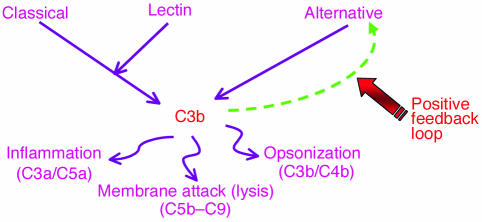
C3b can be deposited on a target by immune complexes that commonly engage the classical pathway, by lectins such as mannose-binding protein that bind to sugars, or through the continuous low-grade turnover of the AP. The deposited C3b serves as a nidus for amplification of C3b deposition via the positive feedback loop. Control of this amplification process is critical to prevent undesirable injury to host cells. The presence of antibodies or lectins on a membrane at a site relatively lacking in membrane regulators is conducive to excessive complement activation on self tissue.
Comment on
-
Complement C5a receptors and neutrophils mediate fetal injury in the antiphospholipid syndrome.J Clin Invest. 2003 Dec;112(11):1644-54. doi: 10.1172/JCI18817. J Clin Invest. 2003. PMID: 14660741 Free PMC article.
References
-
- Silverstein, A.M. 1989. A history of immunology. Academic Press Inc. San Diego, California, USA. 422 pp.
-
- Matsumoto I, Staub A, Benoist C, Mathis D. Arthritis provoked by linked T and B cell recognition of a glycolytic enzyme. Science. 1999; 286:1732–1735. - PubMed
-
- Matsumoto I, et al. How antibodies to a ubiquitous cytoplasmic enzyme may provoke joint-specific autoimmune disease. Nat. Immunol. 2002; 3:360–365. - PubMed
-
- Ji H, et al. Arthritis critically dependent on innate immune system players. Immunity. 2002; 16:157–168. - PubMed
Publication types
MeSH terms
Substances
LinkOut - more resources
Full Text Sources
Other Literature Sources
Medical
