


Genetic Heterogeneity in the rRNA Gene Locus of Trichophyton tonsurans
- PMID: 14662928
- PMCID: PMC309017
- DOI: 10.1128/JCM.41.12.5478-5487.2003
Genetic Heterogeneity in the rRNA Gene Locus of Trichophyton tonsurans
Abstract
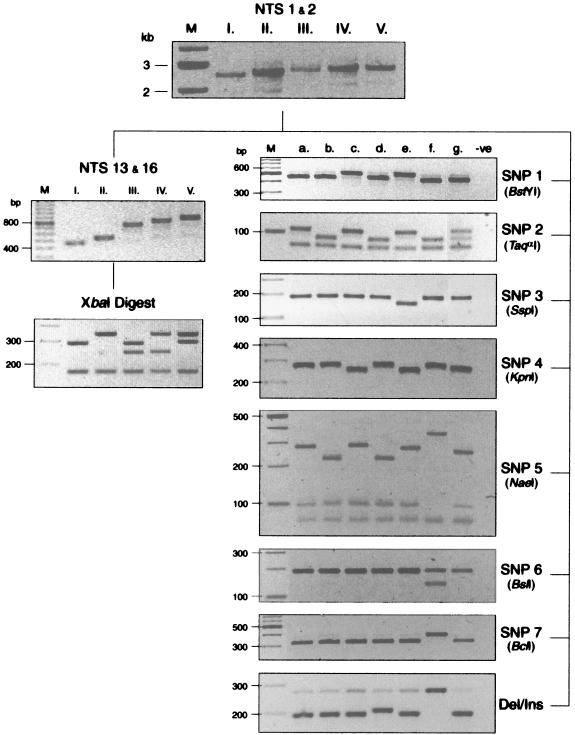
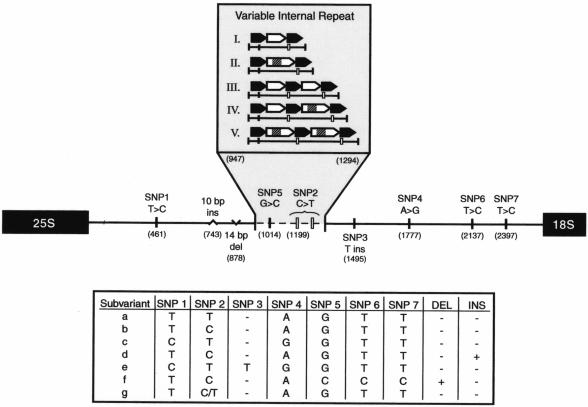
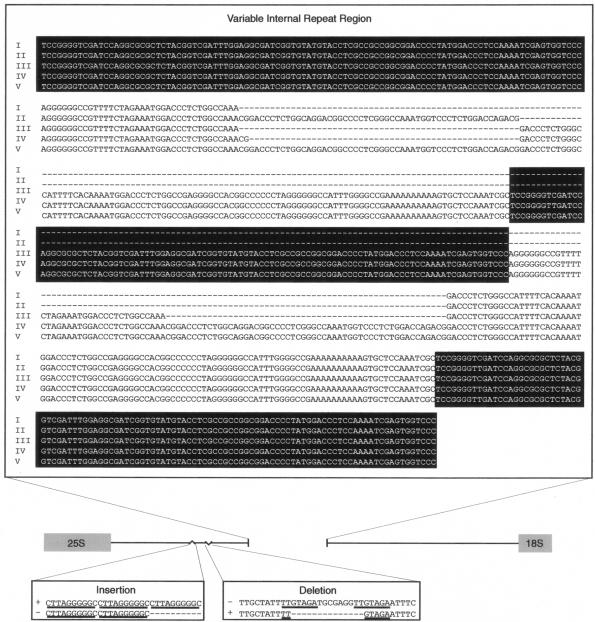
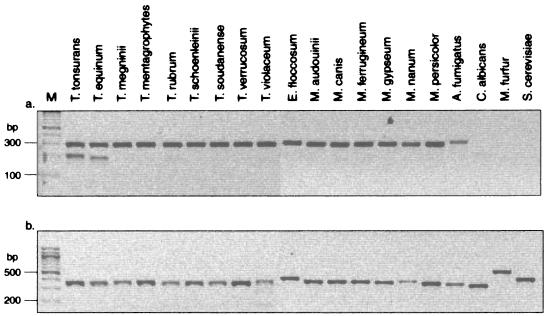
Trichophyton tonsurans is the major pediatric pathogen in tinea capitis, causing disparate disease presentations. Little is known about genetic variation, which may ultimately be linked to divergent disease status. This investigation was aimed at identifying genetic variants of T. tonsurans by methods that can facilitate strain discrimination in population-based studies. Ninety-two isolates were acquired from six U.S. microbiology laboratories, and genomic DNA was isolated from mature colonies. The nontranscribed spacer (NTS) was amplified by PCR, and products from isolates with various amplicon sizes were fully sequenced. Nested amplification, targeting a variable internal repeat (VIR) region, allowed assignment of variant type by fragment size. Subvariant type was assigned by a combination of PCR-restriction fragment length polymorphism-based assays. Five variants differing in size (348 to 700 bp) and sequence were identified within the VIR region comprised of several large repeats (104, 140, and 194 bp) arranged in tandem. Seven single-nucleotide polymorphisms (SNPs) were detected across the NTS, with five occurring in the constant regions flanking the VIR region and two occurring in the VIR region. Additionally, a 10-bp insertion and a 14-bp deletion were identified upstream of the VIR region. The combination of SNPs revealed seven haplotype patterns which were stable upon serial passage over 1 year. No sequence variations were identified within the internal transcribed spacer regions. Unique NTS sequences were utilized to develop a duplex PCR assay that discriminated T. tonsurans from other dermatophytes. Of the 92 isolates evaluated, this genotyping scheme distinguished 12 distinct strains, providing evidence of genetic heterogeneity in T. tonsurans.
Figures
References
-
- Abdel-Rahman, S. M. 2001. Polymorphic exocellular protease expression in clinical isolates of Trichophyton tonsurans. Mycopathologia 150:117-120. - PubMed
-
- Birren B., G. Fink, and E. Lander. 2002. Fungal Genome Initiative: white paper developed by the fungal research community. [Online.] http://www.genome.wi.mit.edu/seq/fgi/FGI_whitepaper_Feb8.pdf. Accessed 30 August 2002.
-
- Davidson, F. D., D. W. R. MacKenzie, and R. J. Owen. 1980. Deoxyribonucleic acid base composition of dermatophytes. J. Gen. Microbiol. 118:465-470. - PubMed
-
- Drake, L. A., S. M. Dinehart, E. R. Farmer, R. W. Goltz, G. F. Graham, M. K. Hardinsky, C. W. Lewis, D. M. Pariser, J. W. Skouge, S. B. Webster, D. C. Whitaker, B. Butler, B. J. Lowery, B. E. Elewski, M. L. Elgart, P. H. Jacobs, J. L. Lesher, Jr., and R. K. Scher. 1996. Guidelines of care for superficial mycotic infections of the skin: tinea corporis, tinea cruris, tinea faciei, tinea manuum, and tinea pedis. J. Am. Acad. Dermatol. 34:282-286. - PubMed
-
- Fuller, L. C., F. C. Child, G. Midgley, and E. M. Higgins. 2003. Scalp ringworm in south-east London and an analysis of a cohort of patients from a paediatric dermatology department. Br. J. Dermatol. 148:985-988. - PubMed
Publication types
MeSH terms
Substances
Grants and funding
LinkOut - more resources
Full Text Sources
Other Literature Sources
Molecular Biology Databases
