


Molecular analysis of Cryptococcus neoformans mitochondrial cytochrome b gene sequences
- PMID: 14662942
- PMCID: PMC308988
- DOI: 10.1128/JCM.41.12.5572-5576.2003
Molecular analysis of Cryptococcus neoformans mitochondrial cytochrome b gene sequences
Abstract
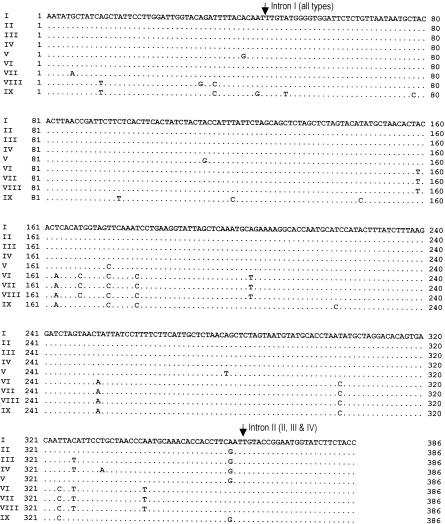
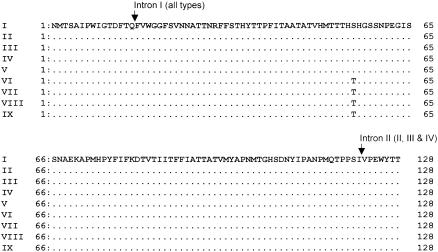
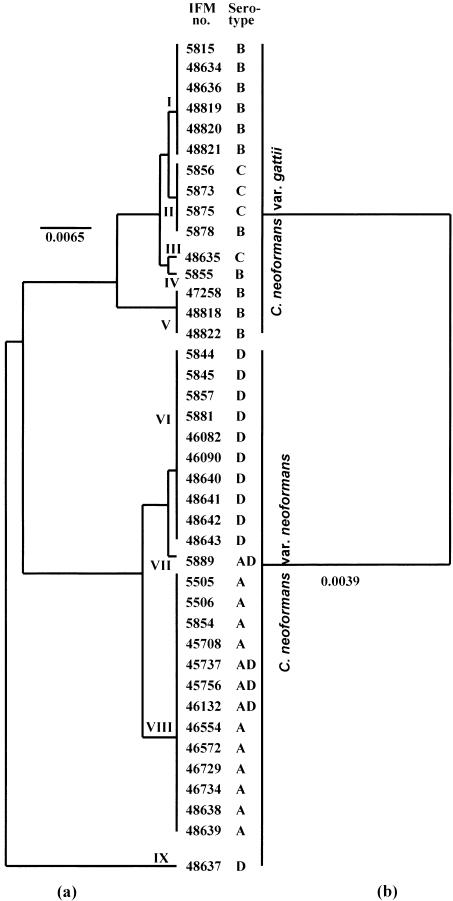
Mitochondrial cytochrome b genes (cyt b) of 40 strains of Cryptococcus neoformans were partially sequenced to determine the genetic relations. With the exception of the type strain of C. neoformans var. neoformans, all strains contained introns in their sequences. Analysis of 386 bp of coding sequence from each strain under investigation revealed a total of 27 (6.99%) variable nucleotide sites and categorized isolates of C. neoformans into nine cyt b types. C. neoformans var. gattii included cyt b types I to V, and C. neoformans var. neoformans comprised types VI to IX. cyt b types were correlated with serotypes. All strains with cyt b types I, IV, and V were serotype B. All other strains except IFM 5878 (serotype B) with cyt b types II and III were serotype C. Serotype D strains had cyt b types VI and IX, and serotype A strains were cyt b type VIII. Of four serotype AD strains, one was cyt b type VII and the remaining three were type VIII. The phylogenetic tree based on deduced amino acid sequences divided the strains only into C. neoformans var. neoformans and C. neoformans var. gattii. These results indicate that cyt b sequences are effective for DNA typing as well as phylogenetic analysis of C. neoformans.
Figures
References
-
- Biswas, S. K., K. Yokoyama, K. Nishimura, and M. Miyaji. 2001. Molecular phylogenetics of the genus Rhodotorula and related basidiomycetous yeasts inferred from the mitochondrial cytochrome b gene. Int. J. Syst. Evol. Microbiol. 51:1191-1199. - PubMed
-
- Chaturvedi, S., B. Rodeghier, J. Fan, C. M. McClelland, B. L. Wickes, and V. Chaturvedi. 2000. Direct PCR of Cryptococcus neoformans MATα and MATa pheromones to determine mating type, ploidy, and variety: a tool for epidemiological and molecular pathogenesis studies. J. Clin. Microbiol. 38:2007-2009. - PMC - PubMed
-
- Diaz, M. R., T. Boekhout, B. Theelen, and J. W. Fell. 2000. Molecular sequence analyses of the intergenic spacer (IGS) associated with rDNA of the two varieties of the pathogenic yeast, Cryptococcus neoformans. Syst. Appl. Microbiol. 23:535-545. - PubMed
-
- Fell, J. W., T. Boekhout, A. Fonseca, G. Scorzetti, and A. Statzell-Tallman. 2000. Biodiversity and systematics of basidiomycetous yeasts as determined by large-subunit rDNA D1/D2 domain sequence analysis. Int. J. Syst. Evol. Microbiol. 50:1351-1371. - PubMed
Publication types
MeSH terms
Substances
LinkOut - more resources
Full Text Sources
Research Materials
