


Case Reports
doi: 10.1128/JCM.41.12.5798-5802.2003.
Extraintestinal pathogenic Escherichia coli as a cause of invasive nonurinary infections
Affiliations
- PMID: 14662987
- PMCID: PMC309005
- DOI: 10.1128/JCM.41.12.5798-5802.2003
Item in Clipboard
Case Reports
Extraintestinal pathogenic Escherichia coli as a cause of invasive nonurinary infections
J Clin Microbiol.
2003 Dec.
Abstract
Multiple Escherichia coli isolates from four adults with extraintestinal infections underwent molecular phylotyping and virulence profiling. A patient with secondary peritonitis had two low-virulence E. coli strains from phylogenetic groups A and D. In contrast, three patients with invasive extraurinary infections (septic arthritis/pyomyositis, nontraumatic meningitis/hematogenous osteomyelitis, and pneumonia) each had a single high-virulence phylogenetic group B2 strain resembling typical isolates causing urinary infection and/or sepsis, i.e., extraintestinal pathogenic E. coli.
Figures
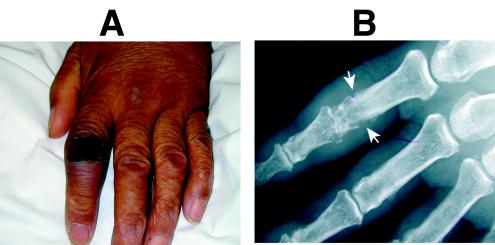
Clinical and radiographic evidence of hematogenous osteomyelitis (case 3). (A) Ecchymosis with associated swelling is evident over the proximal interphalangeal joint of the left index finger. (B) Underlying bony destruction consistent with osteomyelitis is apparent radiographically (white arrows).
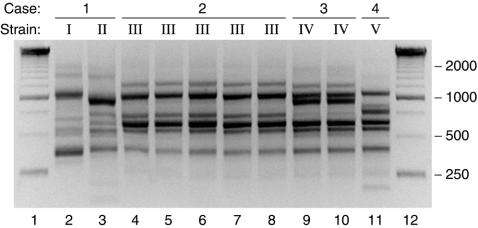
RAPD profiles of 10 Escherichia coli isolates from four patients with serious extraintestinal E. coli infections. Case and strain number are indicated above each sample lane (lanes 2 to 11). Lane numbers are shown at bottom. Lanes 1 and 12, 250-bp ladder.
References
-
- Bauer, R. J., L. Zhang, B. Foxman, A. Siitonen, M. E. Jantunen, H. Saxen, and C. F. Marrs. 2002. Molecular epidemiology of 3 putative virulence genes for Escherichia coli urinary tract infection—usp, iha, and iroNE. coli. J. Infect. Dis. 185:1521-1524. - PubMed
-
- Bertin, Y., C. Martin, J.-P. Girardieu, P. Pohl, and M. Conterpois. 1998. Association of genes encoding P fimbriae, CS31A antigen and EAST 1 toxin among CNF1-producing Escherichia coli strains from cattle with septicemia and diarrhea. FEMS Microbiol. Lett. 162:235-239. - PubMed
-
- Cox, F., and L. Taylor. 1990. Prevention of Escherichia coli K1 bacteremia in newborn mice by using topical vaginal carbohydrates. J. Infect. Dis. 162:978-981. - PubMed
-
- Guyer, D. M., I. R. Henderson, J. P. Nataro, and H. L. T. Mobley. 2000. Identification of Sat, an autotransporter toxin produced by uropathogenic Escherichia coli. Mol. Microbiol. 38:53-56. - PubMed
Publication types
MeSH terms
Substances
Grants and funding
LinkOut - more resources
Full Text Sources
Medical
