


Long term follow up of radiofrequency catheter ablation of atrial flutter: clinical course and predictors of atrial fibrillation occurrence
- PMID: 14676244
- PMCID: PMC1768035
- DOI: 10.1136/heart.90.1.59
Long term follow up of radiofrequency catheter ablation of atrial flutter: clinical course and predictors of atrial fibrillation occurrence
Abstract
Objectives: To evaluate the time to onset and the predictors of atrial fibrillation (AF) during long term follow up of patients with typical atrial flutter (AFL) treated with transisthmic ablation.
Design: Prospective multicentre study.
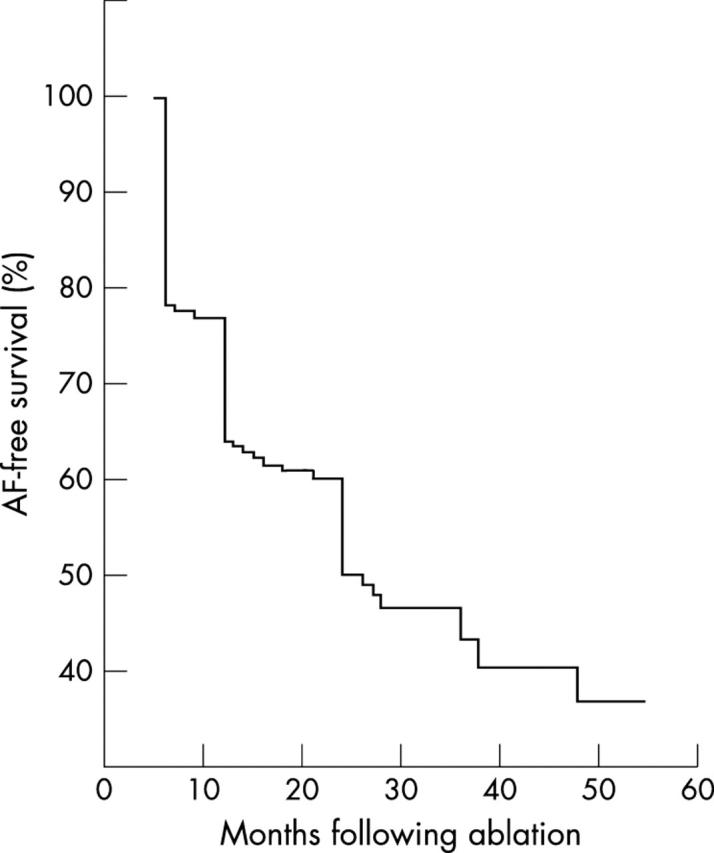
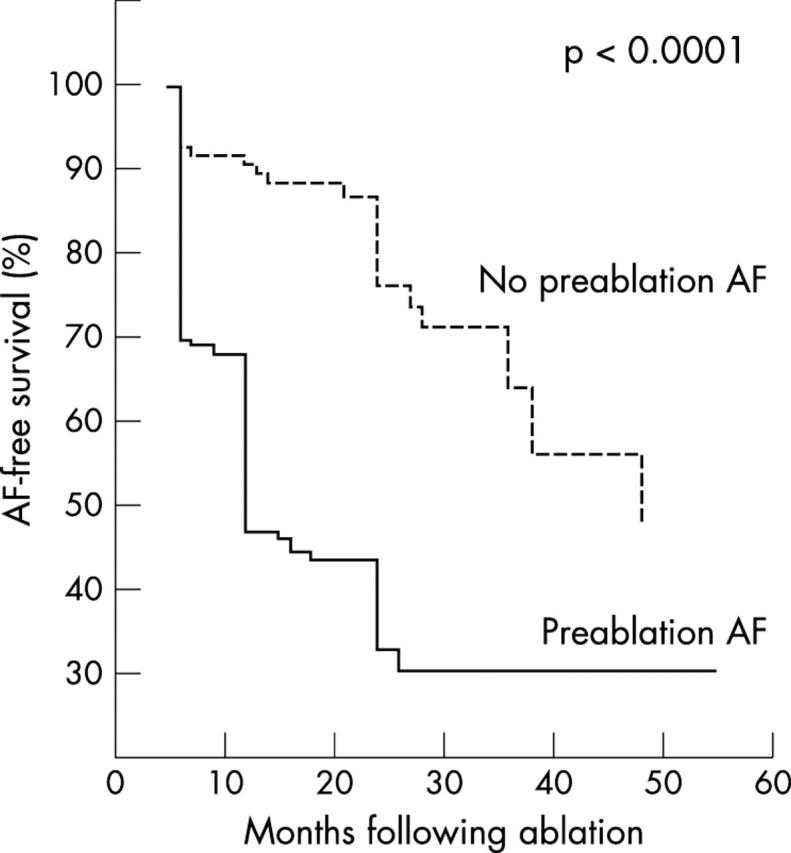
Methods and results: 383 patients (75.4% men, mean (SD) age 61.7 (11.1) years) who underwent transisthmic ablation for typical AFL were investigated. In 239 patients (62.4%) AF was present before ablation. Ablation proved successful in 367 patients (95.8%). During a mean (SD) follow up of 20.5 (12.4) months, 41.5% of patients reported AF. The cumulative probability of postablation AF increased continuously as time passed: it was 22% at six months, 36% at one year, 50% at two years, 58% at three years, and 63% at four years.
Conclusions: AF occurred in a large proportion of patients after transisthmic catheter ablation of typical AFL. The occurrence of AF was progressive during follow up. Preablation AF, age < 65 years, and left atrial size > 50 mm are associated with postablation AF occurrence.
Figures
References
-
- Cosio FG, Lopez-Gil M, Giocolea A, et al. Radiofrequency ablation of the inferior cava-tricuspid valve isthmus in common atrial flutter. Am J Cardiol 1993;71:705–9. - PubMed
-
- Fischer B, Haissaguerre M, Garrigues S, et al. Radiofrequency catheter ablation of common atrial flutter in 80 patients. J Am Coll Cardiol 1995;25:1365–72. - PubMed
-
- Lee SH, Tai CT, Yu WC, et al. Effects of radiofrequency catheter ablation on quality of life in patients with atrial flutter. Am J Cardiol 1999;84:278–83. - PubMed
-
- Natale A, Newby KH, Pisanò E, et al. Prospective randomized comparison of antiarrhythmic therapy versus first-line radiofrequency ablation in patients with atrial flutter. J Am Coll Cardiol 2000;35:1898–904. - PubMed
-
- Poty H, Saoudi N, Aziz AA, et al. Radiofrequency catheter ablation of type 1 atrial flutter: prediction of late success by electrophysiological criteria. Circulation 1995;92:1389–92. - PubMed
Publication types
MeSH terms
LinkOut - more resources
Full Text Sources
Medical
