Long term results of percutaneous balloon valvoplasty of congenital aortic stenosis: independent predictors of outcome
- PMID: 14676248
- PMCID: PMC1768014
- DOI: 10.1136/heart.90.1.70
Long term results of percutaneous balloon valvoplasty of congenital aortic stenosis: independent predictors of outcome
Abstract
Objective: To evaluate long term results and independent predictors of outcome of aortic valvoplasty.
Design: Retrospective follow up study. Independent predictors of outcome identified by multiple logistic regression.
Setting: Tertiary referral centre.
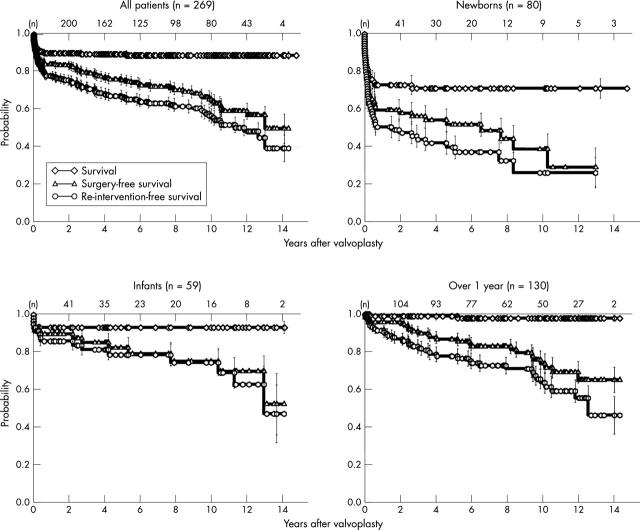
Patients: 269 consecutive patients treated at the median age of 8 months (0-23 years): 80 (30%) under 4 weeks, 59 (22%) between 4 weeks and 1 year, and 130 (48%) over 1 year. The follow up period was up to 14.8 years (median 5.3, in survivors 6.4 years).
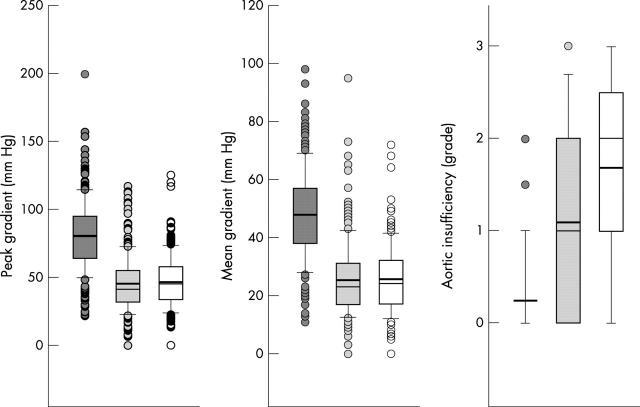
Interventions: Percutaneous balloon valvoplasty with mean (SD) balloon to annulus ratio 0.97 (0.08).
Main outcome measures: Restenosis > or = 70 mm Hg, grade 3 aortic insufficiency, cusps disruption, surgery, death, and valvoplasty failure (significant restenosis or insufficiency or surgery or death).
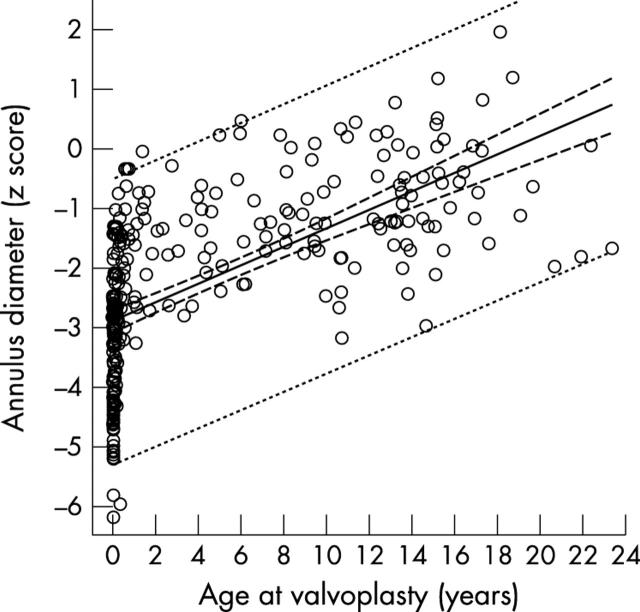
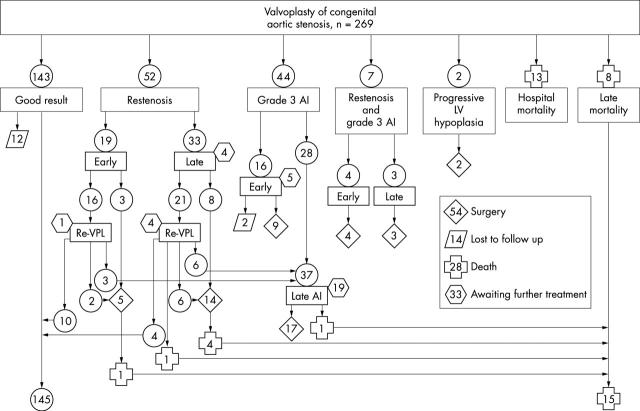
Results: The mortality rate was 10.4% (n = 28), the restenosis rate was 16.7% (n = 45), significant insufficiency developed in 22.3% (n = 60), surgery was needed in 20.1% (n = 54), and "valvoplasty failure" occurred in 41.6% (n = 112) patients. Mean (SEM) survival probability 14.4 years after the procedure was 0.89 (0.02) and mean (SEM) probability of surgery-free survival was 0.50 (0.08). The independent predictors were as follows. For restenosis: small aortic annulus; for cusp disruption: large aortic annulus; for insufficiency: bicuspid aortic valve; for need for surgery: bicuspid aortic valve; for death: small aortic annulus, low left ventricular shortening fraction, and low sequential number of the valvoplasty; and for valvoplasty failure: small aortic annulus, bicuspid aortic valve, and high grade of mitral insufficiency.
Conclusion: Independent predictors of unfavourable outcome are small aortic annulus, bicuspid aortic valve, poor function of left ventricle or mitral valve, and limited operator experience.
Figures
Comment in
-
Management of valvar aortic stenosis in children.Heart. 2004 Jan;90(1):5-6. doi: 10.1136/heart.90.1.5. Heart. 2004. PMID: 14676226 Free PMC article.
References
-
- Lababidi Z. Aortic balloon valvuloplasty. Am Heart J 1983;106:751–2. - PubMed
-
- Lababidi Z, Wu JR, Walls JT. Percutaneous balloon aortic valvuloplasty: results in 23 patients. Am J Cardiol 1984;53:194–7. - PubMed
-
- Lababidi Z, Weinhaus L. Successful balloon valvuloplasty for neonatal critical aortic stenosis. Am Heart J 1986;112:913–6. - PubMed
-
- Rocchini AP, Beekman RH, Ben Shachar G, et al. Balloon aortic valvuloplasty: results of the valvuloplasty and angioplasty of congenital anomalies registry. Am J Cardiol 1990;65:784–9. - PubMed
-
- Galal O, Rao PS, Al Fadley F, et al. Follow-up results of balloon aortic valvuloplasty in children with special reference to causes of late aortic insufficiency. Am Heart J 1997;133:418–27. - PubMed
Publication types
MeSH terms
LinkOut - more resources
Full Text Sources