. 2003 Dec 23;100(26):15724-9.
doi: 10.1073/pnas.2435976100. Epub 2003 Dec 15.

High-resolution yeast phenomics resolves different physiological features in the saline response

Affiliations

High-resolution yeast phenomics resolves different physiological features in the saline response

Jonas Warringer et al. Proc Natl Acad Sci U S A. .

Abstract

We present a methodology for gene functional prediction based on extraction of physiologically relevant growth variables from all viable haploid yeast knockout mutants. This quantitative phenomics approach, here applied to saline cultivation, identified marginal but functionally important phenotypes and allowed the precise determination of time to adapt to an environmental challenge, rate of growth, and efficiency of growth. We identified approximately 500 salt-sensitive gene deletions, the majority of which were previously uncharacterized and displayed salt sensitivity for only one of the three physiological features. We also report a high correlation to protein-protein interaction data; in particular, several salt-sensitive subcellular networks indicating functional modules were revealed. In contrast, no correlation was found between gene dispensability and gene expression. It is proposed that high-resolution phenomics will be instrumental in systemwide descriptions of intragenomic functional networks.


Figures
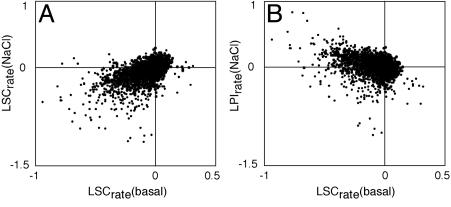
Fig. 1.
Fig. 1.
Scatter plot of quantitative growth defects in basal synthetic medium, LSCrate(basal), versus growth defects in saline medium (A), LSCrate(NaCl), and salt-specific growth defects (B), LPIrate(NaCl).
Fig. 2.
Fig. 2.
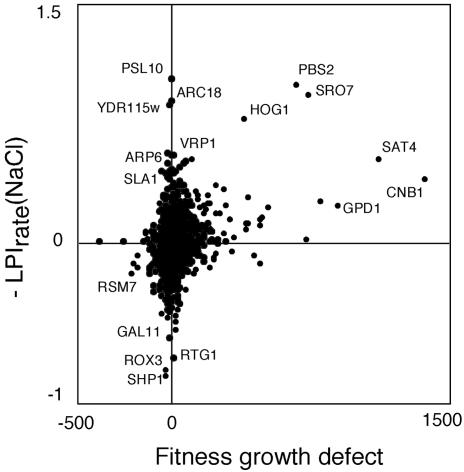
Scatter plot of growth dispensability data (–LPIrate) of strains cultivated individually to strains cultivated in barcoding competition experiments [fitness growth defect after 15 generations; average of two samples (1)]. To allow direct comparison, resistant strains from the barcoding experiment were assigned a negative sign.
Fig. 3.
Fig. 3.
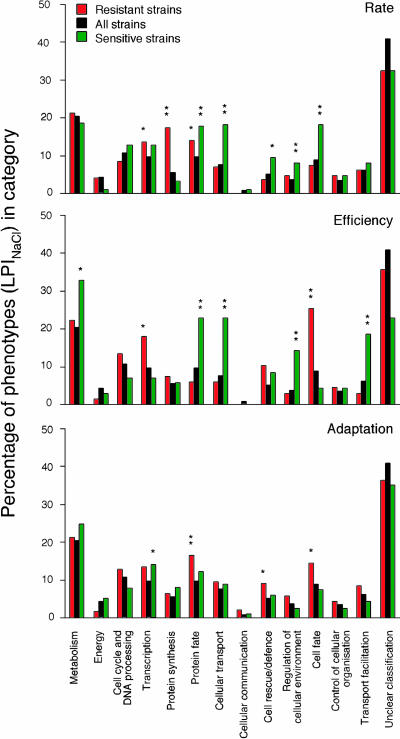
Distribution of genes in functional classes within a category of significant (α < 0.001) salt-specific phenotypes (LPI) compared to the distribution within the complete set of strains: rate resistance (271 strains), rate sensitivity (210 strains), stationary phase resistance (67 strains), stationary phase sensitivity (65 strains), adaptation time resistance (172 strains), and adaptation time sensitivity (285 strains). For lists of significant strains, see Supporting Materials and Methods. Functional classifications were taken from MIPS. *, Significant deviation in distribution (α < 0.025); **, highly significant deviation in distribution (α < 0.00125) from the complete set of strains.
Fig. 4.
Fig. 4.
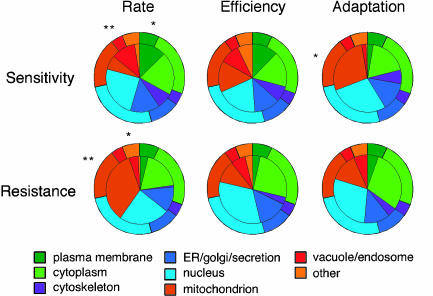
Subcellular localization of genes with significant (α < 0.001) salt-specific phenotypes. The outer pie chart indicates the subcellular distribution of all strains. The inner pie chart indicates the distribution of strains within the specified category (e.g., rate sensitivity). Subcellular distributions were taken from MIPS. *, Significant deviation in distribution (α < 0.025); **, highly significant deviation in distribution (α < 0.00125) from the complete set of strains.
Fig. 5.
Fig. 5.
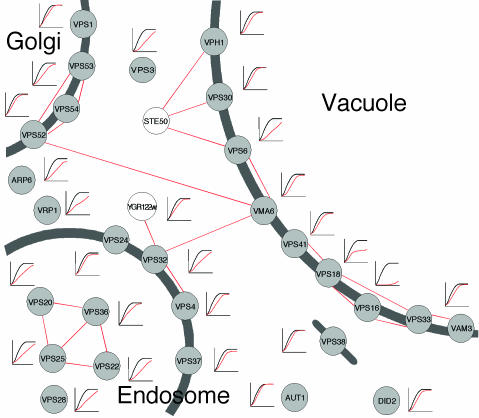
Physical interactions, subcellular localization, and salt growth of genes involved in protein targeting to the vacuole. Red lines indicate reported physical interactions (–25). Growth curves of genes exhibiting significant sensitivity (α < 0.001) to salt for at least one growth variable are displayed on logarithmic scale (OD = 0.05–5.0) over 47 h. Red curves indicate deletion strains and black curves indicate a representative reference strain. Gray circles represent genes earlier classified as involved in the targeting of proteins to the vacuole. Subcellular localizations were taken from the Saccharomyces Genome Database (http://genome-www.stanford.edu/Saccharomyces). Genes with unknown subcellular localization are shown as cytosolic.
Fig. 6.
Fig. 6.
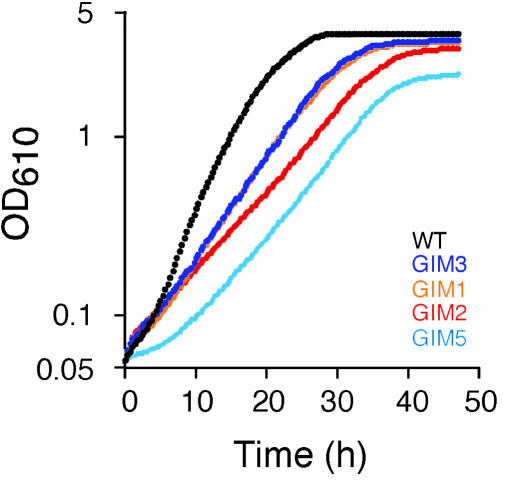
Salt growth of strains deleted for genes in the gim complex as determined by 142 automated measurements of cell density. The salt sensitivity of gim4Δ was not significantly different from the wild type and is not displayed.
Fig. 7.
Fig. 7.
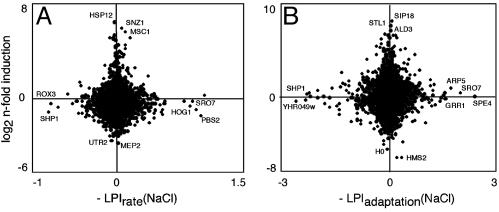
Quantitative comparison of salt phenotypes (–LPI) displayed by strains cultivated in isolation to expression profiling data. (A) Steady-state rate of growth salt phenotype versus steady-state salt induction (average of five samples; H. Alipour, E.E., T. Ferea, P. Mostad, J. Norbeck, O.N., and A.B., unpublished work). (B) Adaptation-time salt phenotype versus adaptation-phase salt induction at 60 min [average of two samples (19)]. Correlation to adaptation-phase salt-induction data at 15, 30, 45, and 120 min was investigated in a similar manner (data not shown). No correlation was found.

References

    1. Giaever, G., Chu, A. M., Ni, L., Connelly, C., Riles, L., Veronneau, S., Dow, S., Lucau-Danila, A., Anderson, K., Andre, B., et al. (2002) Nature 418, 387–391. - PubMed
    1. Kamath, R. S., Fraser, A. G., Dong, Y., Poulin, G., Durbin, R., Gotta, M., Kanapin, A., Le Bot, N., Moreno, S., Sohrmann, M., et al. (2003) Nature 421, 231–237. - PubMed
    1. Gerlai, R. (2002) Trends Neurosci. 25, 506–509. - PubMed
    1. Bennett, C. B., Lewis, L. K., Karthikeyan, G., Lobachev, K. S., Jin, Y. H., Sterling, J. F., Snipe, J. R. & Resnick, M. A. (2001) Nat. Genet. 29, 426–434. - PubMed
    1. Birrell, G. W., Giaever, G., Chu, A. M., Davis, R. W. & Brown, J. M. (2001) Proc. Natl. Acad. Sci. USA 98, 12608–12613. - PMC - PubMed

Publication types

Substances