. 2003 Dec 23;100(26):15416-21.
doi: 10.1073/pnas.2136683100. Epub 2003 Dec 15.

A tenascin-C aptamer identified by tumor cell SELEX: systematic evolution of ligands by exponential enrichment

Affiliations

A tenascin-C aptamer identified by tumor cell SELEX: systematic evolution of ligands by exponential enrichment

Dion A Daniels et al. Proc Natl Acad Sci U S A. .

Abstract

The targeting of molecular repertoires to complex systems rather than biochemically pure entities is an accessible approach that can identify proteins of biological interest. We have probed antigens presented by a monolayer of tumor cells for their ability to interact with a pool of aptamers. A glioblastoma-derived cell line, U251, was used as the target for systematic evolution of ligands by exponential enrichment by using a single-stranded DNA library. We isolated specifically interacting oligonucleotides, and biochemical strategies were used to identify the protein target for one of the aptamers. Here we characterize the interaction of the DNA aptamer, GBI-10, with tenascin-C, an extracellular protein found in the tumor matrix. Tenascin-C is believed to be involved in both embryogenesis and oncogenesis pathways. Systematic evolution of ligands by exponential enrichment appears to be a successful strategy for the a priori identification of targets of biological interest within complex systems.


Figures
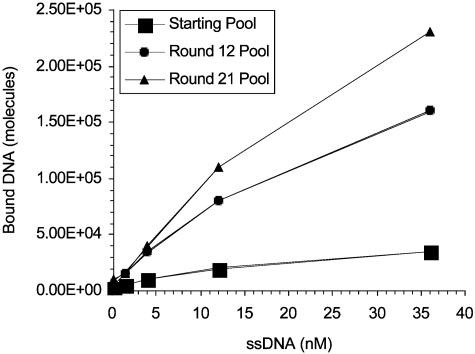
Fig. 1.
Fig. 1.
Relative cell binding of U251-evolved SELEX pools. SELEX pools from round 21, round 12, and the starting round were assayed for binding to U251 cells.
Fig. 2.
Fig. 2.
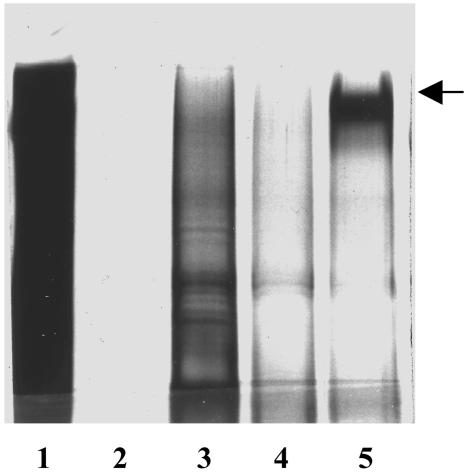
A GBI-10 affinity matrix reveals a high-molecular-weight protein target. Shown are silver-stained gels depicting proteins affinity-purified by GBI-10 (lane 5), Scb10-1 (lane 3), Scb10-2 (lane 4), and beads alone (lane 2) from U251 membrane extracts (lane 1).
Fig. 3.
Fig. 3.
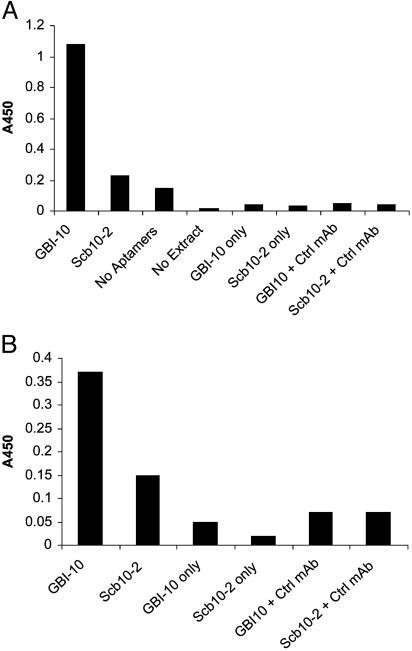
ELISA analysis of the tenascin–GBI-10 interaction. (A) The interaction of GBI-10 and Scb10-2 with tenascin derived from cell-surface extract. Biotinylated aptamers were adsorbed to a streptavidin surface, incubated with U251 cell extract, washed, and further incubated with anti-tenascin mAb 1923 and a secondary peroxidase-conjugated antibody. (B) The interaction of pure tenascin with GBI-10 and Scb10-2. Anti-tenascin monoclonal antibody mAb 1911 was adsorbed to the surface, and then purified tenascin was captured by the adsorbed antibody. Biotinylated oligonucleotides were then incubated with the surface, followed by washing and detection with a peroxidase-conjugated streptavidin.
Fig. 4.
Fig. 4.
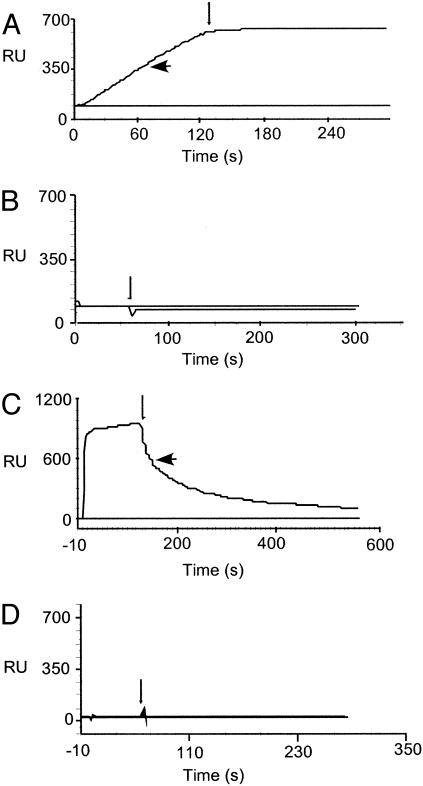
Biosensor analysis of the tenascin–GBI-10 interaction. Binding of tenascin-C and subdomains of tenascin-C to aptamer GBI-10 is shown. Biotinylated GBI-10 (large arrow) or a scrambled-sequence control aptamer, Scb10-2 (no arrow), was bound to a streptavidin-coupled carboxyl methlyl dextran surface. Proteins were passed over the surface at the indicated concentration, followed by buffer only (small arrow). (A) TN-C (50 nM). (B) TNfbg (200 nM). (C) TNfn3–5 (200 nM). (D) TNfnA-D (200 nM). Responses to the control aptamer Scb10-2, always <100 response units, were subtracted from responses to GBI-10, generating the flat lines observed for Scb10-2 in AD.

References

    1. Janda, K. D. (1994) Proc. Natl. Acad. Sci. USA 91, 10779–10785. - PMC - PubMed
    1. Gold, L. (1995) Harvey Lect. 91, 47–57. - PubMed
    1. Gold, L., Polisky, B., Uhlenbeck, O. & Yarus, M. (1995) Annu. Rev. Biochem. 64, 763–797. - PubMed
    1. Cwirla, S. E., Peters, E. A., Barrett, R. W. & Dower, W. J. (1990) Proc. Natl. Acad. Sci. USA 87, 6378–6382. - PMC - PubMed
    1. Scott, J. K. & Smith, G. P. (1990) Science 249, 386–390. - PubMed

Publication types

LinkOut - more resources