


Comment
doi: 10.1073/pnas.0307282100.
Epub 2003 Dec 15.
Another twist in the transforming growth factor beta-induced cell-cycle arrest chronicle
Affiliations
- PMID: 14676328
- PMCID: PMC307558
- DOI: 10.1073/pnas.0307282100
Item in Clipboard
Comment
Another twist in the transforming growth factor beta-induced cell-cycle arrest chronicle
Proc Natl Acad Sci U S A.
.
No abstract available
Figures
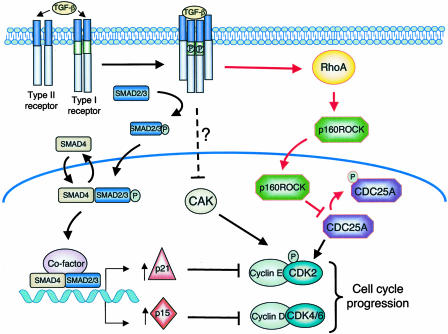
TGF-β signaling pathway. TGF-β binding to the type II receptor results in phosphorylation and activation of the type I receptor. The activated type I receptor then phosphorylates the receptor-associated SMADs (SMAD 2/3) that promote dimer or trimer formation with SMAD4 followed by nuclear translocation. SMAD complexes, in collaboration with cofactors, modulate transcription of TGF-β target genes. Induction of cell-cycle arrest by TGF-β involves transcription of CDK inhibitors p15INK4b and p21CIP1. p15INK4b specifically inhibits CDK4/6, whereas p21CIP1 inhibits cyclin E–CDK2 complexes. The inhibited cyclin–CDK complexes can drive progression of the cell cycle for a longer time. Activation of CDK2 requires phosphorylation of its Thr-160 residue by CAK and removal of inhibitory phosphates on Thr-14 and Tyr-15 by Cdc25A phosphatase. The new pathway proposed by Bhowmick et al. (6) involves TGF-β activation of the RhoA/p160ROCK signaling pathway. By an undefined mechanism, TGF-β activates RhoA and causes the translocation of p160ROCK to the nucleus, where it phosphorylates and inactivates Cdc25A and thereby prevents activation of CDK2.
Comment on
-
TGF-beta-induced RhoA and p160ROCK activation is involved in the inhibition of Cdc25A with resultant cell-cycle arrest.Proc Natl Acad Sci U S A. 2003 Dec 23;100(26):15548-53. doi: 10.1073/pnas.2536483100. Epub 2003 Dec 1. Proc Natl Acad Sci U S A. 2003. PMID: 14657354 Free PMC article.
References
-
- Siegel, P. M. & Massague, J. (2003) Nat. Rev. Cancer 3, 807–820. - PubMed
-
- Waite, K. A. & Eng, C. (2003) Nat. Rev. Genet. 4, 763–773. - PubMed
-
- Walker, R. A. & Dearing, S. J. (1992) Eur. J. Cancer 28, 641–644. - PubMed
-
- Koskinen, P. J., Sistonen, L., Bravo, R. & Alitalo, K. (1991) Growth Factors 5, 283–293. - PubMed
Publication types
MeSH terms
Substances
LinkOut - more resources
Full Text Sources
Other Literature Sources
