


. 2004 Jan 1;32(Database issue):D339-43.
doi: 10.1093/nar/gkh007.
GeneDB: a resource for prokaryotic and eukaryotic organisms
Affiliations
- PMID: 14681429
- PMCID: PMC308742
- DOI: 10.1093/nar/gkh007
Item in Clipboard
GeneDB: a resource for prokaryotic and eukaryotic organisms
Nucleic Acids Res.
.
Abstract
GeneDB (http://www.genedb.org/) is a genome database for prokaryotic and eukaryotic organisms. The resource provides a portal through which data generated by the Pathogen Sequencing Unit at the Wellcome Trust Sanger Institute and other collaborating sequencing centres can be made publicly available. It combines data from finished and ongoing genome and expressed sequence tag (EST) projects with curated annotation, that can be searched, sorted and downloaded, using a single web based resource. The current release stores 11 datasets of which six are curated and maintained by biologists, who review and incorporate information from the scientific literature, public databases and the respective research communities.
Figures
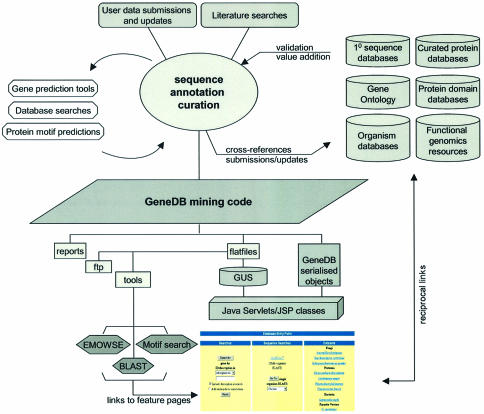
Analysis pipelines complemented by user-feedback, information gained from the literature and other public resources, generate data for GeneDB. Data are parsed through the mining code and serialized in binary files as well as stored in the GUS relational database (see accompanying text for further information).
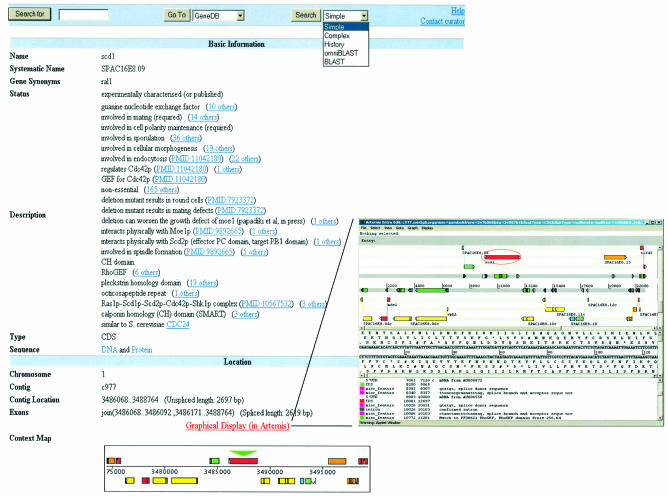
The upper half of the S.pombe scd1 GeneDB feature page (http://www.genedb.org/genedb/Search?name=SPAC16E8.09&organism=pombe ). Tools, a glossary and a feedback form, inviting comments and updates on a particular gene’s annotation, are accessible via the navigation bar. During the curation process, statements, extracted from public resources and the research community, are captured in structured syntax, referenced to the relevant database. Additional sequence features and annotation can be viewed in Artemis, accessible via the link above the gene neighbourhood map.
References
-
- Rice P., Longden,I. and Bleasby,A. (2000) EMBOSS: the European Molecular Biology Open Software Suite. Trends Genet., 16, 276–277. - PubMed
-
- Nielsen H. and Krogh,A. (1998) Prediction of signal peptides and signal anchors by a hidden Markov model. Proc. Int. Conf. Intell. Syst. Mol. Biol., 6, 122–130. - PubMed
-
- Sonnhammer E.L., von Heijne,G. and Krogh,A. (1998) A hidden Markov model for predicting transmembrane helices in protein sequences. Proc. Int. Conf. Intell. Syst. Mol. Biol., 6, 175–182. - PubMed
-
- Rutherford K., Parkhill,J., Crook,J., Horsnell,T., Rice,P., Rajandream,M.A. and Barrell,B. (2000) Artemis: sequence visualization and annotation. Bioinformatics, 16, 944–945. - PubMed
Publication types
MeSH terms
Grants and funding
LinkOut - more resources
Full Text Sources
Research Materials
