. 2004 Jan 1;32(Database issue):D383-7.
doi: 10.1093/nar/gkh001.

The Rice PIPELINE: a unification tool for plant functional genomics

Affiliations

The Rice PIPELINE: a unification tool for plant functional genomics

Junshi Yazaki et al. Nucleic Acids Res. .

Abstract

The Rice Genome Research Project in Japan performs genome sequencing and comprehensive expression profiling, constructs genetic and physical maps, collects full-length cDNAs and generates mutant lines, all aimed at improving the breeding of the rice plant as a food source. The National Institute of Agrobiological Sciences in Tsukuba, Japan, has accumulated numerous rice biological resources and has already successfully produced a high-quality genome sequence, a high-density genetic map with 3000 markers, 30,000 full-length cDNAs, over 700 expression profiles with a 9000 cDNA microarray and 15,000 flanking sequences with Tos17 insertions in about 3765 mutant lines from about 50,000 transposon insertion lines. These resources are available in the public domain. A new unification tool for functional genomics, called Rice PIPELINE, has also been developed for the dynamic collection and compilation of genomics data (genome sequences, full-length cDNAs, gene expression profiles, mutant lines, cis elements) from various databases. The mission of Rice PIPELINE is to provide a unique scientific resource that pools publicly available rice genomic data for search by clone sequence, clone name, GenBank accession number, or keyword. The web-based form of Rice PIPELINE is available at http://cdna01.dna.affrc.go.jp/PIPE/.


Figures
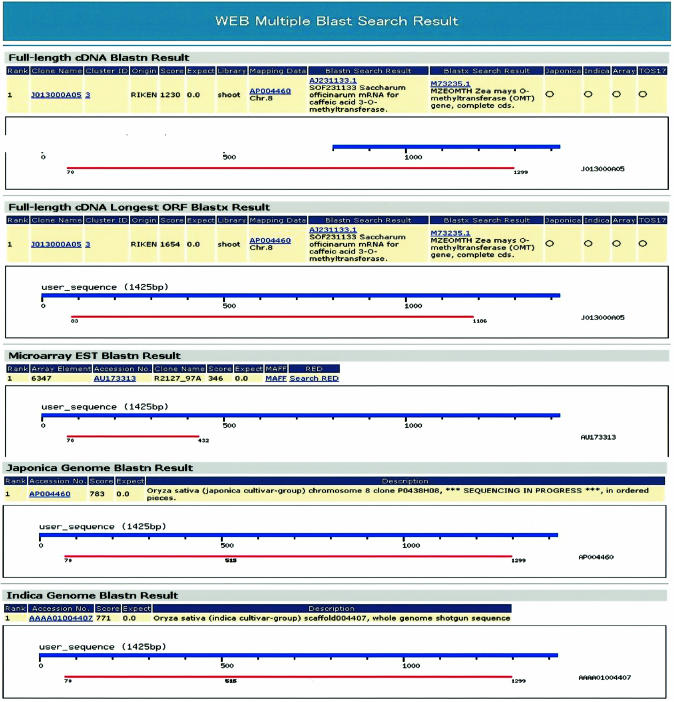
Figure 1
Figure 1
On-screen appearance of the results of a Rice PIPELINE search. The top two parts show the results of a query to the full-length cDNA database, KOME. The clone name is linked with KOME by the details of its full-length cDNA. The mapping data and BLASTN and BLASTX search results are directly linked with the GenBank report. The items at the right end of the result (‘Japonica’, ‘Indica’, ‘Array’ and ‘Tos17’) relate the full-length cDNA data to information on genome sequence, microarray ESTs and flanking sequence in the Tos17 mutant line. The next major item down shows the results of a microarray search of 8987 EST clones. The accession is directly linked with the GenBank report, and MAFF is directly linked with the DNA Bank Rice Database (MAFF DNA Bank: see URL in Table 1). A search of RED is also possible. The two major items at the bottom show the results of a query of the indica and japonica genome sequences. The accession corresponding to the japonica genome BLASTN result is linked with genetic and physical map information on the INE Database. The accession corresponding to the indica genome BLASTN result is linked with the GenBank report. Each alignment map shows the match between the query and result sequences. The red bar in each result sequence is linked with the KOME report, INE information, the MAFF DNA Bank report and the GenBank report.
Figure 2
Figure 2
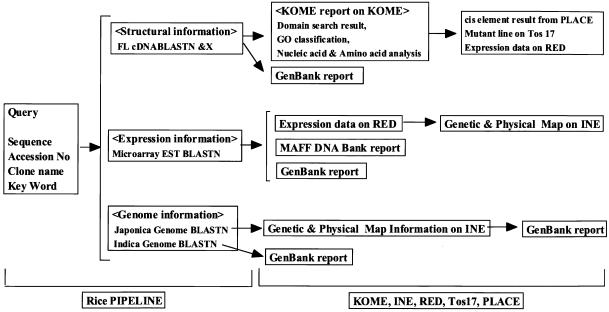
Flow of information in Rice PIPELINE. The top pathway shows the flow of gene structural information from the query. Users can obtain a GenBank report and a KOME report containing nucleic acid and amino acid analyses, domain search results and GO classification from Rice PIPELINE. They can also obtain information on cis-element motifs, phenotypes with flanking sequences, and expression profiles via the KOME report. The middle pathway shows the flow of gene expression information from the query. Users can obtain a GenBank report, a MAFF DNA Bank report, and an expression profile from Rice PIPELINE. Additionally, they can use genetic and physical map information on an INE link with RED. The bottom pathway shows the flow of genome information from BLAST results. Users can utilize map information, including genome sequences, from a PIPELINE search of the japonica genome. The map information of INE is directly linked with the GenBank report. Users can also obtain a GenBank report from the results of a PIPELINE search of the indica genome.

References

    1. Kikuchi S., Satoh,K., Nagata,T., Kawagashira,N., Doi,K., Kishimoto,N., Yazaki,J., Ishikawa,M., Ooka,H., Kojima,K. et al. (2003) Collection, mapping, and annotation of over 28,000 cDNA clones from japonica rice. Science, 301, 376–379. - PubMed
    1. Yazaki J., Kishimoto,N., Ishikawa,M. and Kikuchi,S. (2002) Rice Expression Database: the gateway to rice functional genomics. Trends Plant Sci., 7, 563–564.
    1. Sakata K., Antonio,B.A., Mukai,Y., Nagasaki,H., Sakai,Y., Makino,K. and Sasaki,T. (2000) INE: a rice genome database with an integrated map view. Nucleic Acids Res., 28, 97–102. - PMC - PubMed
    1. Okazaki Y., Furuno,M., Kasukawa,T., Adachi,J., Bono,H., Kondo,S., Nikaido,I., Osato,N., Saito,R. and Suzuki,H. (2002) Analysis of the mouse transcriptome based on functional annotation of 60 770 full-length cDNAs. Nature, 420, 563–573. - PubMed
    1. Harris T.W., Lee,R., Schwarz,E., Bradnam,K., Lawson,D., Chen,W., Blasier,D., Kenny,E., Cunningham,F., Kishore,R. et al. (2003) WormBase: a cross-species database for comparative genomics. Nucleic Acids Res., 31, 133–137. - PMC - PubMed

Publication types

Substances