


BRENDA, the enzyme database: updates and major new developments
- PMID: 14681450
- PMCID: PMC308815
- DOI: 10.1093/nar/gkh081
BRENDA, the enzyme database: updates and major new developments
Abstract
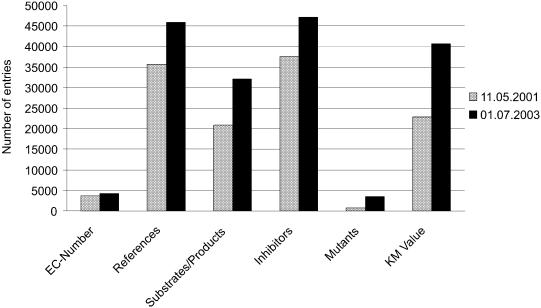
BRENDA (BRaunschweig ENzyme DAtabase) represents a comprehensive collection of enzyme and metabolic information, based on primary literature. The database contains data from at least 83,000 different enzymes from 9800 different organisms, classified in approximately 4200 EC numbers. BRENDA includes biochemical and molecular information on classification and nomenclature, reaction and specificity, functional parameters, occurrence, enzyme structure, application, engineering, stability, disease, isolation and preparation, links and literature references. The data are extracted and evaluated from approximately 46,000 references, which are linked to PubMed as long as the reference is cited in PubMed. In the past year BRENDA has undergone major changes including a large increase in updating speed with >50% of all data updated in 2002 or in the first half of 2003, the development of a new EC-tree browser, a taxonomy-tree browser, a chemical substructure search engine for ligand structure, the development of controlled vocabulary, an ontology for some information fields and a thesaurus for ligand names. The database is accessible free of charge to the academic community at http://www.brenda. uni-koeln.de.
Figures
References
-
- Schomburg D. and Schomburg,I. (2001) Springer Handbook of Enzymes. 2nd edn. Springer, Heidelberg, Germany.
-
- Webb E.C., NC-IUBMB. (1992) Enzyme Nomenclature: Recommendations of the Nomenclature Committee of the International Union of Biochemistry and Molecular Biology on the Nomenclature and Classification of Enzymes. Academic Press, New York, NY.
-
- Ridley D.D. (2002) SciFinder and SciFinder Scholar. J. Wiley & Sons, New York, NY.
MeSH terms
Substances
LinkOut - more resources
Full Text Sources
Other Literature Sources
Miscellaneous
