


ORFDB: an information resource linking scientific content to a high-quality Open Reading Frame (ORF) collection
- PMID: 14681490
- PMCID: PMC314203
- DOI: 10.1093/nar/gkh118
ORFDB: an information resource linking scientific content to a high-quality Open Reading Frame (ORF) collection
Abstract
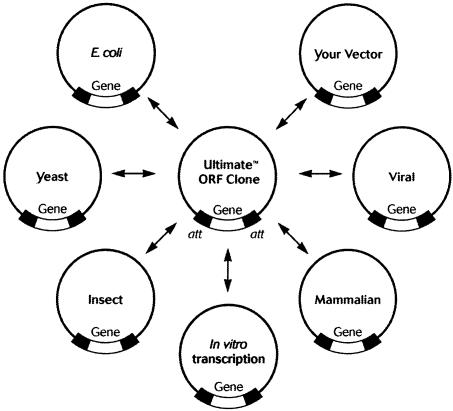
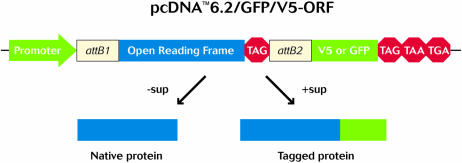
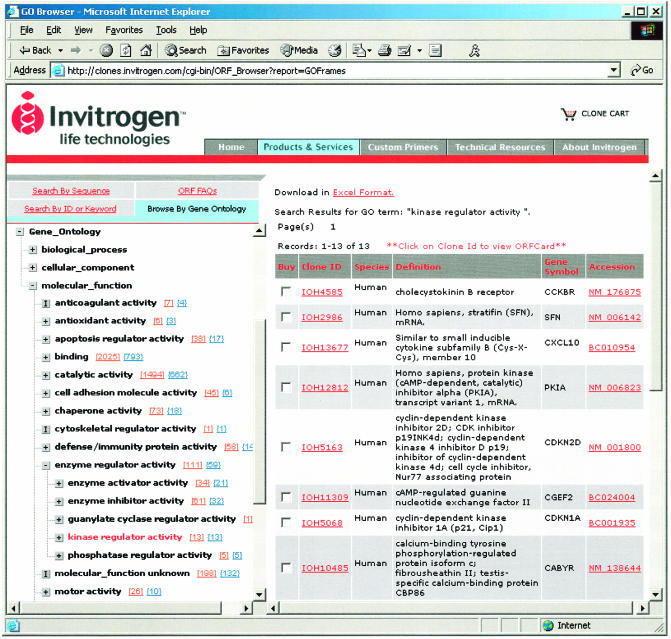
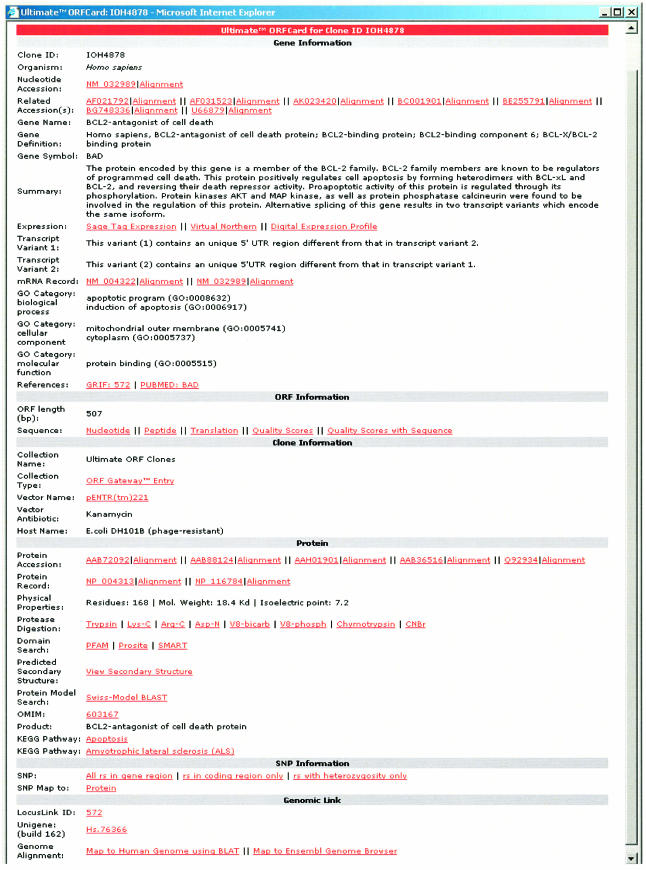
The ORFDB (http://orf.invitrogen.com/) represents an ongoing effort at Invitrogen Corporation to integrate relevant scientific data with an evolving collection of human and mouse Open Reading Frame (ORF) clones (Ultimate ORF Clones). The ORFDB serves as a central data warehouse enabling researchers to search the ORF collection through its web portal ORFBrowser, allowing researchers to find the Ultimate ORF clones by blast, keyword, GenBank accession, gene symbol, clone ID, Unigene ID, LocusLink ID or through functional relationships by browsing the collection via the Gene Ontology (GO) Browser. As of October 2003, the ORFDB contains 6200 human and 2870 mouse Ultimate ORF clones. All Ultimate ORF clones have been fully sequenced with high quality, and are matched to public reference protein sequences. In addition, the cloned ORFs have been extensively annotated across six categories: Gene, ORF, Clone Format, Protein, SNP and Genomic links, with the information assembled in a format termed the ORFCard. The ORFCard represents an information repository that documents the sequence quality, alignment with respect to public protein sequences, and the latest publicly available information associated with each human and mouse gene represented in the collection.
Figures
References
-
- Phizicky E., Bastiaens,P.I.H., Zhu,H., Snyder,M. and Fields,S. (2003) Protein analysis on a proteomic scale. Nature, 422, 208–215. - PubMed
-
- Tyers M. and Mann,M. (2003) From genomics to proteimics. Nature, 422, 193–195. - PubMed
-
- Boone C. and Andrews,B. (2003) ORFeomics: correcting the wiggle in worm genes. Nature Genet., 34, 8–9. - PubMed
-
- Zhu H., Bilgin,M., Bangham,R., Hall,D., Casamayor,A., Bertone,P., Lan,N., Jansen,R., Bidlingmaier,S., Houfek,T. et al. (2001) Global analysis of protein activities using proteome chips. Science, 293, 2101–2105. - PubMed
-
- MacBeath G. and Schreiber,S.L. (2000) Printing proteins as microarrays for high-throughput function determination. Science, 289, 1760–1763. - PubMed
Publication types
MeSH terms
Substances
LinkOut - more resources
Full Text Sources
Research Materials
