Comparative Study
. 2004 Jan;74(1):83-92.
doi: 10.1086/381039. Epub 2003 Dec 16.

Antisense-induced multiexon skipping for Duchenne muscular dystrophy makes more sense

Affiliations
Comparative Study

Antisense-induced multiexon skipping for Duchenne muscular dystrophy makes more sense

Annemieke Aartsma-Rus et al. Am J Hum Genet. 2004 Jan.

Abstract

Dystrophin deficiency, which leads to severe and progressive muscle degeneration in patients with Duchenne muscular dystrophy (DMD), is caused by frameshifting mutations in the dystrophin gene. A relatively new therapeutic strategy is based on antisense oligonucleotides (AONs) that induce the specific skipping of a single exon, such that the reading frame is restored. This allows the synthesis of a largely functional dystrophin, associated with a milder Becker muscular dystrophy phenotype. We have previously successfully targeted 20 different DMD exons that would, theoretically, be beneficial for >75% of all patients. To further enlarge this proportion, we here studied the feasibility of double and multiexon skipping. Using a combination of AONs, double skipping of exon 43 and 44 was induced, and dystrophin synthesis was restored in myotubes from one patient affected by a nonsense mutation in exon 43. For another patient, with an exon 46-50 deletion, the therapeutic double skipping of exon 45 and 51 was achieved. Remarkably, in control myotubes, the latter combination of AONs caused the skipping of the entire stretch of exons from 45 through 51. This in-frame multiexon skipping would be therapeutic for a series of patients carrying different DMD-causing mutations. In fact, we here demonstrate its feasibility in myotubes from a patient with an exon 48-50 deletion. The application of multiexon skipping may provide a more uniform methodology for a larger group of patients with DMD.


Figures
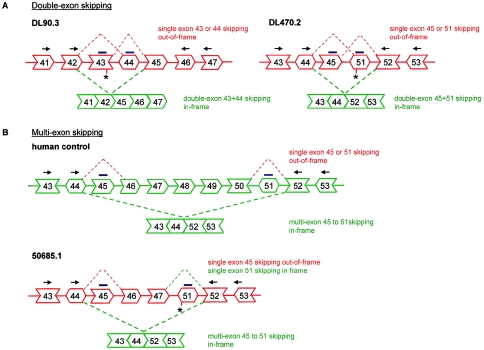
Figure  1
Figure 1
Schematic overview of double and multiexon skipping in three patients with and one human control. AONs are indicated by blue lines. Primers for RT-PCR analysis are indicated by arrows. A, Patient DL90.3 has a nonsense mutation in exon 43 (indicated by an asterisk). The resulting out-of-frame transcript is indicated in red. In contrast to single-exon skipping of exon 43 or 44, double-exon skipping of both exons restores the reading frame (in-frame transcript indicated in green). When myotubes derived from this patient are targeted by AONs specific for exons 43 and 44, single-exon skipping of exon 43 and exon 44 (indicated by red dotted lines) can be expected in addition to the anticipated double-exon skipping. Patient DL470.2 carries an exon 46–50 deletion, which results in a frameshift and a stop codon in exon 51. Single-exon skipping of exon 45 or exon 51 is not frame restoring, whereas double-exon skipping of both exons 45 and 51 is. B, Multiexon skipping of exons 45–51 preserves the reading frame in a control transcript (individual KM109). Patient 50685.1 has a deletion of exons 48–50, resulting in a stop codon in exon 51. Multiexon skipping of exons 45, 46, 47, and 51 restores the reading frame for this patient. In addition to the skipping of exons 45–51, single-exon skipping of exon 45 and exon 51 can also be expected.
Figure  2
Figure 2
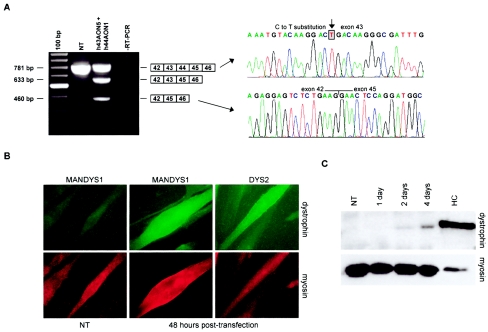
Double-exon skipping in patient DL90.3, who carries a nonsense mutation in the out-of-frame exon 43. A, RT-PCR analysis of dystrophin mRNA fragments in AON-treated myotube cultures showed a shorter, novel transcript not present in nontransfected (NT) myotube cultures. Sequence analysis confirmed the precise skipping of both exon 43 and exon 44. Along with the double skip, we also detected a single skip of exon 44 but not a single-exon skip of exon 43. Note that weak additional fragments, slightly shorter than the wild-type products, were present. These were derived from heteroduplex formation. 100 bp = size marker; RT-PCR = negative control. B, Immunohistochemical analysis of the AON-treated myotube cultures. Cells were stained for myosin to identify fully differentiated myotubes (lower panel). Monoclonal antibodies MANDYS1 and Dys2 were used to detect dystrophin 2 d after transfection. No dystrophin signals could be detected in untreated cells stained with MANDYS1 (left panel) or Dys2 (not shown), whereas clear dystrophin signals could be detected in treated cells for both dystrophin antibodies. Magnification × 63. C, Western blot analysis of the AON-treated myotube cultures. The monoclonal antibody Dys1 was used to detect dystrophin. Protein extracts isolated from MyoD-transduced human control (HC) fibroblasts were used as a positive control. To avoid overexposure, this sample was diluted 1:5. To confirm equal loading of protein samples, blots were additionally stained with an antibody against myosin. No dystrophin was detected in NT myotube cultures. Clear dystrophin signals were observed in AON-treated myotube cultures after 2 d, which were increased at 4 d.
Figure  3
Figure 3
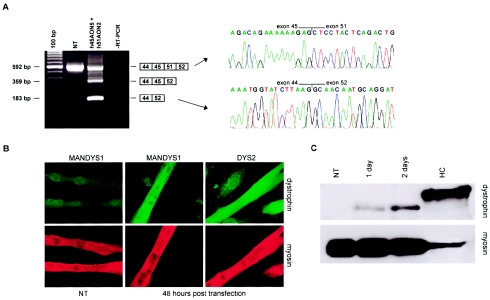
Double-exon skipping in patient DL470.2, who carries a deletion of exons 46–50. A, RT-PCR analysis of dystrophin mRNA fragments of AON-treated myotube cultures showed a shorter, novel transcript not present in NT myotube cultures. The precise skipping of both exon 45 and exon 51 was confirmed by sequence analysis. Along with the double skip, we also detected a single skip of exon 51 but no single skip of exon 45. Because of heteroduplex formation, we observed weak additional fragments, slightly shorter than the wild-type products. 100 bp = size marker; RT-PCR = negative control. B, Immunohistochemical analysis of the AON-treated myotube cultures. Cells were stained for myosin to identify fully differentiated myotubes (lower panel). Monoclonal antibodies MANDYS1 and Dys2 were used to detect dystrophin 2 d after transfection. In treated cells, clear dystrophin signals could be detected for both antibodies, in contrast to untreated cells stained with MANDYS1 (left panel) or Dys2 (not shown). Magnification × 63. C, Western blot analysis of the AON-treated myotube cultures. Monoclonal antibody Dys1 was used to detect dystrophin. Protein extracts isolated from human control myotubes were used as a positive control, which was diluted 1:10 to avoid overexposure. Blots were additionally stained with an antibody against myosin to confirm equal loading of all samples. No dystrophin was detected in NT myotube cultures, whereas clear dystrophin signals were observed in AON-treated myotube cultures after 1 d, which increased after 2 d. Note that the dystrophin from patient DL470.2 is shorter than the control dystrophin. This correlates with the size of the deletion.
Figure  4
Figure 4
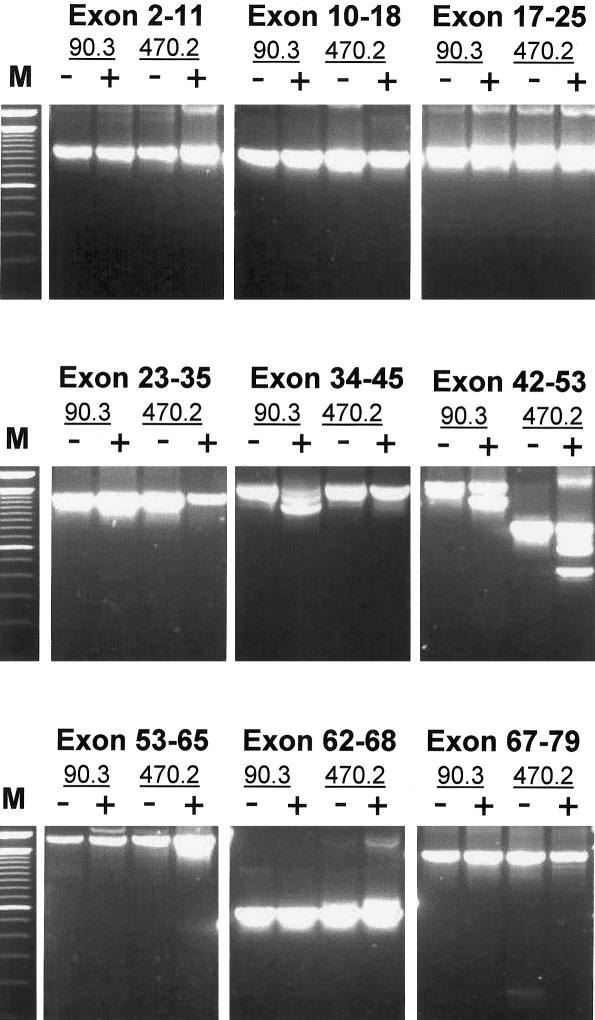
RT-PCR analysis of the entire DMD transcript from RNA, isolated from untreated (−) and treated (+) myotubes from both patients. The anticipated specific-exon skipping patterns are present in the fragments containing exons 34–45 (patient DL90.3) and 42–53 (patients DL90.3 and DL470.2). Note that because of the deletion of exons 46–50, the wild-type fragment for this patient is shorter than that of patient DL90.3. No unexpected splicing anomalies were detected in other parts of the DMD gene, confirming the sequence specificity of the AONs. “M” is the 100-bp size marker.
Figure  5
Figure 5
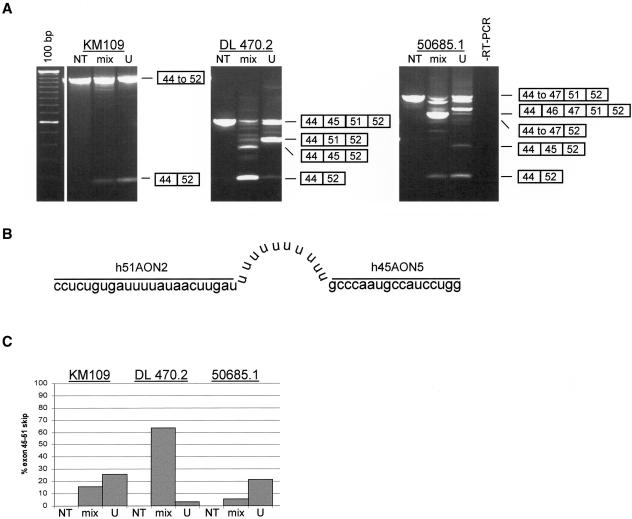
Double and multiexon skipping in myotubes from the human control (individual KM109) and from patients DL470.2 (deletion of exons 46–50) and 50685.1 (deletion of exons 48–50). A, RT-PCR analysis of dystrophin mRNA fragments in myotube cultures treated with either a mixture of h45AON5 and h51AON2 (mix) or a U-linked combination of these AONs (U). In all samples treated with either the mixture of AONs or the U-linked AON, a shorter transcript fragment was detected that contained exon 44 precisely spliced to exon 52 (confirmed by sequence analysis; data not shown). This was not present in NT myotubes. The novel in-frame transcript arose from double-exon skipping in patient DL470.2 (the targeted exons 45 and 51 are flanking the deletion), but in both the control and patient 50685.1 the transcript was a result of multiexon skipping. Also observed were additional shorter fragments, which were caused by single-exon skipping (exon 45 or 51) or partial multiexon skipping (exons 46–51). Note that in some lanes, other fragments, slightly shorter than the wild-type products, were present. This was a result of heteroduplex formation. 100 bp = size marker; RT-PCR = negative control. B, Schematic drawing of the U-linked AON. The exon 51–specific AON (h51AON2) is linked to the exon 45–specific AON (h45AON5) by 10 uracil nucleotides. C, All fragments were quantified using the DNA 1000 LabChip and the Bioanalyzer (Agilent). The percentage of double or multiexon skipping of exons 45–51 was determined by the ratio of this fragment to the total of transcript fragments. In contrast to patient DL470.2, the U-linked AON was more efficient for patients KM109 and 50685.1, when compared to the mixture of individual AONs.

References

Electronic-Database Information

    1. Online Mendelian Inheritance in Man (OMIM), http://www.ncbi.nlm.nih.gov/Omim/ (for DMD and BMD)

References

    1. Aartsma-Rus A, Bremmer-Bout M, Janson A, den Dunnen J, van Ommen G, van Deutekom J (2002) Targeted exon skipping as a potential gene correction therapy for Duchenne muscular dystrophy. Neuromuscul Disord 12:S71 10.1016/S0960-8966(02)00086-X - DOI - PubMed
    1. Aartsma-Rus A, Janson AA, Kaman WE, Bremmer-Bout M, den Dunnen JT, Baas F, Van Ommen GJ, et al (2003) Therapeutic antisense-induced exon skipping in cultured muscle cells from six different DMD patients. Hum Mol Genet 12:907–914 10.1093/hmg/ddg100 - DOI - PubMed
    1. Bertoni C, Lau C, Rando TA (2003) Restoration of dystrophin expression in mdx muscle cells by chimeraplast-mediated exon skipping. Hum Mol Genet 12:1087–1099 10.1093/hmg/ddg133 - DOI - PubMed
    1. Buratti E, Baralle FE, Pagani F (2003) Can a “patch” in a skipped exon make the pre-mRNA splicing machine run better? Trends Mol Med 9:229–232 10.1016/S1471-4914(03)00072-8 - DOI - PubMed
    1. Cartegni L, Chew SL, Krainer AR (2002) Listening to silence and understanding nonsense: exonic mutations that affect splicing. Nat Rev Genet 3:285–298 10.1038/nrg775 - DOI - PubMed

Publication types

MeSH terms