


Intraocular pressure associations with refractive error and axial length in children
- PMID: 14693759
- PMCID: PMC1771921
- DOI: 10.1136/bjo.88.1.5
Intraocular pressure associations with refractive error and axial length in children
Abstract
Aim: To assess whether intraocular pressure (IOP) is associated with refractive error or axial length in children.
Methods: Of subjects from the Singapore Cohort Study of the Risk Factors for Myopia (SCORM), 636 Chinese children aged 9-11 years from two elementary schools underwent non-contact tonometry, cycloplegic autorefraction, and A-scan biometry during 2001. For analyses, refractive error was categorised into four groups; hypermetropia (spherical equivalent refraction (SE) > or = +1.0D), emmetropia (-0.5D<SE< +1.0D), low myopia (-3.0D<SE< or = -0.5D) and high myopia (SE< or = -3.0D).
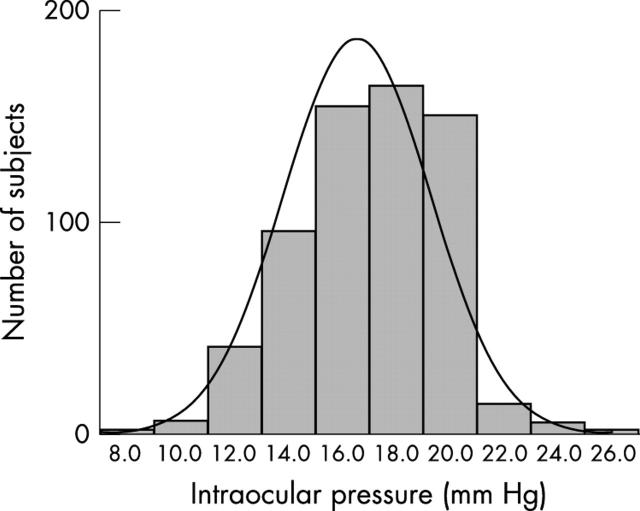
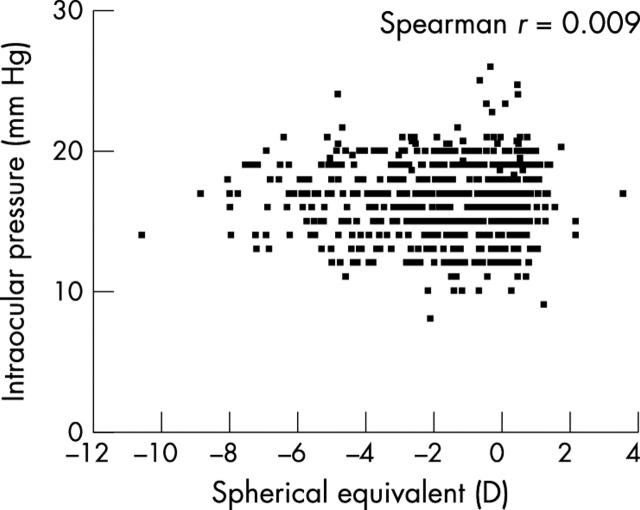
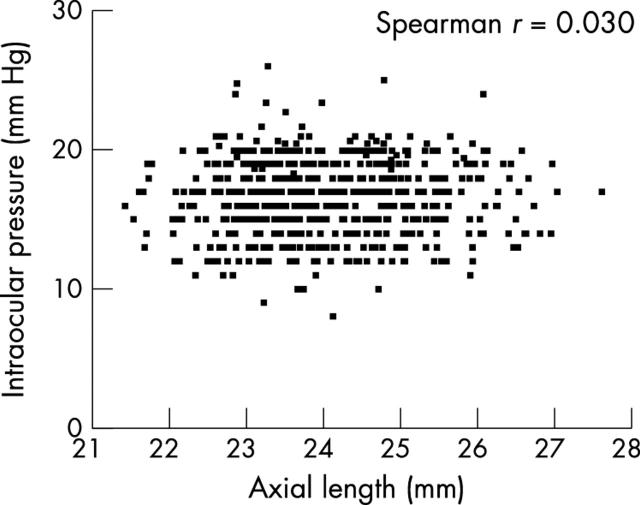
Results: Of the 636 children examined, 50.6% were male. The mean IOP was 16.6 (SD 2.7) mm Hg. There were no significant IOP differences between low (mean IOP = 16.4 (2.8) mm Hg) or high myopes (16.7 (2.5) mm Hg) and emmetropes (16.7 (2.9) mm Hg), p = 0.57. IOP was not correlated with spherical equivalent refraction (Spearman correlation, r = 0.009) or axial length (r = 0.030). In regression analyses adjusting for diastolic blood pressure, neither spherical equivalent (regression coefficient = 0.014) nor axial length (regression coefficient = 0.027) were significantly associated with IOP.
Conclusion: These findings do not support an association between IOP and refractive error or axial length in children. This questions postulated roles of IOP in the pathogenesis of myopia.
Figures
Comment in
-
Refining the aetiology of myopia through negative results.Br J Ophthalmol. 2004 Jan;88(1):1. doi: 10.1136/bjo.88.1.1. Br J Ophthalmol. 2004. PMID: 14693757 Free PMC article. No abstract available.
References
-
- Saw SM, Katz J, Schein OD, et al. Epidemiology of myopia. Epidemiol Rev 1996;18:175–87. - PubMed
-
- Pruett RC. Progressive myopia and intraocular pressure: what is the linkage? A literature review. Acta Ophthalmol Suppl 1988;185:117–27. - PubMed
-
- Edwards MH, Brown B. Intraocular pressure in a selected sample of myopic and non-myopic Chinese children. Optom Vis Sci 1993;70:15–17. - PubMed
-
- Quinn GE, Berlin JA, Young TL, et al. Association of intraocular pressure and myopia in children. Ophthalmology 1995;102:180–5. - PubMed
-
- Jensen H. Myopia progression in young school children and intraocular pressure. Doc Ophthalmol 1992;82:249–55. - PubMed
Publication types
MeSH terms
LinkOut - more resources
Full Text Sources
Medical
