


Increasing the amphiphilicity of an amyloidogenic peptide changes the beta-sheet structure in the fibrils from antiparallel to parallel
- PMID: 14695285
- PMCID: PMC1303808
- DOI: 10.1016/S0006-3495(04)74119-3
Increasing the amphiphilicity of an amyloidogenic peptide changes the beta-sheet structure in the fibrils from antiparallel to parallel
Abstract
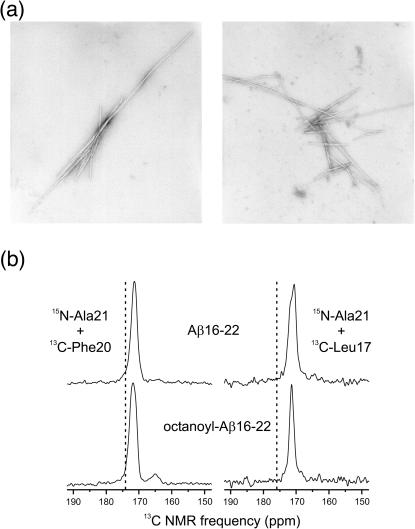
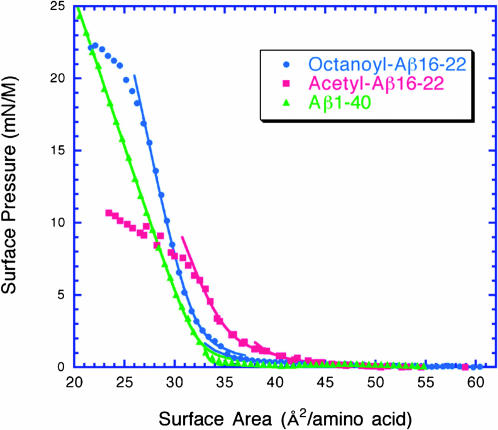
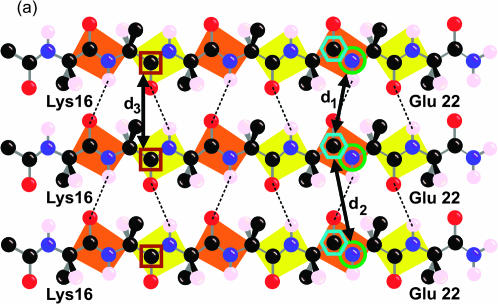
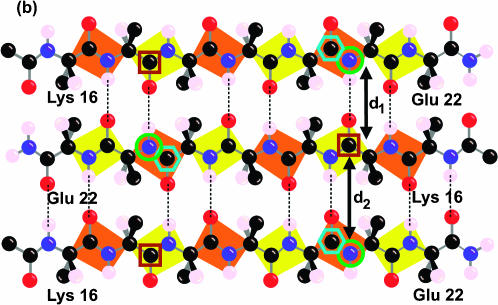
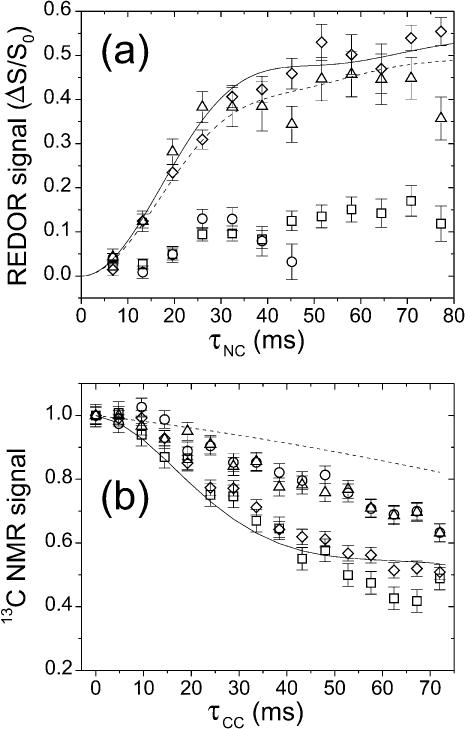
Solid-state NMR measurements have been reported for four peptides derived from beta-amyloid peptide Abeta(1-42): Abeta(1-40), Abeta(10-35), Abeta(16-22), and Abeta(34-42). Of these, the first two are predicted to be amphiphilic and were reported to form parallel beta-sheets, whereas the latter two peptides appear nonamphiphilic and adopt an antiparallel beta-sheet organization. These results suggest that amphiphilicity may be significant in determining fibril structure. Here, we demonstrate that acylation of Abeta(16-22) with octanoic acid increases its amphiphilicity and changes the organization of fibrillar beta-sheet from antiparallel to parallel. Electron microscopy, Congo Red binding, and one-dimensional 13C NMR measurements demonstrate that octanoyl-Abeta(16-22) forms typical amyloid fibrils. Based on the stability of monolayers at the air-water interface, octanoyl-Abeta(16-22) is more amphiphilic than Abeta(16-22). Measurements of 13C-13C and 15N-13C nuclear magnetic dipole-dipole couplings in isotopically labeled fibril samples, using the constant-time finite-pulse radiofrequency-driven recoupling (fpRFDR-CT) and rotational echo double resonance (REDOR) solid-state NMR techniques, demonstrate that octanoyl-Abeta(16-22) fibrils are composed of parallel beta-sheets, whereas Abeta(16-22) fibrils are composed of antiparallel beta-sheets. These data demonstrate that amphiphilicity is critical in determining the structural organization of beta-sheets in the amyloid fibril. This work also shows that all amyloid fibrils do not share a common supramolecular structure, and suggests a method for controlling the structure of amyloid fibrils.
Figures
Comment in
-
Sorting out the driving forces for parallel and antiparallel alignment in the abeta peptide fibril structure.Biophys J. 2004 Jan;86(1 Pt 1):1-2. doi: 10.1016/s0006-3495(04)74077-1. Biophys J. 2004. PMID: 14695243 Free PMC article. No abstract available.
References
-
- Aggeli, A., M. Bell, N. Boden, J. N. Keen, P. F. Knowles, T. C. McLeish, M. Pitkeathly, and S. E. Radford. 1997. Responsive gels formed by the spontaneous self-assembly of peptides into polymeric β-sheet tapes. Nature. 386:259–262. - PubMed
-
- Anderson, R. C., T. Gullion, J. M. Joers, M. Shapiro, E. B. Villhauer, and H. P. Weber. 1995. Conformation of [1-13C,15N]acetyl-L-carnitine. Rotational-echo double resonance nuclear magnetic resonance spectroscopy. J. Am. Chem. Soc. 117:10546–10550.
-
- Balbach, J. J., Y. Ishii, O. N. Antzutkin, R. D. Leapman, N. W. Rizzo, F. Dyda, J. Reed, and R. Tycko. 2000. Amyloid fibril formation by Aβ 16–22, a seven-residue fragment of the Alzheimer's β-amyloid peptide, and structural characterization by solid state NMR. Biochemistry. 39:13748–13759. - PubMed
Publication types
MeSH terms
Substances
Grants and funding
LinkOut - more resources
Full Text Sources
Other Literature Sources
