


Residual integrated viral DNA after hepadnavirus clearance by nucleoside analog therapy
- PMID: 14699050
- PMCID: PMC327200
- DOI: 10.1073/pnas.0307422100
Residual integrated viral DNA after hepadnavirus clearance by nucleoside analog therapy
Abstract
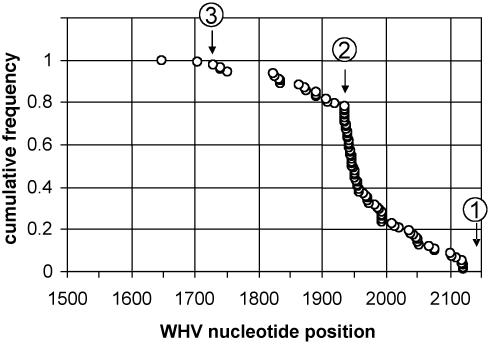
We determined the frequency of integrated viral DNA in the livers of three woodchucks chronically infected with the woodchuck hepatitis virus before and during 30 weeks of therapy with the nucleoside analog L-FMAU [1-(2-fluoro-5-methyl-beta, L-arabinofuranosyl)uracil, clevudine]. We found that although viral covalently closed circular DNA declined 20- to 100-fold, integrated viral DNA showed no discernable decrease over the course of treatment. Thus, chemotherapeutic clearance of covalently closed circular DNA did not involve the replacement of the infected hepatocyte population with uninfected progenitors, but rather, uninfected hepatocytes in the treated liver were derived from the infected hepatocyte population. The frequency of integrated DNA in chronically infected woodchucks was found to be 1 or 2 orders of magnitude higher than that in transiently infected woodchucks, implying that integration and other genomic damage accumulate over the duration of infection. Our results indicate that genetic changes from this damage remain in the liver even while virus infection is cleared and argue for early antiviral intervention in chronic hepatitis.
Figures
References
-
- Leung, N. W., Lai, C. L., Chang, T. T., Guan, R., Lee, C. M., Ng, K. Y., Lim, S. G., Wu, P. C., Dent, J. C., Edmundson, S., et al. (2001) Hepatology 33, 1527–1532. - PubMed
-
- Lau, D. T., Khokhar, M. F., Doo, E., Ghany, M. G., Herion, D., Park, Y., Kleiner, D. E., Schmid, P., Condreay, L. D., Gauthier, J., et al. (2000) Hepatology 32, 828–834. - PubMed
Publication types
MeSH terms
Substances
Grants and funding
LinkOut - more resources
Full Text Sources
