. 2004 Jan;134(1):194-203.
doi: 10.1104/pp.103.028027. Epub 2003 Dec 30.

Ethylene-dependent and -independent processes associated with floral organ abscission in Arabidopsis

Affiliations

Ethylene-dependent and -independent processes associated with floral organ abscission in Arabidopsis

Sara E Patterson et al. Plant Physiol. 2004 Jan.

Abstract

Abscission is an important developmental process in the life cycle of the plant, regulating the detachment of organs from the main body of the plant. This mechanism can be initiated in response to environmental cues such as disease or pathogen, or it can be a programmed shedding of organs that no longer provide essential functions to the plant. We have identified five novel dab (delayed floral organ abscission) mutants (dab1-1, dab2-1, dab3-1, dab3-2, and dab3-3) in Arabidopsis. These mutants each display unique anatomical and physiological characteristics and are governed by three independent loci. Scanning electron microscopy shows delayed development of the flattened fracture plane in some mutants and irregular elongation in the cells of the fracture plane in other mutants. The anatomical observations are also supported by breakstrength measurements that show high breakstrength associated with broken cells, moderate levels for the flattened fracture plane, and low levels associated with the initial rounding of cells. In addition, observations on the expression patterns in the abscission zone of cell wall hydrolytic enzymes, chitinase and cellulose, show altered patterns in the mutants. Last, we have compared these mutants with the ethylene-insensitive mutants etr1-1 and ein2-1 to determine if ethylene is an essential component of the abscission process and find that although ethylene can accelerate abscission under many conditions, the perception of ethylene is not essential. The role of the dab genes and the ethylene response genes during the abscission process is discussed.


Figures
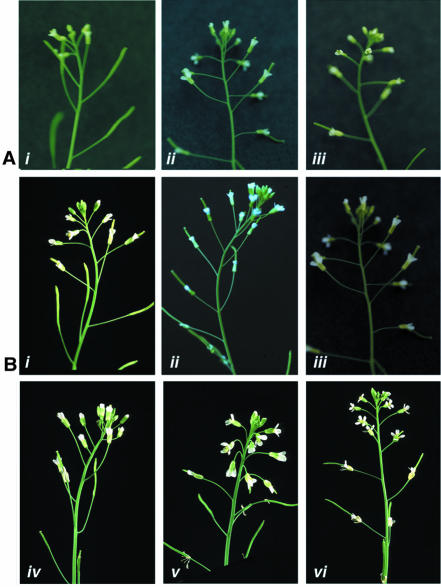
Figure 1.
Figure 1.
Floral organ abscission in wild-type Arabidopsis and selected delayed abscission mutants. 1A, i, Wild type (Columbia [Col]); ii, etr1-1; iii, ein2-1. 1B, i, Wild type (Wassilewskija [Ws]); ii, dab1-1; iii, dab2-1; iv, dab3-1; v, dab3-2; vi, dab3-3.
Figure 2.
Figure 2.
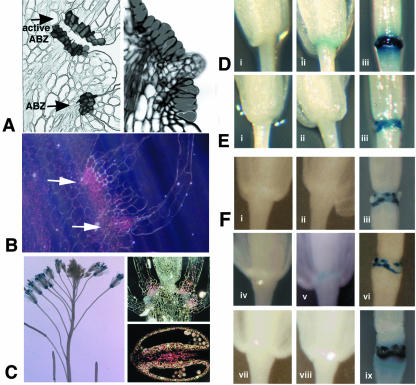
A, Longitudinal sections of the floral organ abscission zones. Left, Longitudinal section of wild-type inflorescence at position three in which sepals, petals, and filaments are preparing for abscission. Right, Longitudinal section of wild-type inflorescence at position seven showing the elongated cells of the remaining abscission layer proximal to the main body of the plant. B, Longitudinal section showing chitinase-GUS expression in the abscission zone cells of the floral receptacle at position four. Dark-field microscopy results in the GUS crystals appearing pink. C, BAC-GUS expression. Left, BAC-GUS expression in the floral receptacle at different developmental positions in Ws wild-type Arabidopsis. Expression in the inflorescence begins in anthers just before anthesis. Expression in the abscission zone begins with anthesis and is highest at positions four to six and then begins to decrease. Top right, BAC-GUS expression in longitudinal sections of the receptacle using dark-field microscopy. Note that the cells in the abscission zones appear pink. Bottom right, BAC-GUS expression in the anther as viewed using dark-field microscopy. Note the cells at the suture (dehiscence zone) appear pink. D, Chitinase-GUS expression in the floral receptacle at different developmental positions in wild-type Arabidopsis. i, Position three; ii, position four; iii, position seven. Note the low level GUS expression at position four. At position seven, all organs have abscised, and expression is very high. E, Chitinase-GUS expression in the floral receptacle at different developmental positions in etr1-1. i, position three; ii, position four; iii, position seven. F, Chitinase-GUS expression in the floral receptacle at different developmental positions in dab mutants at positions four, seven, and 13. i, dab1-1 position four; ii, dab1-1 position seven; iii, dab1-1 position 13; iv, dab2-1 position four; v, dab2-1 position seven; vi, dab2-1 position 13; vii, dab3-1 position four; viii, dab3-1 position seven; ix, dab3-1 position 13. Note that in dab1-1, highest GUS expression is represented at position 13. In dab2-1, low-level GUS expression is just discernable at position seven, and high levels of expression in the sepals, petals, and filaments are represented at position 13. In dab3-1, expression is not detectable in positions four or seven, and high-level expression is represented at position 13.
Figure 3.
Figure 3.
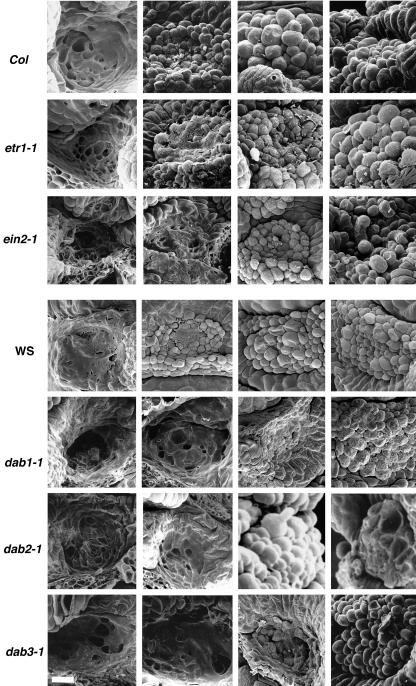
Scanning electron micrographs of the fracture plane of the petal abscission zone. Left to right, Positions three, seven, nine, and 15. The fracture plane is revealed after the petal abscises or when the petal is forceably removed. In wild type, the petals abscise at positions seven or eight. Note that these cells are rounded and fairly similar in size. These can be contrasted with flattened cells of several of the mutants at position seven (ein2-1, dab1-1, dab2-1, and dab3-1) or the irregular cells of dab2-1 at positions nine and 15. Bar = 10 μm size.
Figure 4.
Figure 4.
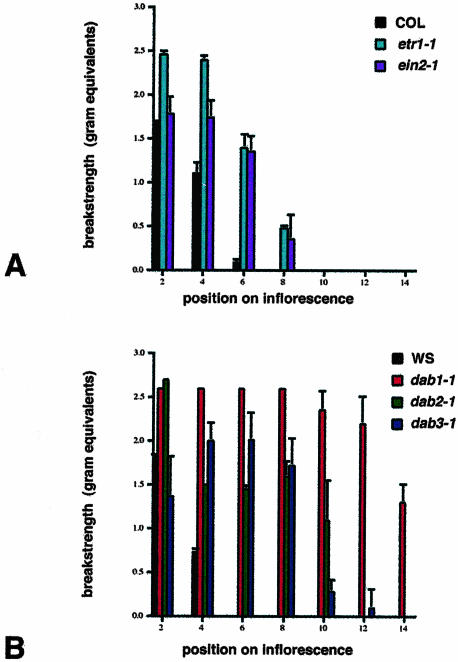
Summary of breakstrength measurements of wild-type Arabidopsis and selected delayed abscission mutants. Petals were forcibly removed from the inflorescence at positions still retaining petals, and the force to remove each petal was measured. A, Wild-type (Col), etr1-1, and ein2-1 breakstrength profiles. B, Wild-type (Ws), dab1-1, dab2-1, and dab3-1 breakstrength profiles (n > 10).

References

    1. Abeles FB, Morgan PW, Saltveit ME (1992) Ethylene in Plant Biology, Ed 2. Academic Press, San Diego
    1. Abeles FB, Rubenstein B (1964) Regulation of ethylene evolution and leaf abscission by auxin. Plant Physiol 39: 963-69 - PMC - PubMed
    1. Addicott FT (1982) Abscission. University of California Press, Berkeley
    1. Bechtold N, Ellis J, Pelletier G (1993) In planta Agrobacterium gene transfer by infiltration of adult Arabidopsis thaliana plants. C R Acad Sci Paris Life Sci 316: 1194-1199
    1. Bevan MW (1984) Binary Agrobacterium vectors for plant transformation. Nucleic Acids Res 12: 8711-8721 - PMC - PubMed

Publication types

LinkOut - more resources