


p53 and VEGF expression are independent predictors of tumour recurrence and survival following curative resection of gastric cancer
- PMID: 14710231
- PMCID: PMC2395306
- DOI: 10.1038/sj.bjc.6601455
p53 and VEGF expression are independent predictors of tumour recurrence and survival following curative resection of gastric cancer
Abstract
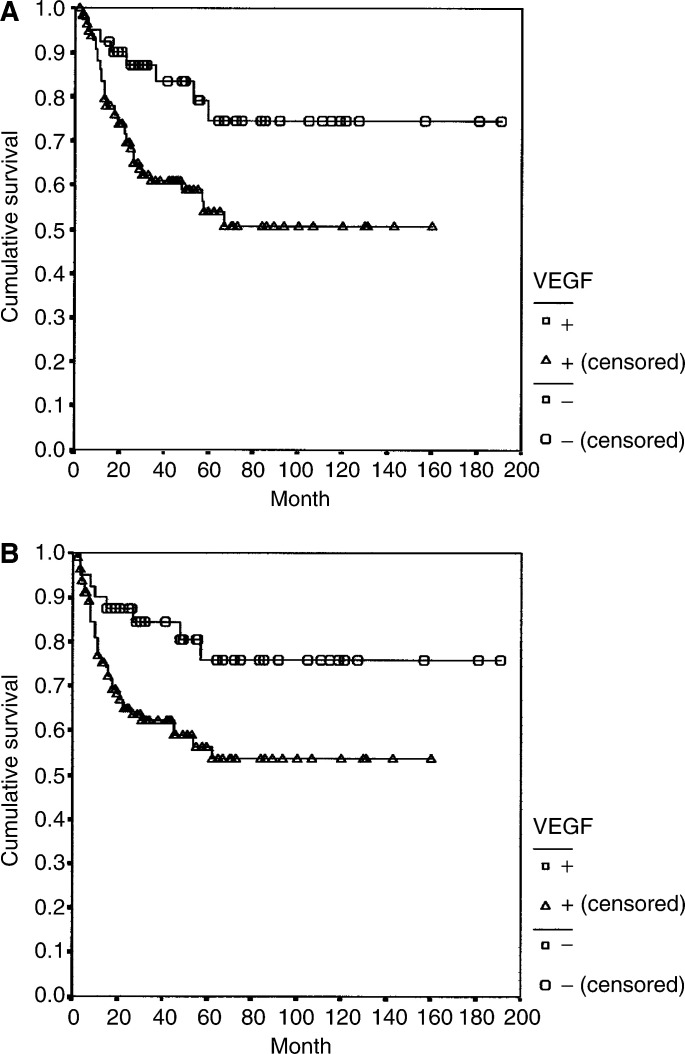
This study was undertaken to determine the value of tumour microvessel density (MVD) and the expression of p53 and vascular endothelial growth factor (VEGF) as prognostic markers in patients with gastric cancer operated on for cure. In all, 156 patients with curatively resected gastric cancer constituted the basis of this blinded retrospective evaluation. Patients were treated with either surgery alone (n=53) or surgery plus adjuvant chemotherapy (n=103). Tumour MVD, p53 expression, and VEGF expression were assayed using immunohistochemical techniques. After a mean follow-up of 43 months, 64 (41%) patients had died and 55 (35%) patients developed tumour recurrence. Positive correlations between MVD and both p53 (P=0.005) and VEGF (P=0.005) expression were observed. Both MVD >/=100 (P=0.05) and positive VEGF expression (P<0.02) were associated with shorter disease-free survival, and positive VEGF expression (P=0.01) was also associated with shorter overall survival. Multivariate analysis confirmed that, in addition to the pathological tumour stage, lymph node ratio, the extent of lymphadenectomy and perineural invasion, p53 expression, and VEGF expression were independently associated with both disease-free survival (P<0.0005 and 0.02, respectively) and overall survival (P<0.02 and 0.01, respectively). Finally, patients whose tumours did not show p53 expression had a survival benefit compared to those expressing p53 when treated with adjuvant chemotherapy (P=0.01). This investigation demonstrates that p53 expression and VEGF expression are independent prognostic factors for both disease-free survival and overall survival in patients with curatively resected gastric cancer, and that p53 status may also influence response to chemotherapy.
Figures


References
-
- Averbach AM, Jacquet P (1996) Strategies to decrease the incidence of intra-abdominal recurrence in resectable gastric cancer. Br J Surg 83: 726–733 - PubMed
-
- Baba M, Konno H, Maruo Y, Tanaka T, Kanai T, Matsumoto K, Matsuura M, Nishino N, Maruyama K, Nakamura S, Baba S (1998) Relationship of p53 and vascular endothelial growth factor expression of clinicopathological factors in human scirrhous gastric cancer. Eur Surg Res 30: 130–137 - PubMed
-
- Boku N, Chin K, Hosokawa K, Ohtsu A, Tajiri H, Yoshida S, Yamao T, Kondo H, Shirao K, Shimada Y, Saito D, Hasebe T, Mukai K, Seki S, Saito H, Johnston PG (1998) Biological markers as a predictor for response and prognosis of unresectable gastric cancer patients treated with 5-fluorouracil and cis-platinum. Clin Cancer Res 4: 1469–1474 - PubMed
-
- Cascinu S, Graziano F, Del Ferro E, Staccioli MP, Ligi M, Carnevali A, Muretto P, Catalano G (1998) Expression of p53 protein and resistance to preoperative chemotherapy in locally advanced gastric carcinoma. Cancer 83: 1917–1922 - PubMed
-
- Castells A, Rustgi AK (2003) Tumour growth, invasion and metastasis. In Gastrointestinal Cancers, Rustgi AK, Crawford JM (eds) pp 69–80. Philadelphia: Saunders
Publication types
MeSH terms
Substances
LinkOut - more resources
Full Text Sources
Medical
Research Materials
Miscellaneous
