


Effects of polyunsaturated fatty acids in growth medium on lipid composition and on physicochemical surface properties of lactobacilli
- PMID: 14711634
- PMCID: PMC321255
- DOI: 10.1128/AEM.70.1.129-136.2004
Effects of polyunsaturated fatty acids in growth medium on lipid composition and on physicochemical surface properties of lactobacilli
Abstract
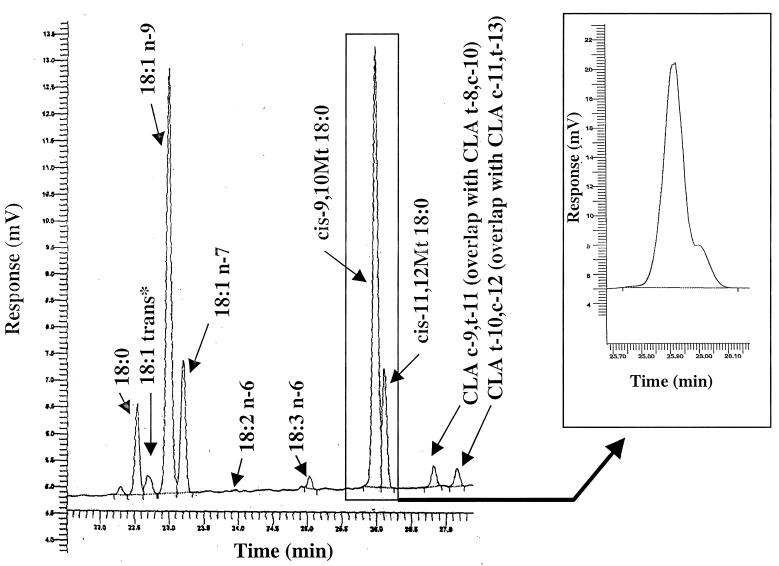
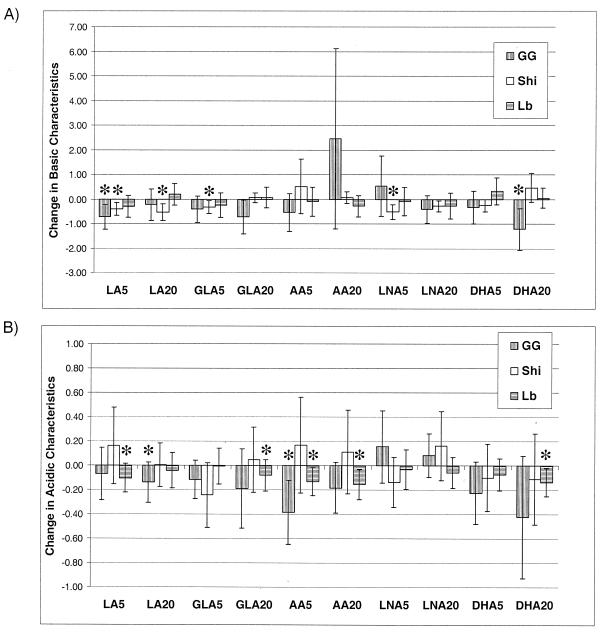
Most probiotic lactobacilli adhere to intestinal surfaces, a phenomenon influenced by free polyunsaturated fatty acids (PUFA). The present study investigated whether free linoleic acid, gamma-linolenic acid, arachidonic acid, alpha-linolenic acid, or docosahexaenoic acid in the growth medium alters the fatty acid composition of lactobacilli and their physical characteristics. The most abundant bacterial fatty acids identified were oleic, vaccenic, and dihydrosterculic acids. PUFA, especially conjugated linoleic acid (CLA) isomers and gamma-linolenic, eicosapentaenoic, docosahexaenoic, and alpha-linolenic acids, also were identified in lactobacilli. When lactobacilli were cultured in MRS broth supplemented with various free PUFA, the incorporation of a given PUFA into bacterial fatty acids was clearly observed. Moreover, PUFA supplementation also resulted in PUFA-dependent changes in the proportions of other fatty acids; major interconversions were seen in octadecanoic acids (18:1), their methylenated derivatives (19:cyc), and CLA. Intermittent changes in eicosapentaenoic acid proportions also were noted. These results were paralleled by minor changes in the hydrophilic or hydrophobic characteristics of lactobacilli, suggesting that PUFA interfere with microbial adhesion to intestinal surfaces through other mechanisms. In conclusion, we have demonstrated that free PUFA in the growth medium induce changes in bacterial fatty acids in relation to the regulation of the degree of fatty acid unsaturation, cyclization, and proportions of CLA and PUFA containing 20 to 22 carbons. The potential role of lactobacilli as regulators of PUFA absorption may represent another means by which probiotics could redirect the delicate balance of inflammatory mediators derived from PUFA within the inflamed intestine.
Figures
References
-
- Christie, W. W. 1982. A simple procedure for rapid transmethylation of glycerolipids and cholesteryl esters. J. Lipid Res. 23:1072-1075. - PubMed
-
- Dionisi, F., P.-A. Golay, M. Elli, and L. B. Fay. 1999. Stability of cyclopropane and conjugated linoleic acids during fatty acid quantification in lactic acid bacteria. Lipids 34:1107-1115. - PubMed
-
- Fairbank, J., L. Ridgway, J. Griffin, D. Wickens, A. Singer, and T. L. Dormandy. 1988. Octadeca-9,11-dienoic acid in diagnosis of cervical intraepithelial neoplasia. Lancet 2:329-330. - PubMed
-
- Fernandez Murga, M. L., G. M. Cabrera, G. Font de Valdez, A. Disalvo, and A. M. Seldes. 2000. Influence of growth temperature on cryotolerance and lipid composition of Lactobacillus acidophilus. J. Appl. Microbiol. 88:342-348. - PubMed
Publication types
MeSH terms
Substances
LinkOut - more resources
Full Text Sources
Other Literature Sources
Molecular Biology Databases
