. 2004 Jan;70(1):159-66.
doi: 10.1128/AEM.70.1.159-166.2004.

Directed evolution of pyruvate decarboxylase-negative Saccharomyces cerevisiae, yielding a C2-independent, glucose-tolerant, and pyruvate-hyperproducing yeast

Affiliations

Directed evolution of pyruvate decarboxylase-negative Saccharomyces cerevisiae, yielding a C2-independent, glucose-tolerant, and pyruvate-hyperproducing yeast

Antonius J A van Maris et al. Appl Environ Microbiol. 2004 Jan.

Abstract

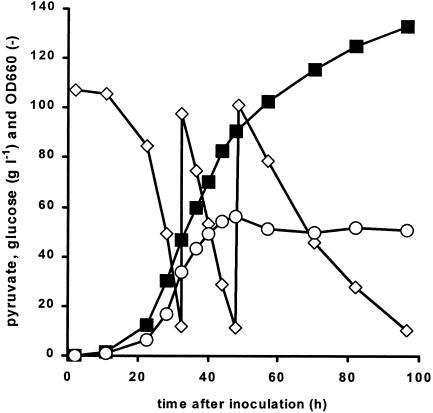
The absence of alcoholic fermentation makes pyruvate decarboxylase-negative (Pdc(-)) strains of Saccharomyces cerevisiae an interesting platform for further metabolic engineering of central metabolism. However, Pdc(-) S. cerevisiae strains have two growth defects: (i) growth on synthetic medium in glucose-limited chemostat cultures requires the addition of small amounts of ethanol or acetate and (ii) even in the presence of a C(2) compound, these strains cannot grow in batch cultures on synthetic medium with glucose. We used two subsequent phenotypic selection strategies to obtain a Pdc(-) strain without these growth defects. An acetate-independent Pdc(-) mutant was obtained via (otherwise) glucose-limited chemostat cultivation by progressively lowering the acetate content in the feed. Transcriptome analysis did not reveal the mechanisms behind the C(2) independence. Further selection for glucose tolerance in shake flasks resulted in a Pdc(-) S. cerevisiae mutant (TAM) that could grow in batch cultures ( micro (max) = 0.20 h(-1)) on synthetic medium, with glucose as the sole carbon source. Although the exact molecular mechanisms underlying the glucose-tolerant phenotype were not resolved, transcriptome analysis of the TAM strain revealed increased transcript levels of many glucose-repressible genes relative to the isogenic wild type in nitrogen-limited chemostat cultures with excess glucose. In pH-controlled aerobic batch cultures, the TAM strain produced large amounts of pyruvate. By repeated glucose feeding, a pyruvate concentration of 135 g liter(-1) was obtained, with a specific pyruvate production rate of 6 to 7 mmol g of biomass(-1) h(-1) during the exponential-growth phase and an overall yield of 0.54 g of pyruvate g of glucose(-1).


Figures
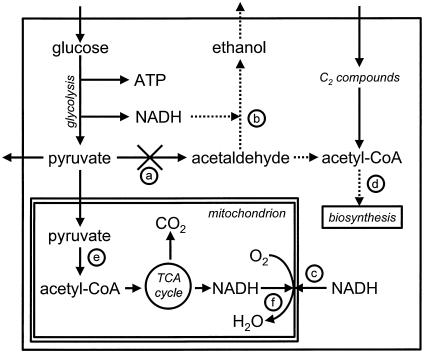
FIG. 1.
FIG. 1.
Schematic representation of the metabolism of pyruvate decarboxylase-negative S. cerevisiae growing on glucose. By deletion of all genes encoding pyruvate decarboxylase (reaction a), two important processes (dotted lines) are impaired as follows. First, reoxidation of cytosolic NADH via alcohol dehydrogenase (reaction b) is blocked. Cytosolic NADH must therefore be oxidized by the mitochondria via external NADH dehydrogenase (reaction c) or redox shuttle systems. Second, the formation of cytosolic acetyl-CoA from acetaldehyde is blocked. Instead, the C2 compounds required for cytosolic acetyl-CoA for lysine and fatty acid biosynthesis (reaction d) must be taken up from the environment. When oxygen consumption exceeds the amount of oxygen necessary for oxidation of glucose to pyruvate, mitochondrial oxidation of pyruvate, via pyruvate dehydrogenase (reaction e) and the tricarboxylic acid cycle (TCA cycle), can occur, resulting in CO2 formation and the oxidation of NADH via internal NADH dehydrogenase (reaction f).
FIG. 2.
FIG. 2.
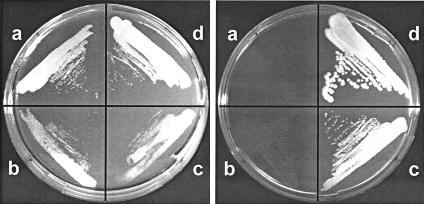
Growth of three Pdc S. cerevisiae strains and wild-type S. cerevisiae on synthetic medium agar plates with ethanol (left plate) or glucose (right plate) as the carbon source. Both plates were supplemented with uracil to alleviate the auxotrophy of the Pdc S. cerevisiae strains. Ethanol plates were incubated for 7 days, and glucose plates were incubated for 3 days. Strains: a, RWB837 (Pdc S. cerevisiae); b, RWB837* (selected C2-independent S. cerevisiae); c, TAM (selected C2-independent and glucose-tolerant Pdc S. cerevisiae); d, CEN.PK 113-7D (wild type).
FIG. 3.
FIG. 3.
Growth and pyruvate production during an aerobic repeated batch culture on glucose of the selected TAM strain. The results shown are from one representative batch experiment. Biomass and pyruvate concentrations in independent replicate experiments varied by <5%. Closed squares, pyruvate concentration; open symbols, glucose concentration (diamonds) or OD660 (circles).
FIG. 4.
FIG. 4.
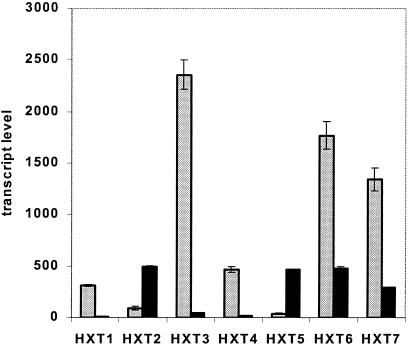
Transcript-level comparison of the main hexose transporter genes (HXT1 to -7) between the selected TAM strain and its isogenic wild type in nitrogen-limited chemostat cultures with glucose as the carbon source. The wild-type data were obtained from the same cultures used by Boer et al. (2). The data represented were obtained from independent duplicate (TAM) or triplicate (wild type) chemostat cultivations. Gray bars, wild type; black bars, TAM strain. Error bars represent standard deviations.

References

    1. Blom, J., M. J. Teixeira de Mattos, and L. A. Grivell. 2000. Redirection of the respiro-fermentative flux distribution in Saccharomyces cerevisiae by overexpression of the transcription factor Hap4p. Appl. Environ. Microbiol. 66:1970-1973. - PMC - PubMed
    1. Boer, V. M., J. H. de Winde, J. T. Pronk, and M. D. W. Piper. 2003. The genome-wide transcriptional responses of Saccharomyces cerevisiae grown on glucose in aerobic chemostat cultures limited for carbon, nitrogen, phosphorus, or sulfur. J. Biol. Chem. 278:3265-3274. - PubMed
    1. Diderich, J. A., L. M. Raamsdonk, A. L. Kruckeberg, J. A. Berden, and K. van Dam. 2001. Physiological properties of Saccharomyces cerevisiae from which hexokinase II has been deleted. Appl. Environ. Microbiol. 67:1587-1593. - PMC - PubMed
    1. Diderich, J. A., L. M. Raamsdonk, A. Kuiper, A. L. Kruckeberg, M. J. Teixeira de Mattos, and K. van Dam. 2002. Effects of a hexokinase II deletion on the dynamics of glycolysis in continuous cultures of Saccharomyces cerevisiae. FEMS Yeast Res. 2:165-172. - PubMed
    1. Dykhuizen, D. E., and D. L. Hartl. 1983. Selection in chemostats. Microbiol. Rev. 47:150-168. - PMC - PubMed

Publication types

MeSH terms

LinkOut - more resources