. 2004 Jan;70(1):452-8.
doi: 10.1128/AEM.70.1.452-458.2004.

Phylogenetic analysis of the hypervariable region of the 18S rRNA gene of Cryptosporidium oocysts in feces of Canada geese (Branta canadensis): evidence for five novel genotypes

Affiliations

Phylogenetic analysis of the hypervariable region of the 18S rRNA gene of Cryptosporidium oocysts in feces of Canada geese (Branta canadensis): evidence for five novel genotypes

Kristen L Jellison et al. Appl Environ Microbiol. 2004 Jan.

Abstract

To assess genetic diversity in Cryptosporidium oocysts from Canada geese, 161 fecal samples from Canada geese in the United States were analyzed. Eleven (6.8%) were positive for Cryptosporidium spp. following nested PCR amplification of the hypervariable region of the 18S rRNA gene. Nine PCR products from geese were cloned and sequenced, and all nine diverged from previously reported Cryptosporidium 18S rRNA gene sequences. Five sequences were very similar or identical to each other but genetically distinct from that of Cryptosporidium baileyi; two were most closely related to, but genetically distinct from, the first five; and two were distinct from any other sequence analyzed. One additional sequence in the hypervariable region of the 18S rRNA gene isolated from a cormorant was identical to that of C. baileyi. Phylogenetic analysis provided evidence for new genotypes of Cryptosporidium species in Canada geese. Results of this study suggest that the taxonomy of Cryptosporidium species in geese is complex and that a more complete understanding of genetic diversity among these parasites will facilitate our understanding of oocyst sources and species in the environment.


Figures
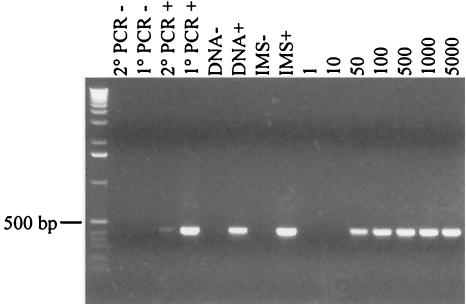
FIG.1.
FIG.1.
The oocyst detection limit (oocysts per gram of feces) was determined by spiking fecal samples with decreasing numbers of oocysts. Secondary PCR products are shown after electrophoresis on a 1.2% agarose gel stained with ethidium bromide. From left to right, the lanes are as follows: molecular size standards; negative controls (−) for secondary (2°) and initial (1°) PCRs, respectively; positive (+) controls for 2° and 1° PCRs, respectively; negative and positive controls for DNA extraction, respectively; negative and positive controls for IMS, respectively; and fecal samples spiked with 1, 10, 50, 100, 500, 1,000, and 5,000 oocysts, respectively.
FIG.2.
FIG.2.
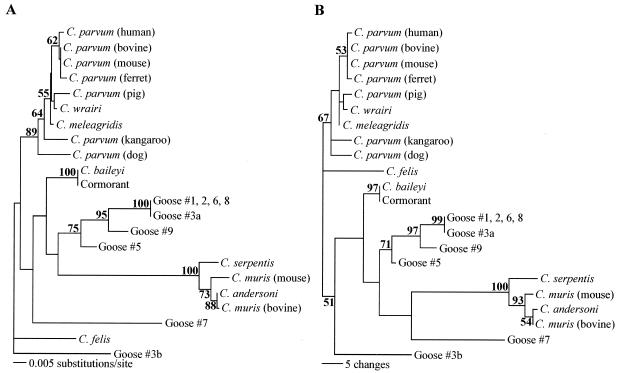
Neighbor-joining (A) and parsimony (B) trees based on the hypervariable region of the 18S rRNA gene (created with PAUP 4.0 software). C. felis was designated an outgroup. Evolutionary distances were determined by the Kimura two-parameter method. GenBank accession numbers of sequences included in the trees are AB089285 (C. andersoni), L19068 (C. baileyi), AF112575 (C. felis), AF112574 (C. meleagridis), L19069 (C. muris bovine genotype), AB089284 (C. muris murine genotype), AF093489 (C. parvum human genotype), AF093493 (C. parvum bovine genotype), AF112571 (C. parvum mouse genotype), AF112572 (C. parvum ferret genotype), AF115377 (C. parvum pig genotype), AF112576 (C. parvum dog genotype), AF112570 (C. parvum kangaroo genotype), AF093499 (C. serpentis), U11440 (C. wrairi), AY324634 (cormorant), AY324635 (goose no. 1), AY324636 (goose no. 2), AY324637 (goose no. 3 [sequence a]), AY324638 (goose no. 3 [sequence b]), AY324639 (goose no. 5), AY324640 (goose no. 6), AY324641 (goose no. 7), AY324642 (goose no. 8), and AY324643 (goose no. 9). Bootstrap values greater than 50% are indicated in bold at each respective node.
FIG. 3.
FIG. 3.
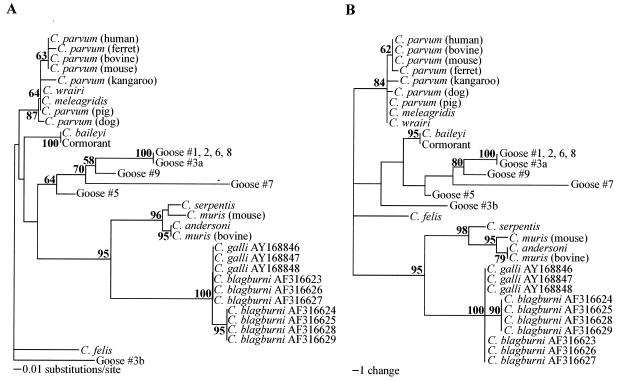
Phylogenetic analysis of the partial hypervariable region of the 18S rRNA gene to assess the relationships between the goose-derived sequences in the present study and C. galli and C. blagburni in finches. Shown are neighbor-joining (A) and most parsimonious (B) trees created with PAUP 4.0. C. felis was designated an outgroup. Evolutionary distances were determined by the Kimura two-parameter method. GenBank accession numbers of sequences included in the trees are AB089285 (C. andersoni), L19068 (C. baileyi), AF112575 (C. felis), AF112574 (C. meleagridis), L19069 (C. muris bovine genotype), AB089284 (C. muris murine genotype), AF093489 (C. parvum human genotype), AF093493 (C. parvum bovine genotype), AF112571 (C. parvum mouse genotype), AF112572 (C. parvum ferret genotype), AF115377 (C. parvum pig genotype), AF112576 (C. parvum dog genotype), AF112570 (C. parvum kangaroo genotype), AF093499 (C. serpentis), U11440 (C. wrairi), AY168846 through AY168848 (C. galli), AF316623 through AF316629 (C. blagburni), AY324634 (cormorant), AY324635 (goose no. 1), AY324636 (goose no. 2), AY324637 (goose no. 3 [sequence a]), AY324638 (goose no. 3 [sequence b]), AY324639 (goose no. 5), AY324640 (goose no. 6), AY324641 (goose no. 7), AY324642 (goose no. 8), and AY324643 (goose no. 9). Bootstrap values greater than 50% are indicated in bold at each respective node.

References

    1. Alderisio, K. A., and N. DeLuca. 1999. Seasonal enumeration of fecal coliform bacteria from the feces of ring-billed gulls (Larus delawarensis) and Canada geese (Branta canadensis). Appl. Environ. Microbiol. 65:5628-5630. - PMC - PubMed
    1. Awad-El-Kariem, F. M., H. A. Robinson, D. A. Dyson, D. Evans, S. Wright, M. T. Fox, and V. McDonald. 1995. Differentiation between human and animal strains of Cryptosporidium parvum using isoenzyme typing. Parasitology 110:129-132. - PubMed
    1. Benson, D. A., M. S. Boguski, D. J. Lipman, J. Ostell, and B. F. F. Ouellette. 1998. GenBank. Nucleic Acids Res. 26:1-7. - PMC - PubMed
    1. Carraway, M., S. Tzipori, and G. Widmer. 1996. Identification of genetic heterogeneity in the Cryptosporidium parvum ribosomal repeat. Appl. Environ. Microbiol. 62:712-716. - PMC - PubMed
    1. Chalmers, R. M., K. Elwin, W. J. Reilly, H. Irvine, A. L. Thomas, and P. R. Hunter. 2002. Cryptosporidium in farmed animals: the detection of a novel isolate in sheep. Int. J. Parasitol. 32:21-26. - PubMed

Publication types

LinkOut - more resources