


Combined effects of high hydrostatic pressure and temperature for inactivation of Bacillus anthracis spores
- PMID: 14711702
- PMCID: PMC321244
- DOI: 10.1128/AEM.70.1.635-637.2004
Combined effects of high hydrostatic pressure and temperature for inactivation of Bacillus anthracis spores
Abstract
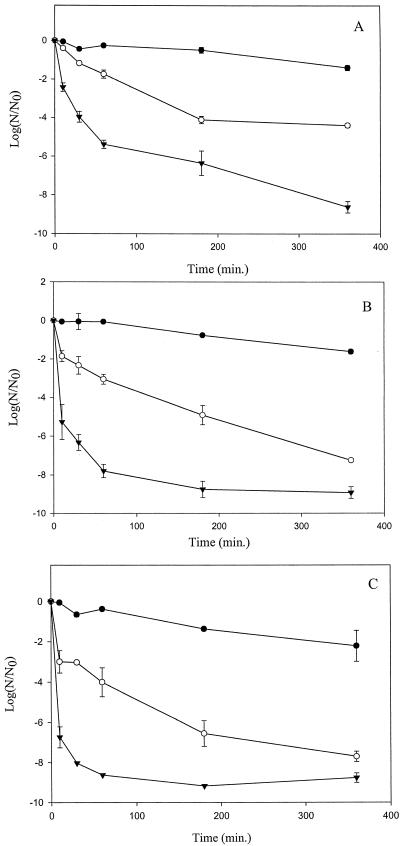
Spores of Bacillus anthracis are known to be extremely resistant to heat treatment, irradiation, desiccation, and disinfectants. To determine inactivation kinetics of spores by high pressure, B. anthracis spores of a Sterne strain-derived mutant deficient in the production of the toxin components (strain RP42) were exposed to pressures ranging from 280 to 500 MPa for 10 min to 6 h, combined with temperatures ranging from 20 to 75 degrees C. The combination of heat and pressure resulted in complete destruction of B. anthracis spores, with a D value (exposure time for 90% inactivation of the spore population) of approximately 4 min after pressurization at 500 MPa and 75 degrees C, compared to 160 min at 500 MPa and 20 degrees C and 348 min at atmospheric pressure (0.1 MPa) and 75 degrees C. The use of high pressure for spore inactivation represents a considerable improvement over other available methods of spore inactivation and could be of interest for antigenic spore preparation.
Figures
References
-
- Bartlett, D. H. 2002. Pressure effects on in vivo microbial processes. Biochim. Biophys. Acta 1595:367-381. - PubMed
-
- Delacour, H., C. Cléry, P. Masson, and D. R. Vidal. 2002. Inactivation des spores bactériennes par les hautes pressions hydrostatiques. Ann. Pharm. Fr. 60:38-43. - PubMed
-
- Inglesby, T. V., T. O'Toole, D. A. Henderson, J. G. Bartlett, M. S. Ascher, E. Eitzen, A. M. Friedlander, J. Gerberding, J. Hauer, J. Hughes, J. McDade, M. T. Osterholm, G. Parker, T. M. Perl, P. K. Russell, and K. Tonat. 2002. Anthrax as a biological weapon, 2002. Updated recommendations for management. JAMA 287:2236-2252. - PubMed
Publication types
MeSH terms
LinkOut - more resources
Full Text Sources
Other Literature Sources
