Magnitude of serum and intestinal antibody responses induced by sequential replicating and nonreplicating rotavirus vaccines in gnotobiotic pigs and correlation with protection
- PMID: 14715539
- PMCID: PMC321356
- DOI: 10.1128/cdli.11.1.12-20.2004
Magnitude of serum and intestinal antibody responses induced by sequential replicating and nonreplicating rotavirus vaccines in gnotobiotic pigs and correlation with protection
Abstract
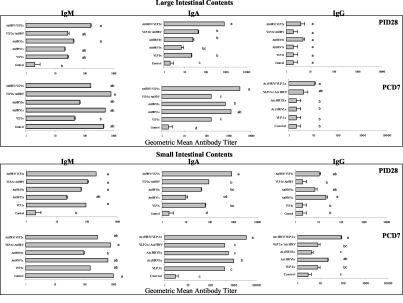
A sequential mucosal prime-boost vaccine regimen of oral attenuated (Att) human rotavirus (HRV) priming followed by intranasal (i.n.) boosting with rotavirus protein VP2 and VP6 rotavirus-like particles (2/6-VLPs) has previously been shown to be effective for induction of intestinal antibody-secreting cell (ASC) responses and protection in gnotobiotic pigs. Because serum or fecal antibody titers, but not intestinal ASC responses, can be used as potential markers of protective immunity in clinical vaccine trials, we determined the serum and intestinal antibody responses to this prime-boost rotavirus vaccine regimen and the correlations with protection. Gnotobiotic pigs were vaccinated with one of the two sequential vaccines: AttHRV orally preceding 2/6-VLP (VLP2x) vaccination (AttHRV/VLP2x) or following VLP2x vaccination (VLP2x/AttHRV) given i.n. with a mutant Escherichia coli heat-labile toxin (mLT) as adjuvant. These vaccines were also compared with three i.n. doses of VLP+mLT (VLP3x) and one and three oral doses of AttHRV (AttHRV1x and AttHRV3x, respectively). Before challenge all pigs in the AttHRV/VLP2x group seroconverted to positivity for serum immunoglobulin A (IgA) antibodies. The pigs in this group also had significantly higher (P < 0.05) intestinal IgA antibody titers pre- and postchallenge and IgG antibody titers postchallenge compared to those in the other groups. Statistical analyses of the correlations between serum IgM, IgA, IgG, and virus-neutralizing antibody titers and protection demonstrated that each of these was an indicator of protective immunity induced by the AttHRV3x and the AttHRV/VLP2x regimens. However, only IgA and not IgM or IgG antibody titers in serum were highly correlated (R2 = 0.89; P < 0.001) with the corresponding isotype antibody (IgA) titers in the intestines among all the vaccinated groups, indicating that the IgA antibody titer is probably the most reliable indicator of protection.
Figures


References
-
- Barnes, G. L., J. S. Lund, S. V. Mitchell, L. De Bruyn, L. Piggford, A. L. Smith, J. Furmedge, P. J. Masendycz, H. C. Bugg, N. Bogdanovic-Sakran, J. B. Carlin, and R. F. Bishop. 2002. Early phase II trial of human rotavirus vaccine candidate RV3. Vaccine 20:2950-2956. - PubMed
-
- Bartlett, A. V., III, A. J. Bednarz-Prashad, H. L. DuPont, and L. K. Pickering. 1987. Rotavirus gastroenteritis. Annu. Rev. Med. 38:399-415. - PubMed
-
- Brown, K. A., J. A. Kriss, C. A. Moser, W. J. Wenner, and P. A. Offit. 2000. Circulating rotavirus-specific antibody-secreting cells (ASCs) predict the presence of rotavirus-specific ASCs in the human small intestinal lamina propria. J. Infect. Dis. 182:1039-1043. - PubMed
Publication types
MeSH terms
Substances
Grants and funding
LinkOut - more resources
Full Text Sources
Miscellaneous