Specificity of the antibody response to the pneumococcal polysaccharide and conjugate vaccines in human immunodeficiency virus-infected adults
- PMID: 14715560
- PMCID: PMC321324
- DOI: 10.1128/cdli.11.1.137-141.2004
Specificity of the antibody response to the pneumococcal polysaccharide and conjugate vaccines in human immunodeficiency virus-infected adults
Abstract
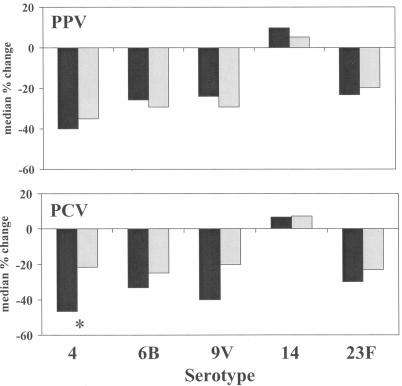
Nonspecific antibodies, which are thought to be nonprotective, have been shown to contribute a substantial proportion of the measured concentration in the standardized immunoglobulin G (IgG) enzyme-linked immunosorbent assay (ELISA) for pneumococcal polysaccharide capsular antibodies. The presence of such antibodies in human immunodeficiency virus (HIV)-infected persons has not been evaluated. The amount of nonspecific antibodies is proportional to the reduction in IgG antibody concentration that occurs with serum absorption with the heterologous polysaccharide 22F. We measured the amount of nonspecific antibodies before and after vaccination with the pneumococcal conjugate vaccine (PCV; n = 33) or the pneumococcal polysaccharide vaccine (PPV; n = 34) in HIV-infected adults with CD4 counts of >/== 200 cells/mm3. Blood was drawn before and 2 months after vaccination. For prevaccination sera, we found a substantial amount of nonspecific antibodies for serotypes 4, 6B, 9V, and 23F (23 to 47% of measured IgG concentration), but not for serotype 14. There tended to be proportionately less nonspecific antibodies in postvaccine sera than prevaccine sera for PCV, but not for PPV. Subjects with a low HIV viral load (</= 400 copies/ml) had proportionately more nonspecific antibodies than those with higher viral load before and after both vaccines. After 22F absorption, the geometric mean concentrations of antibodies were significantly higher post-PCV than post-PPV for the high viral load group for all five serotypes, but for no serotypes in the low viral load group. These findings confirm that absorption with a heterologous pneumococcal polysaccharide (e.g., 22F) is necessary to remove nonspecific antibodies in a standardized IgG ELISA for pneumococcal capsular antibodies in HIV-infected adults.
Figures
References
-
- Ahmed, F., M. C. Steinhoff, M. C. Rodriguez-Barradas, R. G. Hamilton, D. M. Musher, and K. E. Nelson. 1999. Effect of human immunodeficiency virus type 1 infection on the antibody response to a glycoprotein conjugate pneumococcal vaccine: results from a randomized trial. J. Infect. Dis. 173:83-90. - PubMed
-
- Black, S., H. Shinefield, B. Fireman, E. Lewis, P. Ray, J. R. Hansen, L. Elvin, K. M. Ensor, J. Hackell, G. Siber, F. Malinoski, D. Madore, I. Chang, R. Kohberger, W. Watson, R. Austrian, and K. Edwards. 2000. Efficacy, safety, and immunogenicity of heptavalent pneumococcal conjugate vaccine in children. Pediatr. Infect. Dis. J. 19:187-195. - PubMed
-
- Black, S. B., H. R. Shinefield, S. Ling, J. Hansen, B. Fireman, D. Spring, J. Noyes, E. Lewis, P. Ray, J. Lee, and J. Hackell. 2002. Effectiveness of heptavalent pneumococcal conjugate vaccine in children younger than five years of age for prevention of pneumonia. Pediatr. Infect. Dis. J. 21:810-815. - PubMed
-
- Breiman, R. F., D. W. Keller, M. A. Phelan, D. H. Sniadack, D. S. Stephens, D. Rimland, M. M. Farley, A. Schuchat, and A. L. Reingold. 2000. Evaluation of effectiveness of the 23-valent pneumococcal capsular polysaccharide vaccine for HIV-infected patients. Arch. Intern. Med. 160:2633-2638. - PubMed
-
- Centers for Disease Control and Prevention. 1997. Prevention of pneumococcal disease. Morb. Mortal. Wkly. Rep. 46:1-24.
Publication types
MeSH terms
Substances
LinkOut - more resources
Full Text Sources
Other Literature Sources
Medical
Research Materials